
Revolution Wind, a utility-scale offshore wind farm serving Rhode Island and Connecticut, received final approval from the U.S. Bureau of Ocean Energy Management on November 17, 2023, and has now moved back into construction after a federal court lifted a suspension imposed late last year. The U.S. District Court for the District of Columbia granted a preliminary injunction that allows work to resume while legal challenges continue over orders issued by the Bureau of Ocean Energy Management in August and December 2025.
The project is being developed through a 50/50 partnership between Skyborn Renewables and Ørsted. Revolution Wind is located in federal waters south of Rhode Island, northeast of Connecticut, and within close reach of Martha’s Vineyard. It is designed to provide 704 megawatts of power, supplying long-term contracted electricity to utilities in both states.
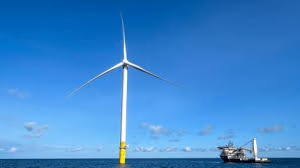
Construction had been progressing steadily before BOEM’s halt. The developer reports that roughly 87% of the project is complete, with all offshore foundations in place and 58 of the 65 turbines installed. Transmission export cables and offshore substations are already operational, leaving the final installation stages dependent on the renewed access now allowed under the court ruling.
Revolution Wind argues that the lease suspension threatens major economic and grid impacts, including higher power costs in a region that relies on new generation to stabilize supply. ISO-New England has similarly warned that lengthy delays could affect reliability as older fossil plants retire. The developers are now seeking to resolve outstanding issues with the administration while ramping crews back into offshore work.
Permitting
The project has undergone a lengthy permitting and consultation process. Federal and state agencies granted approvals in 2023 following reviews involving the Department of Defense, U.S. Coast Guard, Army Corps of Engineers and National Marine Fisheries Service. A mitigation agreement was established to address potential security concerns raised by the military.
Once completed, Revolution Wind is expected to supply enough power for more than 350,000 homes and support thousands of jobs in construction, manufacturing, vessel operations and ongoing maintenance. The project has already logged more than two million union labor hours and is part of Ørsted’s broader U.S. investment strategy. The developer’s Sunrise Wind project remains under a similar suspension and is being evaluated separately.
The development of offshore projects like Revolution Wind, which has resumed construction after a federal court lifted a BOEM suspension, complements onshore initiatives such as Alliant Energy’s Columbia Wind in Wisconsin, which recently filed for regulatory approval for a 277-MW wind farm with plans for more than 40 turbines. Together, these projects highlight ongoing expansion in U.S. wind generation, spanning both offshore and onshore regions and supporting renewable energy growth across the country.
Read also: BP and Equinor Secure U.S. Government Approval for 2.08GW Offshore Wind Farm off Long Island
Revolution Wind Project Factsheet
Project Name: Revolution Wind
Location: Offshore federal waters, 15 miles south of Rhode Island, 32 miles southeast of Connecticut, 12 miles southwest of Martha’s Vineyard
Developers: 50/50 Joint Venture between Skyborn Renewables and Ørsted
Capacity: 704 MW (400 MW to Rhode Island, 304 MW to Connecticut)
Turbines: 65 Siemens Gamesa 11 MW turbines installed on monopile foundations
Construction Status:
-
Approximately 87% complete
-
All offshore foundations installed
-
58 of 65 turbines installed
-
Export cables and offshore substations fully operational
-
Onshore construction ongoing
Regulatory Approvals:
-
Final approval from U.S. Bureau of Ocean Energy Management: November 17, 2023
-
Legal injunction granted by U.S. District Court (Jan 2026) allowing resumption of construction after BOEM suspension
Timeline:
-
Initial permits received: 2023
-
Offshore construction restart: 2026
-
Original expected operation: January 2026 (delayed due to suspension)
-
Planned operational completion: TBD after resumed construction
Power Supply: Enough electricity to serve over 350,000 homes in Rhode Island and Connecticut under long-term power purchase agreements
Employment & Economic Impact:
-
Over two million union labor hours already completed
-
Thousands of direct, indirect, and induced jobs expected
-
Permanent operations and maintenance positions in both states
Permitting & Consultation:
-
Agencies involved: Department of Defense, U.S. Coast Guard, Army Corps of Engineers, National Marine Fisheries Service
-
Agreements in place to mitigate impacts on national security and marine habitat
Significance:
-
Enhances grid reliability in the northeastern U.S.
-
Part of Ørsted’s broader U.S. energy infrastructure investment
-
Supports regional clean energy and renewable energy goals
Leave a Reply