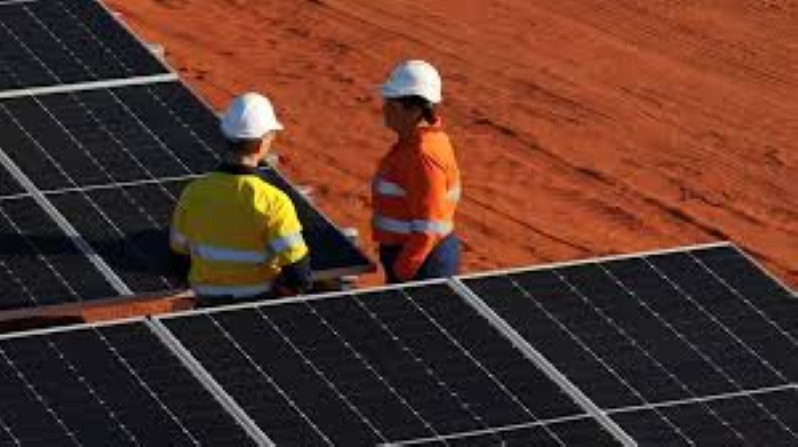
Mining and energy company Fortescue Ltd has started construction of the 440 MW Solomon Airport solar photovoltaic (PV) project at its mining hub in the Pilbara region of Western Australia. This marks another major milestone in the company’s strategy to decarbonize its iron-ore operations. Solomon Solar Farm is also poised to be the largest solar development in Western Australia once complete, and one of the largest in Australia alongside others like Maryvale Solar and Energy Storage Project in NSW. Fortescue’s Solomon solar farm is also one of the largest renewable power projects developed directly by a mining company in Australia.
Construction of the solar facility will involve the installation of approximately 671,000 solar panels. Additionally, project completion is set for 2028 and is as part of the wider Pilbara Energy Connect (PEC) network. PEC already spans hundreds of kilometers and connects solar, wind and battery projects to operational mine sites.
Factsheet for Solomon Airport solar project
Capacity: 440 MW
Location: Pilbara, Western Australia
Developer: Fortescue
Associated Operations: Solomon iron-ore hub
Solar Modules: 671,000 panels
Construction Start: 2026
Completion Date: 2028
Grid Integration: Pilbara Energy Connect transmission network
Purpose: Decarbonize Fortescue’s mining operations
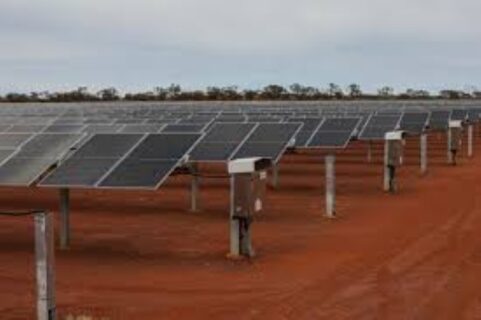
Solomon Airport solar project and Fortescue’s renewable energy build-out in Pilbara
Solomon Airport solar farm project is part of Fortescue’s broader Pilbara renewable energy build-out, which combines solar, wind, battery storage and transmission infrastructure to supply clean electricity to its iron-ore operations. The project will deliver renewable electricity directly to the company’s flagship Solomon iron-ore hub. This hub ships iron ore via a dedicated rail network to Port Hedland for export. Once operational, the solar farm will also contribute significantly to the company’s “Real Zero” initiative, which targets elimination of Scope 1 and Scope 2 emissions from its Australian operations by 2030.
Solomon Airport solar farm also builds on Fortescue’s plan to develop a large-scale clean-energy ecosystem for its iron-ore mining operations. It is part of a plan to build over 1 GW of renewable capacity in the Pilbara alongside battery storage and wind generation. When combined with existing and planned solar projects like North Star Junction, Cloudbreak and Turner River, the network could deliver around 1.3 GW of solar capacity.
Renewable infiltration into the mining sector
Fortescue’s renewable expansion also reflects a transformation in the mining sector, where major producers are increasingly developing their own power generation to cut fuel costs and emissions. Historically, remote mining operations relied heavily on diesel and gas-fired generation due to limited grid access. Fortescue’s renewable endeavors in Pilbara is replacing these sources with a cleaner energy network comprising solar farms, wind projects, high-voltage transmission infrastructure, and battery energy storage systems (BESS).
Project team and supporting programs
Developer and Owner
- Fortescue Ltd – Mining and energy company developing the project
Programs
- Pilbara Energy Connect (PEC) – Integrated transmission and renewable energy network connecting Fortescue’s operations
- Fortescue Zero – supporting electrification and renewable integration
Leave a Reply