
The South Korea Semiconductor Mega-Cluster is a US$471 billion (622 trillion won) chipmaking hub being developed across the Pyeongtaek-to-Yongin corridor in Gyeonggi Province, South Korea, anchored by Samsung Electronics and SK Hynix, with the goal of becoming the world’s largest chip production region by 2030. The cluster will add 13 new fabrication plants and three research facilities to the existing 21 fabs, targeting a production capacity of 7.7 million wafers per month and an estimated 3.46 million jobs. SK Hynix broke ground at the Yongin site in March 2025, with the first cleanroom facility targeted for completion by 2027. Total projected investment in the Yongin cluster alone has since risen to approximately 600 trillion won, driven by surging AI and HBM demand, with Samsung also committing 450 trillion won domestically over the next five years. The scale of this industrial buildout is reshaping Gyeonggi Province more broadly, with major public infrastructure following in its wake — including the recently signed $427 million Siheung Baegot Seoul National University Hospital, an 800-bed facility designated as an AI Advanced Medical Demonstration Hub that will anchor a new bio-industry and healthcare ecosystem on the region’s expanding university campus.
Project Overview
Type: National semiconductor mega-cluster (fabs, R&D centers, and supporting industry)
Location: Pyeongtaek to Yongin, Gyeonggi Province, South Korea
Total planned investment: 622 trillion won (~US$471 billion) through 2047 — now projected to exceed this
New facilities: 13 chip plants + 3 research facilities (on top of 21 existing fabs)
Target production capacity: 7.7 million wafers/month by 2030
Cluster footprint: 2,102 square meters
Power requirement: 3GW initially, scaling to 10GW
Job creation: ~70,000 direct jobs; ~3.46 million total estimated
Logic chip market share goal: 10% by 2030 (up from 3%)
SK Hynix Yongin groundbreaking: March 2025; first fab cleanroom target: 2027
Samsung Pyeongtaek Line 5 (P5) construction resumed late 2025; commercial operations targeted for 2028
Energy: Connected to hydroelectric and national grid; supporting infrastructure managed by Ministry of Trade, Industry and Energy (MOTIE)
Project Team
Government lead: South Korean Ministry of Trade, Industry and Energy (MOTIE)
Minister: Ahn Duk-geun, MOTIE
Lead companies: Samsung Electronics, SK Hynix
Samsung investment commitment: 500 trillion won (~US$370B) by 2047; revised to 450 trillion won domestically over next 5 years
SK Hynix investment commitment: Originally 122 trillion won; now projected to reach ~600 trillion won for Yongin cluster alone
Samsung fab breakdown: 6 new fabs at Yongin (360T won), 3 fabs at Pyeongtaek (120T won), 3 R&D fabs at Giheung (20T won)
SK Hynix fab plan: 4 fabs at Yongin cluster, focused on HBM4, HBM4E, and 321-layer NAND
Supporting infrastructure: MOTIE power supply task force; BC Hydro-equivalent grid expansion underway
Chip focus: High Bandwidth Memory (HBM), DRAM, 2nm and below logic chips, system semiconductors
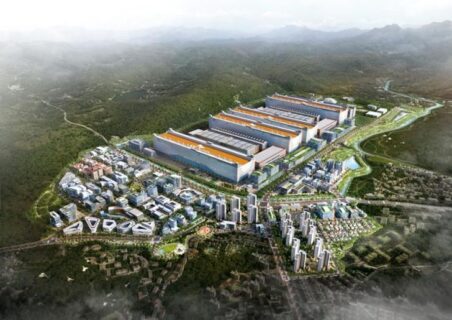
Published 16th January 2024: South Korea plans to build US$471 billion chipmaking hub in collaboration with major companies like Samsung Electronics and SK Hynix.
By 2030, the Pyeongtaek to Yongin region in South Korea is anticipated to become the leading chipmaking hub for chip manufacturing globally. It is projected to have the capacity to produce a 7.7 million wafers each month making it the largest chip making area, in the world.
It is anticipated that an investment of 622 trillion won (US$471 billion) from companies in the years leading up, to 2047 will ensure the security of domestic chip supply.
South Korea has announced its plans to build a chipmaking hub in collaboration with major companies like Samsung and SK Hynix. With an investment exceeding US$470 billion this initiative aims to secure and fortify the nations chip supply thereby participating in the competition, for technological self-sufficiency.
On Monday the government presented a plan that envisions private sector investment of 622 trillion won (, to US$471 billion) over the few decades until 2047.
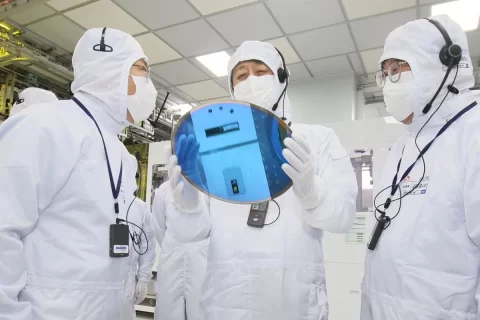
Number of Chip Plants Planned under the ChipMaking Hub Project in ROK
South Korea has plans to invest in the building of 13 chip plants and three research facilities in addition, to the existing 21 fabs. This development will cover a region, from Pyeongtaek to Yongin making it the largest chip production area globally. It is estimated that by 2030 this expanded setup will have the capacity to manufacture 7.7 million wafers every month.
The planned investment for building the chipmaking hub by South Korea has significantly increased since Seoul initially announced the plans of Samsung and Hynix in 2023. The Korean government, known for collaborating with private companies, on national priorities has been actively increasing its support, for the domestic chip industry, which contributes around 16 percent to the country’s total exports.
The government of South Korea is dedicated to safeguarding an aspect of its economy amidst increasing competition. In response, to the growing investments in chipmaking sectors, by Japan and Taiwan the Korean government is taking measures to provide tax incentives to domestic chip companies.
Read also: Samsung Electronics expands its foundry capacity with a new production line in Pyeongtaek, Korea
As part of their long term strategy, Samsung and Hynix have plans to build state of the art chip manufacturing facilities in their home country. Samsung is placing an emphasis, on the foundry sector, which involves producing chips, for companies as part of a massive investment of 500 trillion won by 2047. Meanwhile Hynix, a competitor is targeting an investment of 122 trillion won in memory technology in Yongin over the timeframe.
Besides the plan by South Korea to build a chipmaking hub, Samsung and SK Hynix have already announced their intentions to make investments. As reported by The Korea Herald Samsung plans to allocate a budget of KRW480 trillion ($363 billion) towards establishing manufacturing facilities and production lines. On the hand SK Hynix has earmarked KRW122 trillion ($92 billion) for the construction of a cutting edge memory chip plant.
The South Korea has announced plans to build a smaller a hub, for chip design and materials companies in the region. The main goal is to enhance the country’s self-reliance in semiconductors and expand its share of logic chip production aiming for a 10 percent market share by 2030 up, from the 3 percent.
The chipmaking hub is projected to need a power capacity of 3 gigawatts with growth, to 10GW. To give you a sense of scale the largest nuclear power plant currently operating in South Korea generates over 7.6 GW of electricity.
As South Korea plans establishment of fabs, within the mega chipmaking hub, this will lead to employment opportunities for 70,000 skilled professionals along with an additional 40,000 positions at companies that provide parts and materials. Considering the effect on job creation from the hub the industry ministry estimates that this project will potentially generate employment for, around 3.46 million individuals.
Read also: New York teams up with IBM, Micron for $10B semiconductor facility at Albany University
Read also: Amkor plans to build $2B semiconductor packaging and testing facility in Peoria, AZ