
HOCHTIEF Infrastructure GmbH, the civil engineering subsidiary of German construction giant HOCHTIEF AG and a core operating arm of Spain’s ACS Group, has secured a landmark design-and-build contract valued at up to approximately €900 million ($1.04 billion) to construct a 26-kilometre section of Sweden’s East Link high-speed railway southwest of Stockholm. The contract, awarded by Trafikverket, the Swedish Transport Administration, covers the OL31 Vagnhärad section of the Ostlänken programme — the largest infrastructure investment in Sweden’s modern history — with construction scheduled to run through 2034 and the full East Link line targeting passenger operations by 2035. The award positions HOCHTIEF as one of the anchor contractors on a programme that is reshaping the rail backbone of Sweden’s most economically productive corridor.
OL31 Vagnhärad: The Scope of a Complex Section
The OL31 Vagnhärad contract covers 26 kilometres of new double-track railway cutting through the Södermanland landscape southwest of Stockholm, between the existing Southern Main Line junction at Järna and the settlement of Vagnhärad in Trosa municipality. The terrain presents some of the most geotechnically demanding conditions on the entire Ostlänken alignment: a combination of soft clay deposits, bedrock outcrops, and sensitive ecological zones that together require extensive tunnelling, large bridge structures, and precision earthworks to thread a high-speed alignment through the landscape with minimal environmental disruption.
Project Fact Sheet: OL31 Vagnhärad — East Link (Ostlänken)
Project Name: OL31 Vagnhärad — East Link High-Speed Railway (Ostlänken)
Location: Southwest of Stockholm, Södermanland, Sweden (Järna to Vagnhärad, through Trosa municipality)
Contract Value: Up to approximately €900 million (~$1.04 billion / ~SEK 9.5 billion)
Contract Type: Early Contractor Involvement (ECI) Design-and-Build
Section Length: 26 kilometres (double-track)
Key Structures: Several tunnels; large bridges; new intermodal travel centre at Vagnhärad station
Construction Period: 2026–2034
Target Line Opening: 2035
Programme Context: Part of East Link (Ostlänken), 160 km Järna–Linköping; total programme cost ~€10.4 billion (SEK 110.3 billion)
Maximum Train Speed: 250 km/h
Programme Significance: Largest infrastructure investment in modern Swedish history; Sweden’s largest developer is Trafikverket (10-year infrastructure budget: SEK 799 billion)
Project Team: OL31 Vagnhärad — East Link
Contractor: HOCHTIEF Infrastructure GmbH (subsidiary of HOCHTIEF AG / ACS Group)
HOCHTIEF CEO: Juan Santamaría
Client: Trafikverket (Swedish Transport Administration)
East Link Programme Manager: Magnus Sjöberg (Trafikverket)
Parent Company: ACS Group (Madrid, Spain — majority owner of HOCHTIEF AG)
Concurrent Ostlänken Contractors: Bouygues Travaux Publics (Skavsta section); Implenia (Bibana Nyköping section, ~€135M)
Engineering/Design Partners: SYSTRA, COWI, Ramboll, Atkins (programme-wide design roles)
Electrification Standard: 15 kV AC
Signalling Standard: ETCS Level 2 digital signalling
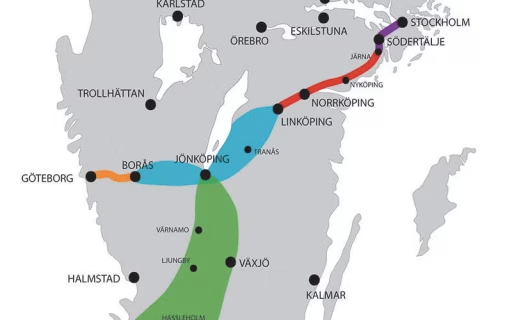
Within those 26 kilometres, HOCHTIEF’s scope encompasses the design and construction of several tunnels — including passages through bedrock conditions characteristic of this part of Södermanland — and major bridges carrying the new double-track formation over watercourses and existing road and rail infrastructure. The contract also includes civil works for a new intermodal travel centre in Vagnhärad itself, establishing the station as a multimodal transport hub connecting the East Link’s 250 km/h mainline with regional bus and road networks. The full contract was structured under an Early Contractor Involvement (ECI) design-and-build framework — a procurement model Trafikverket has applied across Ostlänken’s major packages to bring Tier 1 civil contractors into the final design phase, locking in constructability solutions and managing geotechnical risk before large-scale earthworks commence. Construction is expected to continue to 2034, after which testing and commissioning will prepare the section for the 2035 opening of the full line.
HOCHTIEF, ACS, and the Project’s Leadership Structure
HOCHTIEF Infrastructure GmbH is the contracting entity, operating as the civil engineering delivery arm of HOCHTIEF AG, which is itself majority-owned by ACS Group, the Spanish infrastructure conglomerate headquartered in Madrid. The award represents a significant expansion of HOCHTIEF’s presence in Scandinavia, a market where the company has been building its civil engineering portfolio alongside its established positions in Germany, Australia, and the Americas. HOCHTIEF CEO Juan Santamaría welcomed the contract as evidence of the group’s end-to-end infrastructure capabilities, framing the Vagnhärad section as a meaningful contribution to efficient and sustainable transport in Northern Europe.
On the client side, Trafikverket — Sweden’s national transport infrastructure manager and the country’s largest project developer — is administering the East Link programme under Magnus Sjöberg, who serves as Programme Manager for Ostlänken. Sjöberg has been a consistent public communicator on the programme’s procurement strategy, which has deliberately structured Ostlänken’s construction into fewer but larger contracts — each in the order of SEK 9–10 billion — to create better conditions for time- and cost-effective delivery. HOCHTIEF’s OL31 Vagnhärad award, at SEK approximately 9.5 billion, sits squarely within this volume contract framework. Concurrently, Trafikverket has awarded the adjacent Skavsta section to Bouygues Travaux Publics, and previously contracted Implenia for the 8-kilometre Bibana Nyköping link at approximately €135 million — together signalling a competitive international contractor cohort mobilising across the Ostlänken alignment.
Sweden’s Largest Infrastructure Programme and the Ostlänken Context
The East Link — Ostlänken in Swedish — is a 160-kilometre new double-track railway running from Järna, just south of Stockholm, to Linköping in Östergötland, with an authorised investment of approximately €10.4 billion (SEK 110.3 billion). It is, as Trafikverket has repeatedly stated, the largest infrastructure investment in Sweden’s modern history, and one of the most technically complex greenfield rail projects underway anywhere in Europe. The line is designed for maximum operating speeds of 250 km/h, connecting Stockholm to Linköping and creating the foundation for a future fast rail network linking Sweden’s three largest cities — Stockholm, Gothenburg, and Malmö — through a planned onward extension called the Götalandsbanan.
Approximately 25 per cent of the 160-kilometre alignment will be built on bridges or in tunnels — a design specification driven both by geotechnical conditions along the route and by environmental requirements to minimise surface impact across the Södermanland and Östergötland counties the line traverses. Five new transport hubs will be built along the corridor: at Vagnhärad, Nyköping, Skavsta, Norrköping, and Linköping. The programme is structured into 11 construction packages across three sequential stages, with the initial stage — from Järna to Nyköping and Skavsta — now advancing under major contracts. The Ostlänken’s opening in 2035 will not only cut Stockholm-Linköping journey times significantly but will relieve the severely congested Southern Main Line (Södra stambanan), releasing capacity for regional trains and heavy freight that is currently constrained by mixed-traffic operations on tracks originally designed for far lower volumes.
HOCHTIEF’s Global Rail Portfolio and the Northern European Rail Moment
The OL31 Vagnhärad award adds Sweden to a rapidly expanding international rail portfolio for HOCHTIEF that spans three continents and multiple high-profile programmes. In the United States, the company is active on a section of the California High-Speed Rail — one of the most challenging and politically contested rail infrastructure programmes in the world — while in Australia it is delivering the Logan and Gold Coast Faster Rail project as part of Queensland’s passenger network upgrade. In Germany, its home market, HOCHTIEF holds a 2025-awarded Deutsche Bahn contract for the expansion of a 42-kilometre double-track line on the right bank of the Rhine between Wiesbaden and Lorchhausen. These concurrent international commitments reflect a deliberate strategic positioning by HOCHTIEF and its ACS parent as a global Tier 1 heavy civil contractor with specialised rail capability at the highest levels of project complexity.
The Vagnhärad award also arrives at a moment when Northern Europe is emerging as one of the most active arenas for new rail investment on the continent. Sweden’s Ostlänken is the largest single programme, but it is part of a broader Nordic and Northern European infrastructure surge that includes Norway’s InterCity network expansion, Finland’s proposed Helsinki–Tampere high-speed link, and the broader decarbonisation imperative driving modal shift from air and road to rail across the region. Trafikverket’s ten-year infrastructure investment plan carries a total envelope of SEK 799 billion — a commitment that places Sweden among Europe’s most ambitious infrastructure investors by GDP share. That regional momentum extends south into the Baltic states, where Rail Baltica — a $1 billion-plus programme creating a new standard-gauge main line connecting Estonia, Latvia, and Lithuania to the wider European rail network — has entered active construction procurement, with contracts covering the Ülemiste–Pärnu and Pärnu–Ikla sections now tendered, reinforcing the strategic and economic case for a fully integrated Northern European rail corridor. For HOCHTIEF, the €900 million Vagnhärad contract is both a commercial milestone and a strategic beachhead in a Scandinavian market that, over the decade to 2034, will absorb tens of billions of euros in rail construction work.
Leave a Reply