
President Donald Trump said on Tuesday that the price tag for the new Presidential Ballroom at the White House has climbed to $400M, a figure he disclosed during a White House Hanukkah event, marking a 100% increase from the project’s initial estimates just six months ago. While the administration maintains the project is a gift to the nation funded entirely by private donors, the rising costs and the physical transformation of the Executive Mansion have sparked a firestorm of legal and preservationist debates.
The Cost Evolution: From $200M to $400M
When the project was first unveiled in July 2025, it was pitched as a $200 million addition. However, the budget has ballooned as the scope of the project expanded. By September, estimates hit $250 million, climbing to $300 million in October, before reaching today’s record $400 million milestone.
The President attributes this increase to the “world-class” materials required for the structure, including specialized five-inch-thick bulletproof glass. Despite the massive figure, the White House continues to emphasize that the project carries “zero cost” to taxpayers, citing a pool of private donors that reportedly includes major tech giants like Amazon, Apple, Google, and Microsoft.
Demolition and Construction: Out with the East, In with the New
The project’s most jarring phase began with the demolition of the historic East Wing. Crews have spent months clearing the site to make way for a massive 90,000-square-foot facility.
The new “Glass Ballroom” is designed to be a permanent solution for large-scale diplomatic events and presidential inaugurations. Which previously required the construction of temporary, costly tents on the lawn. Construction is now in full swing, with the goal of completing the structure by the summer of 2028.
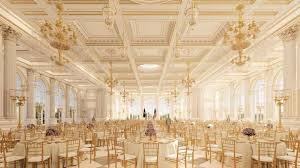
The Vision: Renderings and Architecture
Architectural renderings released by the administration depict a sleek, modern structure that contrasts sharply with the traditional neoclassical architecture of the original White House.
The Glass Enclosure: The centerpiece is a sprawling ballroom encased in high-security glass, offering panoramic views of the Washington Monument.
Capacity: The facility is built to house thousands of guests, moving away from the intimate, cramped quarters of the existing State Dining Room.
Security: Behind the aesthetics lies a “fortress” design, incorporating cutting-edge defensive technologies and reinforced structural supports.
The Legal Battle for the South Lawn
The project has not proceeded without significant resistance. The National Trust for Historic Preservation filed a lawsuit to halt construction, arguing that the demolition and new construction violate the National Historic Preservation Act. Critics argue that bypassing Congressional approval sets a dangerous precedent for the modification of national landmarks.
However, the project cleared a major hurdle yesterday when a federal judge ruled that construction could continue while the lawsuit proceeds. The court’s decision allows crews to move forward with the foundation and structural framing, making the project increasingly difficult to reverse.
What’s Next?
As the foundation is laid, the “Glass Ballroom” remains a polarizing symbol of 2025. To supporters, it is a much-needed modernization funded by the private sector; to critics, it is an architectural scar on a historic site. With the budget now at $400 million and construction accelerating, the White House is doubling down on a vision that will permanently alter the most famous residence in the world.
Elsewhere, despite the Trump administration putting federal funding on hold, the Hudson Tunnel Project continues to progress. The Gateway Development Commission announced that workers have completed manufacturing and factory acceptance testing of the first two tunnel boring machines, marking a major milestone that advances the project toward active tunneling under the Hudson River. The team will ship the machines to New Jersey for on-site assembly ahead of tunneling, scheduled to begin in 2026.
Factsheet: The $400M White House Ballroom Project
Current Status as of: December 17, 2025
Financial Overview
Current Projected Cost: $400 million (Announced by President Trump on Dec 16, 2025).
Cost Trajectory: Initial estimate was $200M (July 2025); increased to $250M (Sept), $300M (Oct), and finally $400M today.
Funding Source: 100% private donations (reported donors include Amazon, Apple, Google, and Microsoft).
Taxpayer Impact: $0 (According to White House statements).
Construction & Scale
Location: Site of the former East Wing, White House, Washington, D.C.
Size: Approximately 90,000 square feet.
Current Phase: Active construction following the total demolition of the East Wing.
Key Materials: 5-inch-thick bulletproof glass and reinforced structural steel.
Projected Completion: Summer 2028.
Purpose & Design
Primary Use: Diplomatic state dinners, official receptions, and presidential inaugurations.
Primary Goal: To eliminate the need for temporary tent structures and provide a high-capacity, high-security indoor venue.
Aesthetic: A modern glass-enclosed “fortress” design offering direct views of the Washington Monument.
Legal & Regulatory Status
Legal Challenges: Currently facing a lawsuit from the National Trust for Historic Preservation regarding the destruction of historic property and lack of Congressional oversight.
Judicial Status: As of Dec 16, 2025, a federal judge ruled that construction may proceed.
Controversy: Critics cite a violation of the National Historic Preservation Act; proponents cite the modernization of aging infrastructure at no cost to the public.
Leave a Reply