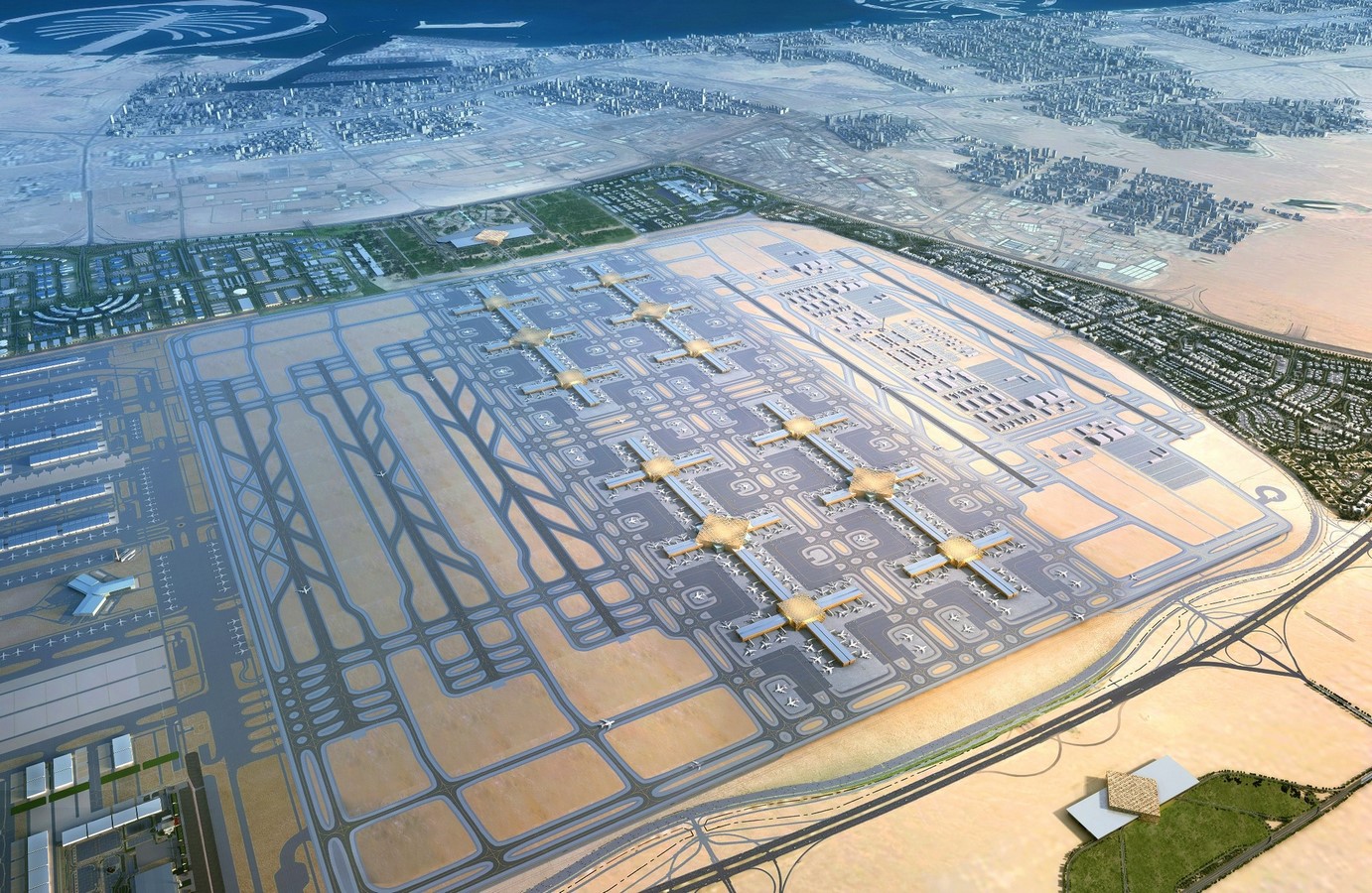
The monumental $35 billion expansion of Al Maktoum International Airport (DWC) at Dubai South is rapidly progressing through its pre-execution and early construction phases, positioning it to become the world’s largest airport ecosystem upon full completion. Spanning an immense 70 square kilometers, the futuristic hub is designed to feature five to six parallel runways, 400 aircraft gates, and four massive concourses. To supercharge passenger and logistical operations, the master plan integrates next-generation technologies like AI-driven immigration corridors that drastically reduce clearance times to mere seconds, alongside extensive robotics for automated baggage handling and food services. Ground logistics are concurrently advancing to turn the airport into a fully connected multimodal transit city, underscored by finalized infrastructure approvals for a direct extension of the Dubai Metro Blue Line and a dedicated stop on the regional Etihad Rail network.
The airport’s surrounding aviation ecosystem achieved a major milestone today with the official groundbreaking of a $5.1 billion, 1.1 million-square-meter Emirates Engineering mega-complex. Contracted to the China Railway Construction Corporation (CRCC) and slated for a mid-2030 Phase 1 delivery, this massive facility will serve as the world’s most advanced maintenance, repair, and overhaul (MRO) center, boasting a record-breaking capability to service 28 wide-body aircraft simultaneously. This aggressive infrastructure push is heavily driving Dubai’s real estate market, with property prices in the surrounding Dubai South district forecasted to rise by 15% to 20% in the near term as developers rush to meet the housing and commercial demands of an aviation sector projected to contribute over 30% of Dubai’s GDP by 2030. Sustainability remains core to the master project, with airport air traffic control buildings already achieving LEED Gold status and new developments targeting LEED Platinum ratings by integrating vast rooftop solar photovoltaic arrays, automated smart climate systems, and closed-loop water harvesting infrastructure.
March 12, 2023
Al Maktoum International Airport, also known as Dubai World Central, is an international airport in Jebel Ali, 37 kilometers southwest of Dubai, United Arab Emirates that opened on 27 June 2010.
The aim of the US$32.6 billion expansion project is to turn the airport into the world’s largest airport by size and passenger capacity by 2050. On completion of the project, it is expected that DWC will be capable of handling in excess of 220 million passengers and approximately 16 million tonnes of cargo per year.
The expansion will be built in two phases over six to eight years. The first phase is scheduled to complete in 2030. It involves two more parallel Code F, CAT III B, 4.5 Km runways each with a capability of simultaneous operation.
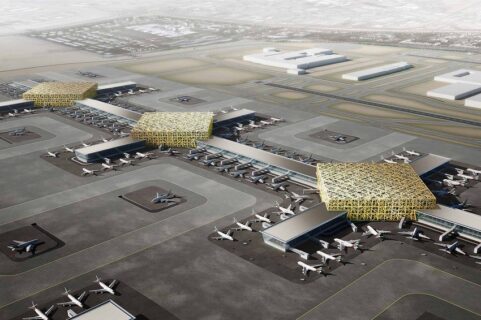
Additionally, 2 Satellite concourses each with a 385,000 sq m footprint and each capable of handling 65 million passengers a year, 200 wide-body aircraft contact stands, comprising 100 stands each for Code E and Code F aircraft.
Reported in September 2014
Dubai endorses US$32 billion Al Maktoum International airport expansion into World’s largest airport
A plan to expand Al Maktoum International airport at Dubai World Central into the world’s largest airport has been endorsed by Dubai’s top government organ. The planned expansion of the facility will see the Al Maktoum airport handle 200 million passengers per year.
The first phase of expansion works at the Al Maktoum International airport will aim at establishing a facility that will handle 120 million passengers per year. The facility is also supposed to accommodate 100 mammoth Airbus A380 double-decker jets at any time once completed. This will involve building enough runway and terminal space. The first phase will also involve adding two new runways and two large concourses that will each house several aircraft gates.
Handling millions of passengers per year, the facility will surpass the 94.4 million people capacity handled last year by the world’s busiest airport, Hartsfield-Jackson Atlanta International Airport.
To indicate the nature of the expansive work at the Al Maktoum International airport, the first phase of expansion is to take six to eight years. That included Paul Griffiths, chief executive of state-backed airport operator Dubai Airports indicating that six to eight years was the aggressive timeline. He added, “’It’s a very aggressive time scale…”
Later construction works for the to-be world’s largest airport will see through the establishment of five parallel runways, each spaced far apart from the other such that they all can be used at the same time and so they can accommodate hundreds of wide-body planes.
Construction or expansion works at the Al Maktoum International airport will help increase airport capacity/facilities in Dubai. This will help Dubai keep pace with an increasing number of traffic in the Emirate. Dubai boasts of the world’s seven largest busiest airports – the Dubai International airport, the latter having handled 66.4 million passengers last year alone. The airport will also open its new concourse next year.
Emirates region is the world’s largest user of A380 and Boeing 777 long-haul jets.
Project Factsheet
Location: Jebel Ali, Dubai South, United Arab Emirates (approx. 40km southwest of central Dubai)
Developer: Dubai Aviation Engineering Projects (DAEP)
Owner / Operator: Dubai Government / Dubai Airports Company
Architectural Consultants: Dar Al-Handasah (Consultant) & Coop Himmelb(l)au (Design Architect)
Project Cost: AED 128 billion ($34.85 billion USD) for the new terminal expansion
Total Footprint: 70 square kilometers (approx. five times the size of DXB)
Annual Passenger Capacity: 260 million guests
Annual Cargo Capacity: 12 million tonnes
Runway System: 5 parallel Code F runways (4.5 km each, allowing quadruple simultaneous landings)
Aircraft Gates / Stands: 400+ contact gates
Passenger Terminals: 5 terminal buildings (including West and East processing terminals)
Satellite Concourses: 4 massive concourses
Air Traffic Control: 2 control towers (Main tower stands at 92 meters high)
Phase 1 Expansion (Current Focus)
- Target Capacity: 130 million passengers annually.
Key Deliverables:
- Construction of the new West Terminal Building.
- Concourse 1 development (spanning 2.3 million sqm) featuring 100 contact gates.
- Activation of Runway 2 and Runway 3.
- Underground automated baggage handling system and dedicated ground service networks.
- Integration of an underground Automated People Mover (APM) system (4 stations).
Phase 2 Expansion
- Target Capacity: 150 million passengers annually within the next decade.
- Key Deliverables: Construction of Concourse 2 (running parallel to Concourse 1) and expansion of the APM and logistics support systems to accommodate over 200 total contact gates.
Ultimate Phase
- Target Capacity: 260 million passengers and 12 million tonnes of cargo.
- Key Deliverables: Construction of the East Terminal Building, Concourses 3 and 4, full 5-runway simultaneous operation, and full migration of Emirates Airline’s hub operations to DWC.
Sustainability and Technology Features
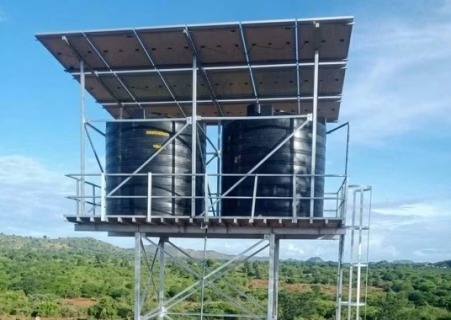
- Net-Zero Energy Goals: The master plan utilizes massive onsite photovoltaic solar farms alongside offsite clean energy procurement to offset operational loads.
- Regenerative Design: Optimized building enclosures with highly insulated structurally glazed walls, shading louvers, and light shelves to reduce the desert heat load.
- Water Conservation: A target of 64% reduction in potable water usage via vacuum toilets, greywater harvesting, cooling tower condensate collection, and an internal constructed wetland for stormwater filtration.
- Next-Gen Baggage & Transit: Features an uninterrupted, multi-station internal APM train for rapid terminal-to-concourse transit and a fully automated subterranean baggage system.

Leave a Reply