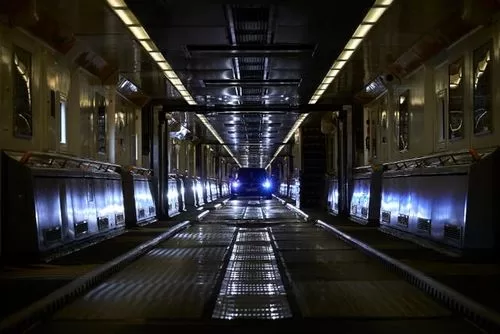
The Channel Tunnel, often called the ‘Chunnel’ or ‘The Channel Fixed Link’, is one of the most significant engineering marvels of the modern world. Running between Folkestone in England and Coquelles near Calais in France, it has revolutionized transport between the two nations since its opening in 1994.
At 50.45 kilometers (31.35 miles) in total length, the Chunnel holds the record for the longest undersea tunnel in the world, with 37.9 kilometers (23.5 miles) of its route running beneath the English Channel in second and third place for this distinction are the Seikan Tunnel and the Jintang Undersea Tunnel in China. It lies an average of 45 meters below the seabed, a geotechnical achievement that has transformed European travel and commerce. Even the the Fehmarnbelt tunnel which will become the world’s longest underwater rail and road tunnel when completed is being constructed at a depth of about 40 meters below the sea surface.
Construction: A Six-Year Cross-Channel Effort
The ambitious project, which had been proposed and shelved since the early 19th century, was finally realized when France and the United Kingdom signed an agreement in the 1980s. Construction officially commenced on December 15, 1987, and spanned six years, employing approximately 15,000 workers at its peak.
The construction involved complex boring through the stable, impermeable chalk marl layer underneath the sea. This critical geological formation provided the ideal stable ground for the massive tunnel boring machines (TBMs).
| Project Factsheet | Details |
| Location | Under the English Channel, linking Folkestone (UK) and Coquelles (France) |
| Total Length | 50.45 km (31.35 miles) |
| Undersea Length | 37.9 km (23.5 miles) – Longest in the World |
| Start Date | December 15, 1987 |
| Completion/Opening | June 5, 1994 |
| Estimated Cost | Approximately £9 billion (over $12 billion in today’s money) |
Builder Consortium
The tunnel was constructed by TransManche Link (TML), an Anglo-French association of construction companies:
-
UK: Includes major firms such as Balfour Beatty, Wimpey Major Projects, and Tarmac Construction.
-
France: Includes Bouygues S.A. and Spie Batignolles contractor Company.
A Triple-Bore System for Safety and Efficiency
The Channel Tunnel is technically composed of three parallel tunnels:
-
Two Rail Tunnels: Each measuring 7.6 meters in diameter, these are used for high-speed Eurostar passenger trains, freight trains, and the Eurotunnel Shuttle for vehicle transport.
-
One Service Tunnel: A smaller tunnel, 4.8 meters in diameter, located in the center. This is dedicated to maintenance, ventilation, and, most critically, serving as an escape route or emergency access.
All three tunnels are connected by cross-exit passages every 375 meters. This crucial feature enables rapid evacuation of passengers and vehicles from a rail tunnel into the service tunnel in the event of an incident like a fire.
Environmental and Economic Lifeline
The Channel Tunnel is recognized for its advanced safety systems, including smoke detectors, fire suppression systems, and powerful ventilation fans. Its design prioritized safety and the ability to manage any disaster efficiently.
The tunnel’s significance extends far beyond its engineering:
-
Economic Catalyst: It facilitates the movement of millions of passengers and tons of freight every year, actively enhancing economic relations, commerce, and tourism between the UK and mainland Europe. High-speed Eurostar trains have cut the journey time between London and Paris or Brussels to under 2 hours 15 minutes.
-
Environmental Advantage: Trains operating through the tunnel are electric, emitting significantly less $\text{CO}_2$ than short-haul flights. The Channel Tunnel is a crucial component in promoting a more environmentally friendly mode of transport across the English Channel.
In conclusion, the Channel Tunnel stands as a testament to human innovation, revolutionizing cross-Channel services and contributing to a more integrated Europe through its commitment to innovation, safety, and sustainability.
Leave a Reply