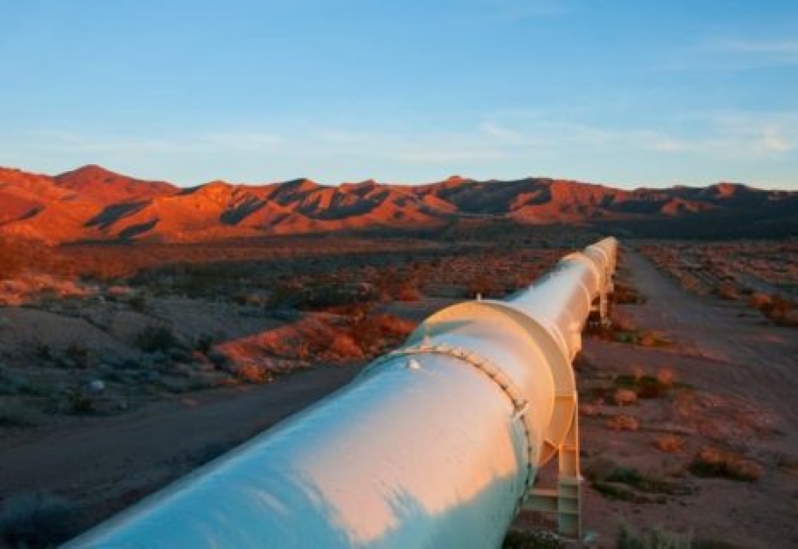
Oil pipelines are among the most important – and often invisible – pieces of global energy infrastructure, stretching across continents to move crude from remote production basins to refineries and export terminals. The world’s longest pipelines are a show of just how central oil remains to modern economies, even as energy systems gradually diversify toward renewables, LNG, and electrification.
At the same time, these vast steel pipelines sit within a geopolitically sensitive landscape, where supply routes can be as important as production itself. Nowhere is this more evident than in regions tied to chokepoints like the Strait of Hormuz, where conflict or disruption can ripple through global oil markets and reinforce why secure, long-distance pipeline networks continue to matter, even in the evolving global energy economy.
There are two types of pipelines in the oil world. These are crude oil pipelines and product pipelines. Crude oil pipelines carry crude oil to refineries, while product pipeline transport refined products to downstream markets. The latter include gasoline, kerosene, jet fuel, and heating oil from refineries. In this article, we look at the longest oil pipelines in the world, as of 2026.
List of the top 5 longest crude oil pipelines in the world
- Colonial Pipeline in the Americas (length: 8, 850 kilometers)
- Druzhba Pipeline in Europe (length: 5,500 kilometers)
- Eastern Siberia-Pacific Ocean Oil Pipeline in Asia (length: 4,857 kilometers)
- Keystone Pipeline in the Americas (length: 4,700 kilometers)
- Kazakhstan-China Pipeline in Asia (length: 2,228 kilometers)
- Enbridge Oil Pipeline in North America (length: 2,200-2500 kilometers)
- East African Crude Oil Pipeline in Africa (length: 1,443 kilometers)
1. Colonial Pipeline
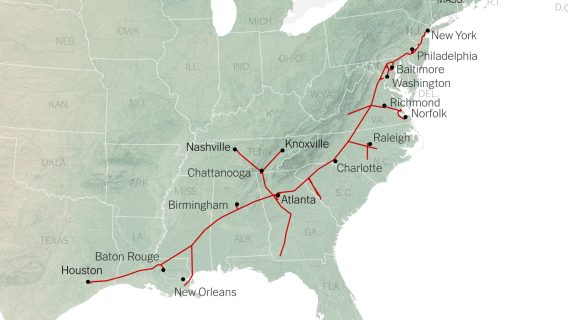
The 8,850-kilometer Colonial Pipeline is the largest pipeline system for oil or rather refined oil products in the U.S.
Consisting of three tubes, the pipeline originates in Houston, Texas, on the coast of the Gulf of Mexico and terminates at the Port of New York and New Jersey. It cuts across the coastal states of Texas, Louisiana, Mississippi, Alabama, Georgia, South Carolina, North Carolina, Virginia, Maryland, Delaware, Pennsylvania, and New Jersey. Branches from the main Colonial Pipeline also reach Tennessee, a landlocked state in the Southeastern region of the United States.
The main Colonial Pipeline lines are 40 inches and 36 inches in (inner) diameter. One of the lines is devoted primarily to gasoline while the other carries distillate products such as jet fuel, diesel fuel, and home heating oil. Products move through the main lines at a rate of approximately 3 to 5 miles per hour. This is an equivalent of 4.8 to 8.0 km/h. On a daily basis, the pipeline delivers an average of 1×10⁸ US gallons, the equivalent of 3.8×10⁸ L of gasoline, home heating oil, aviation fuel and other refined petroleum products to communities and businesses throughout the South and Eastern United States.
Overall, the Colonial Pipeline has the capacity to carry about 3 million barrels of fuel per day.
Also Read: The longest natural gas pipelines in the world
2. Druzhba Pipeline
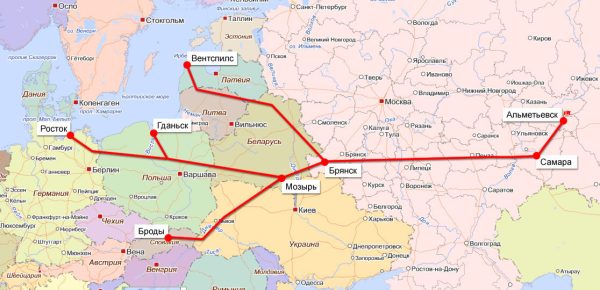
Also referred to as the Friendship Pipeline and the Comecon Pipeline, the Druzhba Pipeline is the second-longest and one of the largest oil pipelines in the world.
The pipeline begins at Almetyevsk in the Russian Federation, where pipelines carrying crude oil from Siberia, the Urals and the Caspian Sea meet. From Almetyevsk, the pipeline runs to Mozyr in Belarus. Here it splits into a northern and a southern branch with the northern branch continuing through Belarus and Poland to Germany. The southern branch on the other hand runs through Ukraine, splitting at Uzhgorod into Druzhba 1 and Druzhba 2. Druzhba 1 continues to Slovakia where it splits again and goes to the Czech Republic in one branch and Hungary in another. Druzhba 2 proceeds to Hungary.
The entire Druzhba pipeline is approximately 5500 kilometers long including all its branches while its current capacity is 1.2–1.4 million barrels a day. Reportedly, there is a possibility to increase the capacity of the pipeline up to 2 million barrels a day.
3. Eastern Siberia-Pacific Ocean Oil Pipeline
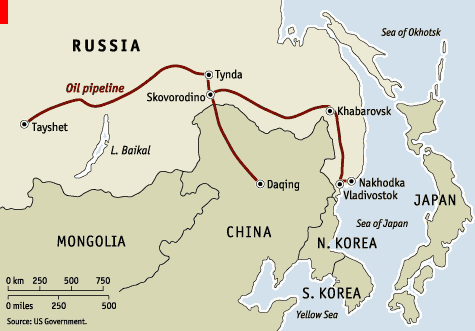
The Eastern Siberia–Pacific Ocean Oil Pipeline (ESPO Pipeline or ESPOOP) is a pipeline system for exporting Russian crude oil to the Asia-Pacific markets i.e. Japan, China and Korea.
The 4,857 kilometers long pipeline was built between 2006 and 2012 in two phases. The first phase involved the construction of a 2,757-kilometer section from Taishet in Irkutsk Oblast to Skovorodino in Amur Oblast, along with a branch from Skovorodino to Daqing, China. This section of the pipeline has a diameter of 48 inches. Its annual crude oil transfer capacities are about 80 million tonnes.
The second phase on the hand involved the construction of an approximately 2,100-kilometer section from Skovorodino to the Pacific Ocean terminal at Kozmino. The section from Skovorodino to Khabarovsk features 1,067mm diameter pipes, whereas the section from Khabarovsk to Kozmino features 1,020mm diameter pipes.
4. Keystone Pipeline
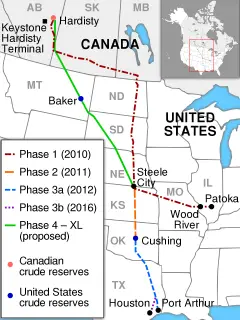
This is 4700 kilometers oil pipeline system in Canada and the United States. The pipeline runs from the Western Canadian Sedimentary Basin in Alberta to refineries in Illinois and Texas. Additionally, it extends to oil tank farms and an oil pipeline distribution center in Cushing, Oklahoma.
Keystone Pipeline was delivered in three phases. The first phase which is 3,456 kilometers long runs from Hardisty, Alberta, to the junction at Steele City, Nebraska. It then proceeds on to the Wood River Refinery in Roxana, Illinois, and Patoka Oil Terminal Hub (tank farm) north of Patoka, Illinois. The second phase connects Phase 1 in Steele City, Nebraska, south through Kansas to the oil hub and tank farm in Cushing, Oklahoma. It covers a distance of 468 kilometers.
The third phase was delivered in two subsections. Phase 3a started at Cushing, Oklahoma, where American-produced oil is added to the pipeline. This then runs south for about 700 kilometers to a delivery point near terminals in Nederland, Texas. Phase 3b on the other hand is a 76 kilometers pipeline that transport crude oil from the pipeline in Liberty County, Texas, to refineries and terminal in the Houston area.
Keystone Pipeline would also probably be the second longest oil pipeline in the world, were it not for the cancellation of its 526 kilometers 4th phase.
5. Kazakhstan-China Pipeline
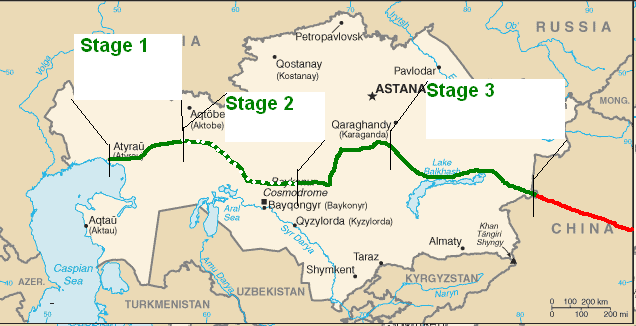
Owned by the China National Petroleum Corporation (CNPC) and the Kazakh oil company KazMunayGas, Kazakhstan–China oil pipeline is considered China’s first direct oil import pipeline allowing oil import from Central Asia. The construction of the Kazakhstan-China pipeline was proposed by Kazakhstan and agreed upon in 1997.
The 2,228 kilometers long pipeline runs from Atyrau in Kazakhstan to Alashankou in China’s Xinjiang. The Kenkiyak-Atyrau section of the pipeline is approximately 449 kilometers long. The Atasu-Alashankou section of the pipeline on the other hand is 987 kilometers long while the Kenkiyak-Kumkol section is 792 kilometers long.
Atasu-Alashankou section of the pipeline was also been used to transport crude oil from the giant Kashagan oilfield to China for the first time in 2025. Oil was diverted to the Kazakhstan-China pipeline because of disruptions at the Caspian Pipeline Consortium (CPC) export terminal. Kazakhstan’s Kashagan oilfield is also at the center of legal disputes with international oil and gas companies such as TotalEnergies who is investing in Kazakh renewables with projects such as Mirny wind and battery storage project.
6. Enbridge Pipeline System
The 2,200-2,500 kilometers Enbridge pipeline is one of the longest crude oil pipelines in North America and the world. Its total network coverage is about 27,000 kilometers, spanning the United States and Canada. It operates across key producing regions such as Alberta’s oil sands in Canada and major refining hubs in the U.S. Midwest and Gulf Coast.
Enbridge also links multiple pipelines, storage terminals, and distribution corridors. Additionally, its geography is important because it connects landlocked Canadian crude production to both domestic U.S. demand centers and export terminals serving global markets. This makes Enbridge a key pipeline in North American oil logistics and energy security.
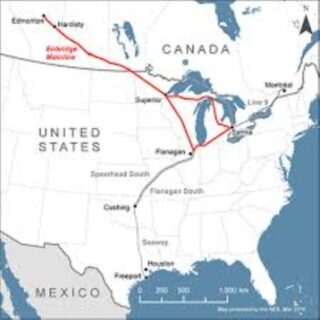
Enbridge operates a mix of large-diameter high-capacity pipelines, pumping stations, and control systems designed for continuous long-distance crude transport. Its system moves a variety of crude grades, including heavy bitumen blends from Alberta. It also uses advanced monitoring technologies such as SCADA systems, leak detection sensors, and pressure management systems to ensure operational safety over long distances.
Additionally, because it spans diverse terrain, from boreal forests to agricultural land and river crossings, the network is heavily regulated and requires continuous maintenance and expansion upgrades. This is because it needs to match production growth and shifts in refinery demands.
7. East African Crude Oil Pipeline (EACOP)
The East African Crude Oil Pipeline (EACOP) is a major under-construction export pipeline linking Uganda and Tanzania, designed to transport crude oil from Uganda’s Lake Albert Basin to the port of Tanga on the Indian Ocean. The pipeline runs approximately 1,443 kilometers, making it the longest heated crude oil pipeline in the world upon completion. Geographically, it crosses highly sensitive ecosystems, including wetlands, lakeshores, and wildlife corridors across Uganda and northern Tanzania. This fact has made it one of the most closely scrutinized energy infrastructure projects in Africa.
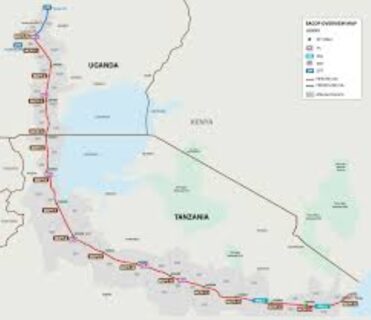
Technically, EACOP is engineered as a heated pipeline system, necessary because Uganda’s waxy crude becomes solid at ambient temperatures. The pipeline will maintain temperatures of around 50-60°C using electrical heating and insulation systems to keep the crude flowing. It is designed with multiple pumping stations, pressure control facilities, and storage terminals. Once operational, it will handle about 216,000 barrels per day at peak capacity.
EACOP is backed by a consortium led by TotalEnergies, along with Uganda National Oil Company and Tanzania Petroleum Development Corporation. It will serve as a significant export corridor intended to monetize Uganda’s oil reserves for international markets via the Indian Ocean.


Leave a Reply