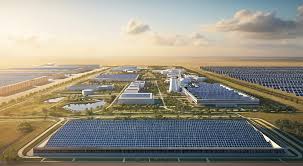
Fermi America announced on February 25, 2026, that Project Matador has received final approval of a 6-gigawatt Clean Air Permit from the Texas Commission on Environmental Quality (TCEQ), clearing a major regulatory hurdle for the first phase of the company’s planned 11GW private power campus in Texas.
The permit applies specifically to the initial 6GW of natural gas-fired generation capacity and does not cover the project’s full planned output. It follows a preliminary determination issued in 2025 and concludes the state’s formal air quality review process, including public comment procedures. With final authorization now in place, Fermi America can proceed with construction activities tied to this first segment.
Project Matador, the planned 11‑gigawatt AI data center and energy campus outside Amarillo, Texas, continues to make progress across financing, energy infrastructure, regulatory approvals, and construction planning. Developed by Fermi America in partnership with the Texas Tech University System, the campus will integrate natural gas, nuclear, solar, and battery storage to support 15 hyperscale data centers totaling 18 million square feet.
Financing
February 10, 2026 — $500 Million Warehouse Facility
Fermi America secured a $500 million warehouse credit facility from MUFG to fund early-stage capital expenditures and infrastructure procurement. This financing provides foundational support for the first phases of the multi-gigawatt campus.
February 19, 2026 — $200 Million Equipment Financing Draw
The company made an initial draw on a $200 million equipment financing facility arranged by Keystone National Group and Cape Commercial Finance. The draw accelerates procurement and delivery of generation equipment for the first 2.3 gigawatts of planned capacity.
Energy Infrastructure
Natural Gas
-
November 4, 2025 — Preliminary TCEQ Approval for 6 GW
The Texas Commission on Environmental Quality granted preliminary environmental approval for the project’s first 6 gigawatts of natural gas generation, covering air permits and emissions. Final confirmation will follow public hearings. -
October 30, 2025 — GE TM2500 Turbine Agreement
Fermi America finalized an agreement with Mobile Power Solutions to acquire seven GE TM2500 gas turbines (totaling 157.5 MW) for early-stage power deployment.
Nuclear
-
February 11, 2026 — FEED Agreement with Hyundai Engineering & Construction
Fermi America expanded its strategic partnership with Hyundai Engineering & Construction to advance Front-End Engineering Design for four AP1000 nuclear reactors to be manufactured by Westinghouse Electric Company. Reactor construction is projected to begin later in the decade following federal licensing approvals.
Grid Access
-
December 5, 2025 — Electric Service Agreement with SPS/Xcel
The company executed a 200 MW service agreement with Southwestern Public Service Company to support early operations while on-site generation capacity is phased in.
Local Agreements and Regulatory Approvals
June 15, 2025 — Amarillo Water Supply Contract
The Amarillo City Council approved a long-term municipal water contract beginning at 2.5 million gallons per day, with scalability options to support future phases. Fermi America is funding all related infrastructure improvements.
September 2025 — Tax Abatement and Foreign Trade Zone Designation
Carson County approved tax incentives and designated the site within a foreign trade zone to support multi-phase development.
October 2025 — Environmental Assessments
Terracon Consultants completed environmental, noise, and safety assessments for construction and operation protocols.
Construction Updates
February 17, 2026 — Temporary Construction Halt
Fermi America announced a temporary halt to construction activities at the Project Matador site. The pause affects early Phase 1 work, including site grading, road improvements, and installation of underground utilities.
The company cited the reason as awaiting final approvals from the Texas Commission on Environmental Quality (TCEQ), which are required to proceed with natural gas generation and related infrastructure. Fermi America emphasized that the halt is temporary and not a project cancellation, and that construction will resume once the necessary permits are issued.
At the time of the announcement, equipment procurement and planning work continued off-site, including turbine staging, nuclear FEED design coordination, and utility connection preparations.
Early On-Site Work Completed Before Pause:
-
Site grading and earthworks for data center pads and utility corridors.
-
Road improvements and internal campus road preparation.
-
Preliminary installation of underground utilities (water, power, and wastewater conduits).
-
Preparatory clearing and alignment marking for the planned rail spur.
Phased Buildout Overview
-
Phase 1 (2026): Site grading, road expansion, underground utilities, water infrastructure, and initial natural gas generation for early data center operations.
-
Phase 2 (2027): Start of nuclear reactor construction after federal licensing approvals and completion of initial auxiliary systems.
-
Phase 3 (2028–2030): Continued nuclear buildout, expanded generation capacity, and integration of renewable and battery storage assets.
-
Phase 4 (2031–2032): Final commissioning, operational readiness inspections, and full deployment of generation and data center capacity.
Strategic Significance
Project Matador is positioned as a leading integrated AI-energy campus in the United States, combining large-scale data center infrastructure with diversified energy sources. Its phased, multi-track development approach spans financing, permitting, energy procurement, and construction.
Fuel Gas Systems by Titan Enable Project Matador’s Phase 1 Energy Deployment
On February 17, 2026, Titan Production Equipment, LLC was awarded a key contract to engineer, design, and manufacture Fuel Gas Letdown Stations for Project Matador, an ambitious AI data center and energy campus being developed by Fermi America, with strategic support from the Texas Tech University System.
Titan’s role ensures stable, efficient, and scalable natural gas delivery to the campus during early operations and throughout the project’s long-term phased expansion.
“Project Matador is a generational investment in American competitiveness, and we’re honored to contribute our engineering expertise to its success,” said Chris Werner, CEO of Titan Production Equipment.
The fuel gas stations facilitate in the advancement of Project Matador despite the hiccup it has incurred earlier this week as it temporarily halts construction. Fermi America has temporarily halted the construction of the Project Matador AI campus as it awaits permits from state-owned TCEQ. Fermi clarified that it temporarily halted the project, not cancelled it, contrary to earlier speculation. After reports that the company dismissed workers at its data center construction site, the Panhandle 1st Coalition began reviewing Fermi America’s actions.
Project Factsheet
- Owner: Fermi America LLC
- Strategic Partner: Texas Tech University System (land lease and royalties)
- Location: Adjacent to Pantex, Amarillo, Texas
- Land Area: 5,769 acres
- Data Centers: 15 centers totaling 18 million sq. ft.
- Power Capacity: Up to 11 GW
The campus will provide energy, space, and security for companies advancing AI infrastructure and serve as a national model for multi-source energy integration.
Phased Construction and Timeline
Construction on Project Matador will take place in multiple phases over the next decade:
- Phase 1 (2026): Site grading, road expansion, underground utilities, water/wastewater infrastructure, and initial 1 GW natural gas for three 500,000 sq. ft. data centers.
- Phases 2–3 (2027–2028): Nuclear reactor buildings, steel modules, and additional energy systems.
- Phases 4–5 (2029–2030): System integration, grid testing, operational readiness inspections, and Hot Functional Testing (HFT).
- Phase 6 (2031–2032): Completion of all 15 data centers and full deployment of 11 GW capacity.
The first Westinghouse AP1000 nuclear reactors at Project Matador by Hyundai are projected to begin construction in 2027 and become operational by April 2031.
Energy Infrastructure
Project Matador integrates multiple energy sources:
- Natural Gas: Initial 6 GW deployment, supported by Titan’s Fuel Gas Letdown Stations.
- Nuclear Power: Up to four full-scale reactors and several small modular reactors.
- Renewables: Solar and battery storage systems.
- Grid & Hybrid Systems: Ensures redundancy and operational efficiency.
Projected Energy Mix: 50% natural gas, 40–45% nuclear, remainder solar.

Approved and Permitted Components
- Natural Gas Power: Project Matador’s first phase of natural gas power — totaling 6 gigawatts — has received preliminary approval from the Texas Commission on Environmental Quality, and final confirmation will follow a public hearing. The initial generators are already en route, set to go online in 2026.
- Water Supply: Amarillo City Council approved a 20-year contract for 2.5 MGD, with potential scaling to 5.5–10 MGD. Fermi funds all infrastructure improvements.
- Nuclear Reactors: Combined Operating License (COL) submitted to NRC; air-cooled condensers approved to limit water use to under 50 acre-feet/year. Excavation and construction await NRC authorization.
- Carson County: Tax abatement and Foreign Trade Subzone designation approved.
- Environmental Assessment: Completed by Terracon Consultants; noise, safety, and debris protocols codified.
- Roads and Transport: Existing roads will handle construction traffic, while a new rail spur is being built with TxDOT oversight for safe transport of large equipment.
Water and Cooling
Project Matador will use a hybrid air-and-water system to optimize energy efficiency. In its first year, the natural gas units will consume 1.5–2 billion gallons of water, enough to irrigate 1,900–2,500 acres of crops. Once the nuclear reactors are online, crews will store spent fuel rods on-site temporarily to cool before moving them off-site for disposal.
Jobs and Economic Impact
Project Matador will become a major source of employment in the Texas Panhandle. The construction phase will require 5,000 to 10,000 workers, including 3,000 for the AI data centers. Once operational, the campus will support around 600 full-time jobs and thousands of indirect positions.
Fermi America will phase the buildout across 15 stages. The Carson County agreement requires 40 full-time positions per phase, totaling 600 permanent local jobs. The company will also partner with Amarillo College and local trade schools, training workers for construction and long-term operations.
Amarillo College officials support the project, emphasizing opportunities for students and residents to gain technology and energy skills. Fermi America is recruiting key leadership, including a foreign trade zone administrator and site development director, preparing the workforce ahead of the campus’s first milestones.
Economic incentives, including a Carson County tax abatement, provide a stable tax rate. These measures help secure long-term investment and growth in the region.
Why Project Matador Matters
Project Matador aims to strengthen U.S. leadership in artificial intelligence with a state-of-the-art campus powered by nuclear, natural gas, solar, and battery systems. The development will create thousands of jobs and offer workforce training programs, while integrating multi-layered security and resilient energy infrastructure. Titan Production Equipment’s contract for the Fuel Gas Letdown Stations marks a key milestone in the multi-billion-dollar, decade-long buildout, keeping the campus on track to reach full operational capacity by 2032.
Project Matador ranks among the largest and most significant infrastructure projects in the United States today, combining advanced AI data centers with multi-source energy generation. Its scale, cutting-edge technology, and economic impact make it a benchmark for future developments in energy and artificial intelligence.

Leave a Reply