The Battery Park City Authority has reached a labor agreement for the $1.7 billion Battery Park City Resiliency Project, a major milestone in New York City’s efforts to harden its waterfront against climate risks. It is the city’s first project to adopt a progressive design-build model, where design and construction are integrated under a single contract to enhance efficiency and control costs.
The agreement with the Building and Construction Trades Council establishes union labor terms. They includes participation goals for minority-, women-, and veteran-owned businesses. It also outlines avenues for apprentices and local workers to improve opportunities for young people, women, veterans, and others to build their careers in the construction trades.
Early construction has already started under a Turner–SPC joint venture, marking the official kickoff of the city’s first progressive design-build project. Officials say the model streamlines planning, scheduling, and staffing while reducing delays and provides cost certainty for the complex multi-year effort.
Additionally, the resiliency system will extend from First Place along the Battery Park City Esplanade, across West Street, and end near Chambers Street. It is designed to protect property, residents, and infrastructure from sea-level rise, storm surge, and extreme rainfall events. Once complete, the improvements may remove Battery Park City from federal flood maps, eliminating certain homeowners’ flood-insurance requirements.
Redevelopment of public space
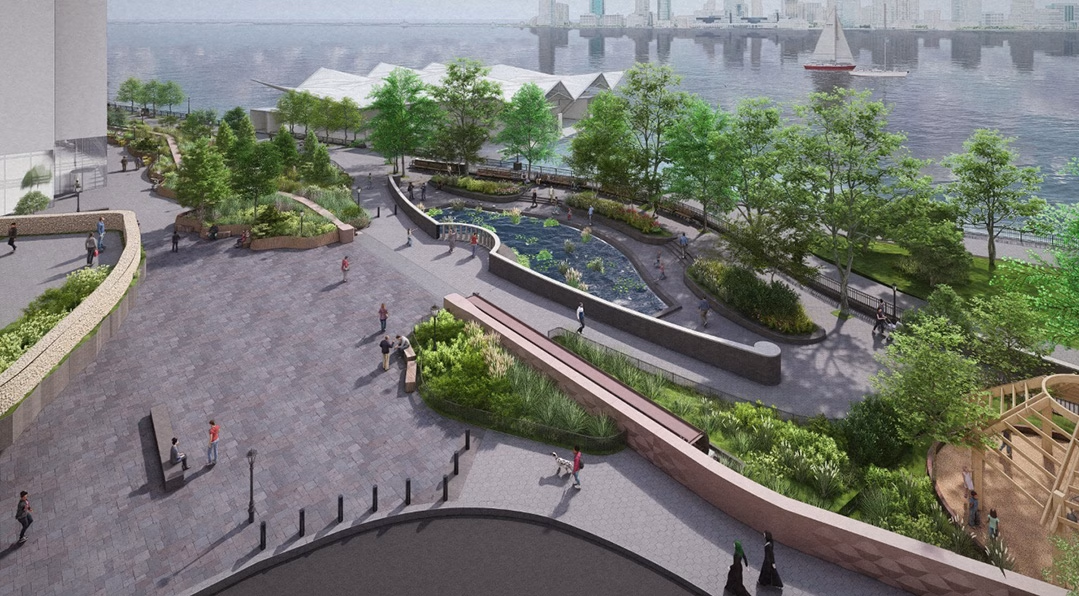
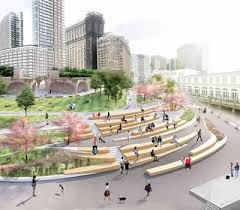
Beyond flood protection, the project features the redevelopment of public spaces and landscapes. Proposals are to increase planting coverage by more than 30 percent. And include approximately 85 percent native species to support birds and pollinators. The design adds shade, seating, improved universal accessibility, and about 1,200 linear feet of reconstructed bulkhead to enhance in-water habitats.
The project marks the third major resiliency effort by the authority since Superstorm Sandy. Wagner Park, part of the South Battery Park Park City Resiliency Project, reopened this year with new buried floodwalls, a stormwater-management system, and new landscaping. A previous project hardened the community’s ballfields and also a recreation center with an 800-foot-long barrier that protects facilities serving tens of thousands of youth each year.
The labor agreement is cited by city and project officials as one way to guarantee fair wages, safe working conditions, and career-building opportunities, while encouraging minority, women-owned, and veteran-owned participation. The progressive design-build framework, in conjunction with the labor agreement, enables the project team to deliver maximum efficiency, maintain transparency, and adapt to emerging environmental and design needs.
On November 24, Mayor Adams announced new project labor agreements covering more than $7 billion in city construction projects. Aimed at strengthening critical infrastructure and supporting good-paying union jobs.
Project team
The collaborative project team includes Turner Construction, SPC Construction, ARCADIS US, Bjarke Ingels Group, SCAPE Landscape Architecture, and other technical partners. The planning process included comprehensive outreach to the community and stakeholders. To make sure that the project reflects neighborhood priorities and addresses climate resilience in a way that is both sustainable and equitable. With construction underway and the labor agreement in place, the Battery Park City Authority says the project is positioned to deliver long-term protections for the waterfront, modernize infrastructure, and create opportunities for middle-class careers in New York City’s construction sector.
The Battery Park City Resiliency Project is part of a broader wave of large-scale infrastructure investments across New York City and the region, including the Port Authority’s $45 billion Capital Plan for airports, transit, and ports.
Battery Park City Resiliency Project Factsheet
Project Scope
$1.7 billion coastal flood protection system
Runs from First Place north along the Esplanade, across to east side of West Street/Route 9A, terminating above Chambers Street at Greenwich Street
First progressive design-build project in New York City
First progressive design-build undertaken by a New York State authority
Key Benefits
Protects against 2.5 feet of projected sea level rise
Removes Battery Park City from FEMA flood zone (eliminates flood insurance requirement for federally-backed mortgages)
30% increase in total planting coverage
85% native species coverage
Approximately 1,200 linear feet of reconstructed bulkhead for marine life
Universal accessibility and improved seating
Workforce Commitment
Project Labor Agreement with Building and Construction Trades Council
Thousands of family-sustaining union jobs
Fair wages and safe work environments
Expanded opportunities for MWBEs, SDVOBs, women, veterans, and apprentices
Delivery Team
Joint venture: Turner Construction Company and SPC Construction Co. LLC
Design partners: ARCADIS US, Inc., Bjarke Ingels Group, SCAPE Landscape Architecture
Progressive design-build model for cost certainty and risk reduction
Context
Third major resiliency project by Battery Park City Authority since Superstorm Sandy (2012), following South Battery Park City Resiliency Project (Wagner Park) and BPC Ball Fields & Community Center Project.
Leave a Reply