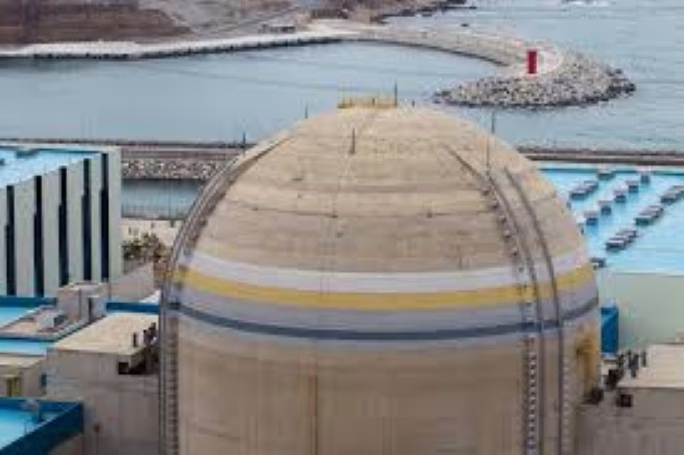
South Korea has moved forward with plans to expand its nuclear power generation capacity through the development of two additional large-scale reactors, as part of its long-term strategy to address rising electricity demand and energy security objectives. The proposal forms part of the country’s broader national power supply roadmap, which aims to balance industrial growth, decarbonization commitments, and grid reliability. The reactors are expected to support stable baseload generation while complementing renewable energy expansion and emerging hydrogen production initiatives.
Current Developments in the National Energy Expansion Plan
Recent policy updates indicate that the government continues to evaluate candidate sites and procurement frameworks for the two reactors. Authorities are aligning the project with long-term industrial electricity needs, including large AI data centers and hydrogen production clusters. As South Korea strengthens clean-energy infrastructure, the development also complements industrial initiatives such as the $6.3 billion Hyundai Motor Group Innovation Hub, which depends on reliable large-scale power supply to support robotics and hydrogen systems deployment.

South Korea to Build Two New Nuclear Reactors: Details on the Development
Under the plan, KHNP will begin bidding procedures to select host sites by 2027. This will advance the early preparatory phase of the project, including environmental reviews, community engagement and site evaluation. The ministry also aims for nuclear safety regulatory approval by around 2031. This will create the framework for construction to proceed toward the planned 2037-2038 completion window. Details on specific reactor models, generating capacity per unit and bid participants are expected to emerge as the siting and licensing process progresses.
The Changing Energy Landscape
Just like the world’s, South Korea’s energy landscape is changing in response to looming capacity pressures and decarbonization goals. There is also the need to meet demands of a growing industrial and digital sector.
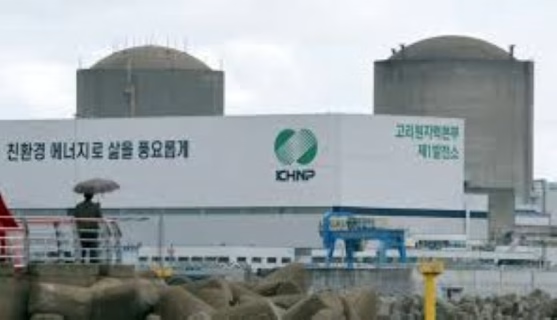
South Korea’s government forecasts electricity demand will rise significantly through the late 2030s. This will be mainly driven by economic growth, increased adoption of electric vehicles and data‑intensive technologies including AI. Nuclear power currently supplies about one‑third of South Korea’s electricity and is expected to increase its share in the national mix as part of the country’s carbon‑neutral strategy by 2038.
Additionally, the planned new reactors sit alongside other expansions in South Korea’s nuclear pipeline. This includes the ongoing construction at existing sites such as Shin Hanul and Saeul. These will also complement investments in small modular reactors (SMRs) anticipated later in the decade. Further regional investments in the nuclear sector are also taking shape east of South Korea, across the East Sea, in Japan. The island nation is building a new nuclear reactor at Mihama, Fukui Prefecture – marking one of the first concrete steps post-Fukushima in new build-outs.
What to Look Out For as South Korea Plans to Build Two New Nuclear Reactors
Despite the momentum set by the policy, obstacles remain. First off, permitting and siting decisions can be long-drawn-out. Second off, local community acceptance can also influence timelines. Not to mention, financing large nuclear builds requires favorable capital market conditions. Also important is the ever-changing policies on the energy sector could change the direction this whole plan follows. However, the current consensus within government and among a significant portion of public positions is that the new reactors are strategic to South Korea’s energy future.
Project Fact Sheet
- Project Name: South Korea Two New Nuclear Reactors Project
- Location: Republic of Korea (Site under evaluation)
- Project Owner: Korea Hydro & Nuclear Power
- Regulatory Authority: Ministry of Trade, Industry and Energy
- Technology Type: Large-scale pressurized water reactors
- Purpose: Baseload electricity generation
- Estimated Capacity: Expected multi-GW combined output
- Estimated Investment: Multi-billion USD (final cost pending approval)
- Current Stage: Planning and site selection
- Construction Start: Pending regulatory approvals
- Completion Date: Not yet announced
Project Team
Owner
- Korea Hydro & Nuclear Power – Overall project developer and operator
Government Sponsor
- Ministry of Trade, Industry and Energy – National energy policy oversight
- Engineering & Design
- KEPCO Engineering & Construction – Nuclear plant design and engineering
Major Equipment Supplier
- Doosan Enerbility – Reactor components and heavy equipment manufacturing
- Civil & EPC Contractor (Potential)
- Hyundai Engineering & Construction – Civil works and plant construction
Leave a Reply