
UMaine 3D printing for nuclear construction is helping accelerate Kairos Power’s Hermes low-power demonstration reactor in Oak Ridge, Tennessee. The University of Maine applies industrial-scale 3D printing and hybrid casting to build complex radiation-shielding walls, while its extreme-condition sensors support real-time monitoring and operational safety.
Project Context: Hermes Reactor
The Hermes reactor is located in Oak Ridge, Tennessee, on the site of the former East Tennessee Technology Park (ETTP), which was previously used for uranium enrichment. Hermes is a 35 MW thermal (MWth) low-power demonstration reactor designed to validate advances in nuclear technologies for safety, efficiency, and scalability. Construction began after the NRC granted permission in December 2023, with site work starting in May 2025. Hermes features on-site ETUs to prototype reactor components and coolant systems, including a molten salt production facility that is integral to the reactor operation. DOE’s Advanced Reactor Demonstration Program invests as much as $303 million in the project, demonstrating public-private commitment to advanced nuclear development.
It showcases fluoride salt coolant technology, high-temperature operation, and modular construction approaches. With certain details such as total project costs, full electrical output, and commercial-scale plans yet to be publicly disclosed, Hermes represents a first-of-its-kind milestone in U.S. advanced nuclear energy.
UMaine’s Contributions: 3D-Printed Formwork and Hybrid Casting
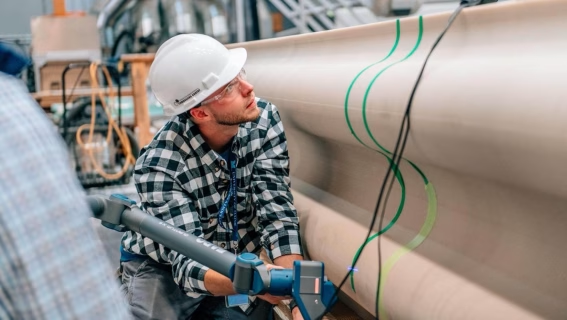
UMaine’s Advanced Structures and Composites Center (ASCC) designed and 3D-printed specialized sinusoidal form liners for Hermes’ massive radiation-shielding concrete walls, standing 27 feet tall and 3 feet thick. Using a hybrid casting approach—combining 3D-printed polymer liners with steel frameworks. UMaine enables precise, fast, and cost-efficient construction of complex structures that conventional methods struggle to produce.
ASCC operates one of the world’s largest polymer 3D printers and applies rigorous digital assurance and metrology to ensure every curve and angle meets nuclear-grade tolerances, dramatically accelerating construction timelines.
Sensor Development for Extreme Reactor Conditions
UM researchers are also currently developing microelectronic sensors capable of surviving extreme reactor environments, including temperatures up to 800°C and radiation levels. These sensors would provide real-time monitoring of reactor power, structural strain, and thermal conditions, enabling operational efficiency and safety. Funded in part by DOE, the work represents a critical technical gap for next-generation reactors like Hermes.
Collaboration, Workforce, and Broader Impact
UMaine’s participation comes under the SM²ART Moonshot Project, a collaborative effort of ORNL, DOE, and Kairos Power. The project serves as an example of how universities can connect research, industrial-scale manufacturing, and workforce development. Students, graduate researchers, and industry professionals all gain hands-on experience in advanced manufacturing and nuclear technologies. A new generation of talent will benefit the energy and defense sectors.
The approach UMaine pioneered-industrial-scale 3-D printing, hybrid casting, and extreme-condition sensor development. Not only accelerates Hermes construction but also establishes methods that might apply to future commercial reactors, defense infrastructure, and large-scale industrial projects.
Hermes low-power demonstration reactor is a precursor to the U.S. program for nuclear energy revival. This FHR-technology test bed, known as Hermes, features technologies expected to improve efficiency, enhance safety, and provide modular construction techniques that were not available with earlier reactors.
Funded by the U.S. Department of Energy and licensed by the Nuclear Regulatory Commission, construction milestones have already been started: foundation work and Engineering Test Units. When fully delivered, Hermes will be a crucial demonstration of advanced reactor technology. Providing operational data and construction experience that could speed up the deployment of future commercial reactors in the United States. By proving these next-generation systems in a controlled, low-power environment, the project helps position nuclear energy as a reliable, carbon-free option in the nation’s clean energy strategy.
Hermes Reactor Factsheet: UMaine 3D Printing for Nuclear Construction
Project: Hermes Low-Power Demonstration Reactor
Location: Oak Ridge, Tennessee, USA
Developer: Kairos Power
University Partner: University of Maine – Advanced Structures and Composites Center (ASCC)
DOE Support: Up to $303 million (Advanced Reactor Demonstration Program)
Overview of the reactor:
Type: Fluoride salt–cooled high-temperature reactor (FHR)
Thermal capacity: 35 MWth
Purpose: To demonstrate advanced nuclear technology, modular construction, and high-temperature safety systems
Construction & Milestones:
NRC construction permit: December 2023
Foundations & Engineering Test Units: 2024–2025
Reactor vessel installed: July 2025
UMaine Contributions:
3D-printed polymer form liners for 27-ft tall radiation shielding walls
Hybrid casting for precision and faster construction
Extreme-condition sensors for temperature, radiation, and structural monitoring
Workforce training for students and industry professionals
Significance:
Accelerates the safe and efficient construction of next-generation nuclear reactors.
Provides a model for university-industry collaboration.
Supports U.S. clean energy and advanced nuclear development.
Leave a Reply