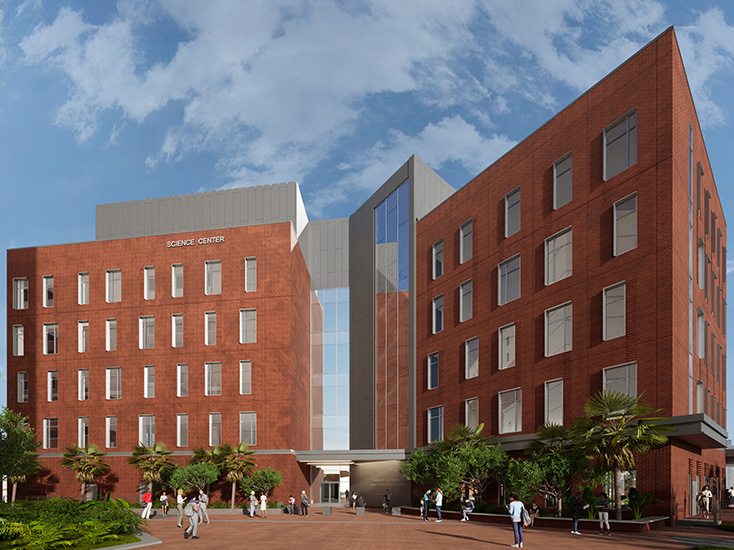
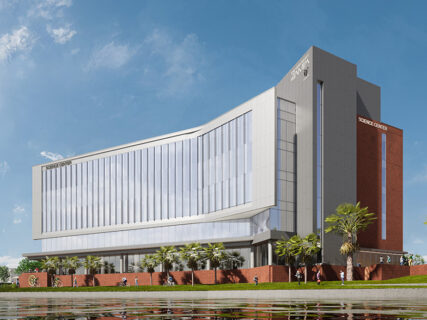
The University of Tampa is set to begin construction this spring on a new Science Center aimed at expanding the campus’s teaching and research facilities in the sciences. The five-story, 153,000-square-foot building will be located along the Hillsborough River on UTampa’s downtown campus and is expected to open in Spring 2029.
The new Science Center will consolidate the scattered science facilities on campus and serve as the main academic center for the College of Natural and Health Sciences. The new facility will house the biology, chemistry and biochemistry, forensic science, and marine science departments, among others. It will also serve as the academic center for allied health, computational science, environmental science, and other science-oriented disciplines.
Designed for Innovative Learning and Research
The new facility is designed to meet the needs of the future and to accommodate new and innovative learning concepts. It will feature 25 teaching labs, 23 research labs, microscopy and tissue culture labs, four aquarium research labs, and a bioinformatics classroom. It will also feature 73 faculty offices and outdoor spaces such as a riverside garden, an entrance plaza, and a northeast quadrangle.
University officials say this is the largest academic facility investment in the 94-year history of the university. The project is also partly funded by a generous donation from Dr. Stephen F. and Marsha Dickey, long-time supporters of UTampa. The project is in the hands of HDR Architects and is to meet the U.S. Green Building Council’s LEED standards.
University officials believe this new Science Center has great potential to provide an academic facility where students can learn in an interdisciplinary manner and acquire the skills necessary to pursue careers in healthcare, biotechnology, sustainability, and other emerging fields. A groundbreaking ceremony is to be held in the spring semester.
UTampa’s investment in a modern Science Center reflects a growing trend among U.S. liberal arts colleges to centralize science facilities and foster interdisciplinary research. Similar initiatives are underway at institutions like Colby College, which last December confirmed plans for a 200,000-square-foot science complex designed by Skidmore, Owings & Merrill, aimed at integrating multiple scientific disciplines under one roof and supporting applied research in areas such as biomedical and environmental engineering.
University of Tampa Science Center: Project Factsheet
Location: Hillsborough River, Downtown Tampa Campus
Size: 153,000 square feet, five stories
Timeline:
Groundbreaking: Spring 2025
Construction Start: Spring 2025
Opening: Spring 2029
Purpose: Central academic hub for the College of Natural and Health Sciences, consolidating science teaching and research spaces across campus
Academic Programs:
Biology
Chemistry and Biochemistry
Forensic Science
Marine Science
Allied Health
Computational Science
Environmental Science
Key Features:
25 teaching laboratories
23 research laboratories
4 aquarium research labs
3 microscopy rooms
2 tissue culture labs
Bioinformatics/computational sciences classroom
Advanced instrumentation laboratory
73 faculty offices
35-seat convertible classroom
Outdoor Spaces:
Riverside Garden (West Riverwalk)
Entrance Plaza (shared with Grand Center and Macdonald-Kelce Library)
Northeast Quadrangle (green space)
Design:
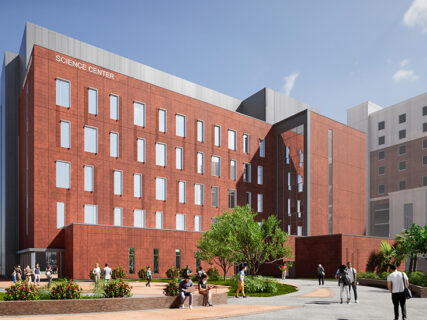
West side: Red brick complementing Plant Hall
East side: Glass and contemporary design with river/downtown views
LEED certification candidate
Architect: HDR Architects
Contractor: Barr and Barr
Major Donor: Dr. Stephen F. and Marsha Dickey Family
Significance: Largest academic facility investment in University’s 94-year history
Leave a Reply