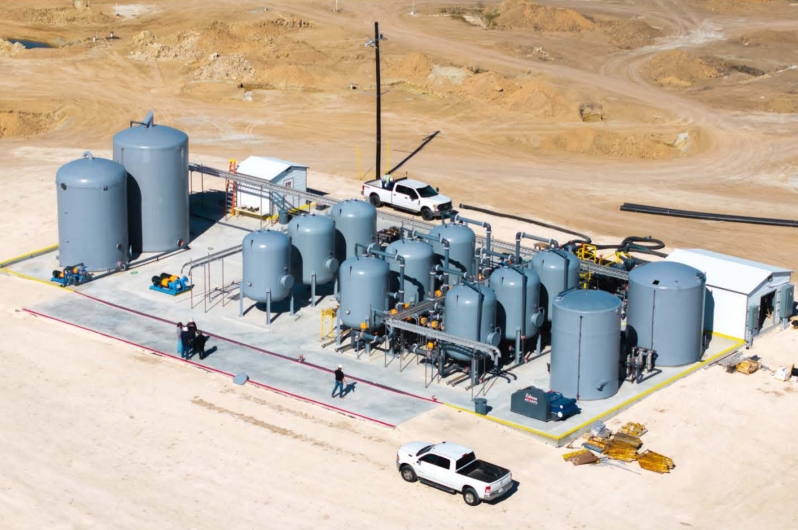
Dallas-based enCore Energy Corp. has completed phase one construction of Upper Spring Creek In-Situ Recovery (ISR) Uranium Project in South Texas, marking a major development in the company’s strategy to expand domestic uranium production capacity in the United States. The milestone includes completion of the initial section of the project’s Satellite Remote Ion Exchange (IX) Plant. It also features near-completion of the first production wellfield that will supply uranium-bearing solution to the facility. Production will start once final regulatory approvals are received. Operations are targeted for late 2026.
Upper Spring Creek Project is a wholly owned enCore Energy asset. It is part of the company’s broader South Texas Uranium Project network. The facility is designed to provide uranium-loaded resin feed to the company’s fully licensed Rosita Central Processing Plant (CPP), where uranium will ultimately be processed into yellowcake. According to enCore Executive Chairman William M. Sheriff, the construction milestone strengthens the company’s operational capabilities and advances its objective of becoming a leading supplier of domestically produced uranium for the growing U.S. nuclear energy sector.
Construction Progress at Upper Spring Creek Uranium Project Exceeds Initial Targets
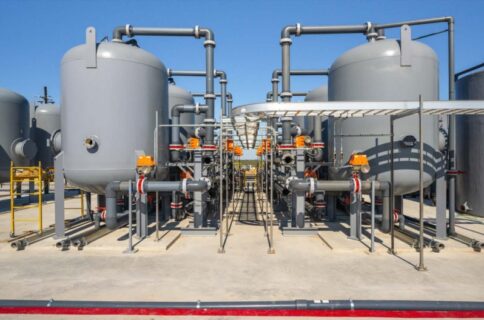
The newly completed phase at Upper Spring Creek Project represents the largest satellite facility ever constructed by enCore. The currently operational portion of the Satellite IX Plant can process approximately 1,600 gallons per minute (gpm). This is 50% of its planned capacity. Furthermore, expansion activities are underway. enCore plans to increase throughput to approximately 75% of total capacity by the end of June 2026 and achieve the full design capacity of 3,200 gpm by the end of July.
Development of the associated wellfield infrastructure is also progressing simultaneously. Drilling activities for the first 800-gpm production module have been completed. Additionally, installation of supporting infrastructure is nearing completion. Construction and drilling activities for three additional 800-gpm modules are also advancing, with Module 2 already approximately 90% complete. Once connected to the wellfields, the facility will begin extracting uranium from the project’s mineralized sandstone formations.
Additionally, the project’s progress follows a key regulatory milestone achieved in 2025 when the Texas Commission on Environmental Quality (TCEQ) approved the inclusion of Upper Spring Creek within enCore’s Radioactive Materials License. This allowed construction of the wellfields and Satellite IX Plant to start.
Importance to South Texas Uranium Operations
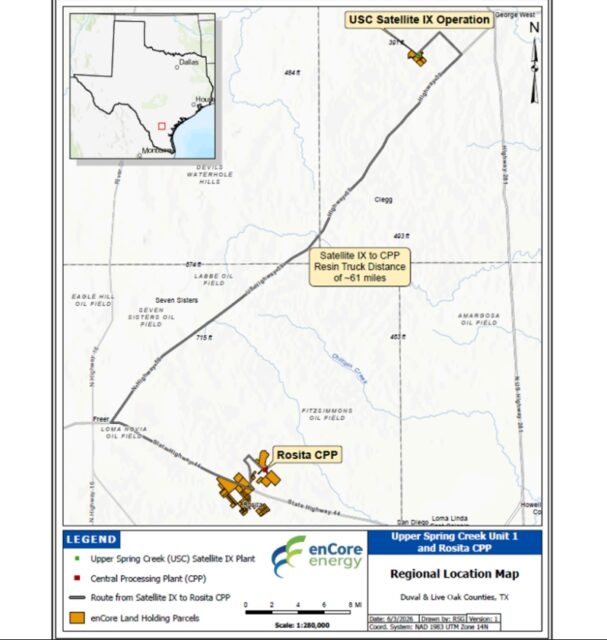
Upper Spring Creek is important to enCore’s South Texas production targets. Upper Spring Creek uses a satellite production model, compared to being a standalone processing facility. Here, uranium-bearing solution is processed through the IX Plant, loaded onto resin beads, and transported to the Rosita Central Processing Plant for final uranium recovery and yellowcake production. This approach reduces capital costs, enables modular expansion and allows the company to make use of existing licensed infrastructure.
Upper Spring Creek Project also lies within the historic Clay West uranium district. It targets uranium mineralization hosted within the Oakville Formation. The mineralized sands extend across a large portion of South Texas and occur at depths ranging from approximately 300 to 450 feet below surface. This makes them well suited for ISR extraction methods. ISR technology is also widely regarded as one of the most environmentally responsible and economically efficient approaches to uranium production. Reasons for this include minimized surface disturbance when compared to conventional mining methods.
Growing U.S. Uranium Production Platform
The Upper Spring Creek development comes as enCore continues to expand its domestic uranium portfolio amid increasing demand for nuclear fuel driven by energy security concerns. Data center growth, electrification and decarbonization initiatives are all part of this concern. The company reported extracting nearly 700,000 pounds of uranium during 2025 from its South Texas operations and ended the year with approximately US$96 million in liquidity. The company has also strengthened its balance sheet through recent warrant exercises that generated approximately US$18.1 million in additional capital for project development.
Alongside Upper Spring Creek, enCore is advancing several other ISR uranium projects across the U.S., including the Alta Mesa expansion in Texas, the Dewey-Burdock Project in South Dakota, and the Gas Hills Project in Wyoming. Other key uranium projects are also taking shape in the country, including the expansion of Centrus’ Ohio Uranium Enrichment Plant.
Project Outlook
With construction of the initial processing infrastructure complete and wellfield development nearing completion, Upper Spring Creek is transitioning from a construction project to an operational asset. The remaining key milestone is receipt of final regulatory approvals, after which uranium extraction can begin. Once fully commissioned, the facility is expected to become a significant source of uranium-loaded resin feed for the Rosita processing complex. It will also contribute to enCore’s goal of increasing domestic uranium supply to support the expanding U.S. nuclear power industry.
Upper Spring Creek ISR Uranium Project Fact Sheet
Location: South Texas
Owner/Developer: enCore Energy Corp.
Project Type: In-Situ Recovery (ISR) Uranium Production Facility
Current Status: First phase of construction completed; awaiting final permits before production
Processing Infrastructure: Satellite Remote Ion Exchange (IX) Plant
Current Processing Capacity: 1,600 gpm
Planned Full Capacity: 3,200 gpm
Associated Processing Facility: Rosita Central Processing Plant
Target Production Start: Late 2026 (subject to final approvals)
Resource Host Formation: Oakville Formation
Mining Method: In-Situ Recovery (ISR) Uranium Extraction
Regulator: Texas Commission on Environmental Quality (TCEQ)

Leave a Reply