
The U.S. has launched a joint initiative, Operation Windlord, between the Department of Energy (DOE) and the Department of War to deploy and test a transportable next-generation nuclear reactor designed for rapid relocation and military-grade energy resilience. The prototype reactor was recently airlifted from March Air Reserve Base, California, to Hill Air Force Base, Utah, marking the first operational logistics movement of the unit. Three C-17 aircraft carried eight modules forming the Ward 250 microreactor before ground transfer to the Utah San Rafael Energy Lab.
The system, designated Ward 250, is the face of a new class of compact nuclear microreactors aimed at powering remote installations and infrastructure and defense facilities independent of civilian grids.
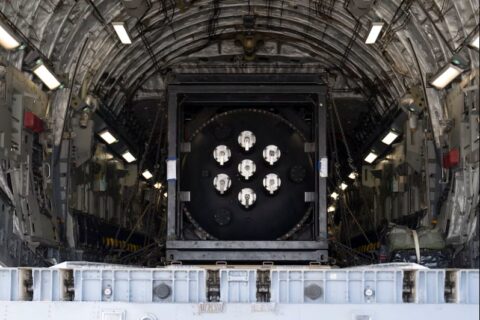
Technical Specifications for Operation Windlord Nuclear Reactor Development
- Program name: Ward 250/ Operation Windlord
- Capacity: 5 MW
- Estimated output: equivalent electricity for 5,000 homes
- Transport: C-17 Globemaster III aircraft
- Design type: compact modular reactor
- Intended use: mobile energy supply for bases and critical infrastructure
The defining engineering feature is the mobility which supposes that the reactor is small enough to be flown anywhere in the world within hours.
Testing and Deployment Timeline
- Feb 2026: Reactor transported by military aircraft for testing phase
- Next phase: Transfer to Utah San Rafael Energy Lab for evaluation and validation trials
- Post-testing: Potential deployment to military bases
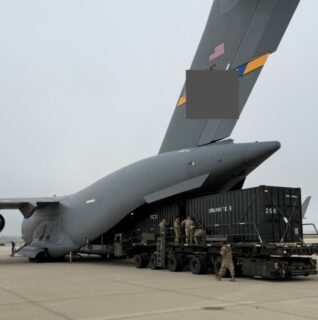
Strategic Objectives of the DOE and Dept of War’s Operation Windlord Nuclear Reactor Development
- The partnership is a show of President Trump’s federal push to accelerate nuclear restart in the U.S. and re-industrialize the sector. Energy Secretary Chris Wright also described the initiative as signaling the start of an “American nuclear renaissance,” emphasizing private-sector investment and technological advancement.
- Additionally, Operation Windlord also aligns with recent executive orders aimed at removing regulatory barriers that had slowed nuclear development in the U.S. The restart is also being witnessed in tradition nuclear builds like Project Matador in Texas that will be using Westinghouse AP1000 reactors.
Defense and Infrastructure Importance
According to U.S. Dept of War officials, future military operations will demand exponentially more energy due to:
- AI-driven computing systems
- Directed-energy weapons
- Space-based systems
- Cyber infrastructure
Officials also stated that energy independence is critical to reduce reliance on vulnerable civilian grids and fuel supply chains.
Project Team Behind DOE and Dept of War’s Operation Windlord Nuclear Reactor Development
- U.S. Department of Energy as technology developer and provider of nuclear oversight
- U.S. Department of War for logistics, deployment, defense applications
- Valor Atomics serving as a project developer
- March Air Reserve Base that is serving as the initial loading and transport
- Hill Air Force Base for transfer staging
- Utah San Rafael Energy Lab as the testing site
Project Outlook
The initiative by the U.S. Departments of War and Energy also highlights a structural shift in nuclear strategy. This features the diversification of large centralized plants with small modular and microreactor systems that can be deployed rapidly, scaled faster, and integrated with advanced technologies. The defense sector is also increasingly acting as a proving ground for these reactors. This is as they provide early funding and operational validation before commercial rollout.
If testing is successful, transportable microreactors could become a major growth segment in the nuclear market, particularly in the U.S. This will also greatly feature in remote mining, island grids, disaster response, and military installations. The strong federal backing may also hasten the deployment through regulatory approvals, effectively shortening commercialization timelines.

Project Pele: The Pentagon-led Transportable Microreactor Initiative
Project Pele, a separate Pentagon-led transportable microreactor project being developed at Idaho National Laboratory (INL), is focused on Generation IV-class reactor technology in the 1–5 MWe range. These are optimized for mobility, inherent safety, and fast deployment. Its demonstrations are also scheduled for this year.
The Pentagon originally funded multiple competing designs from industry developers before narrowing the field. In 2021, BWX Technologies and X-energy were selected to finalize prototype concepts, with BWXT ultimately chosen to construct the full-scale demonstration unit.
Additionally, testing is scheduled to occur at Idaho National Laboratory for up to three years following delivery, allowing federal agencies to validate performance, reliability, and operational resilience.
Parallel private-sector development in this sphere is also advancing. Reactor startup Valar Atomics has begun construction of its Ward 250 test reactor under the DOE’s Nuclear Reactor Pilot Program, marking one of the earliest commercial-aligned demonstrations in the microreactor category.
Cost and Financing of Project Pele
Project Pele’s prototype reactor is being built under a federal cost-type contract valued at up to approximately $300 million, awarded to BWXT by the DoD Strategic Capabilities Office.
Earlier program phases included about $39.7 million in combined design contracts awarded to competing developers during initial concept development.
Independent analyses also indicate that the total cost of delivering a first working prototype microreactor could reach several hundred million dollars. Additionally, deploying multiple operational units could ultimately cost billions.
Separately, private-sector reactor developers are also raising capital to support commercialization of the program. Valar Atomics secured about $130 million in funding to advance its Ward 250 reactor platform.
At the broader program level, the DOE has also committed substantial federal support to advanced nuclear innovation. This includes $800 million in cost-shared funding for selected small modular reactor developers.
Leave a Reply