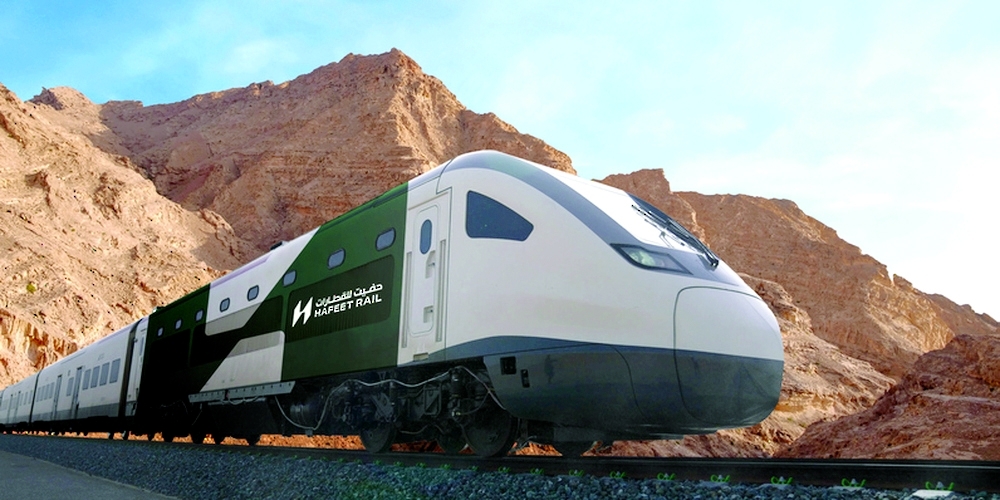
Hafeet Rail Oman UAE project continues to gain traction as authorities move forward with plans to enhance regional connectivity and economic integration. The $3 billion railway will link Oman and the United Arab Emirates, supporting trade and mobility. Moreover, the project aligns with broader infrastructure and urban development goals across both countries.
Hafeet Rail Oman UAE supports regional trade
The Hafeet Rail project will connect key industrial and commercial hubs between Oman and the UAE. Notably, the railway will link Sohar Port in Oman to the UAE national rail network. As a result, it will streamline cargo movement and reduce logistics costs.
Furthermore, the project will improve cross-border transport efficiency. It will also reduce reliance on road freight while enhancing supply chain resilience. Consequently, businesses will benefit from faster and more reliable trade routes.
In addition, the railway will facilitate passenger travel between the two countries. This development will support tourism and regional mobility. Therefore, the project delivers both economic and social benefits.
Hafeet Rail Oman UAE aligns with development strategy
The project reflects a shared commitment to infrastructure-led growth. Both Oman and the UAE continue to invest in transport systems that enable long-term economic expansion. Moreover, the railway complements industrial zones and logistics hubs in both countries.
Importantly, the project also supports urban development initiatives. For instance, large-scale real estate investments, including the $2 Billion Real Estate Deals at MIPIM 2026, rely on strong infrastructure networks. These agreements highlight Oman’s push to attract global capital into its property sector.
As a result, integrated transport systems such as Hafeet Rail play a critical role in supporting new urban communities. They also enhance accessibility and increase land value around development zones.
Infrastructure synergy with real estate growth
Oman continues to align infrastructure expansion with real estate development. The Hafeet Rail project strengthens this approach by connecting emerging urban centers. Additionally, it supports logistics corridors that attract industrial and commercial investments.
Meanwhile, recent announcements on Oman real estate deals at MIPIM 2026 reinforce this coordinated strategy. These agreements aim to accelerate urban transformation and diversify the economy. Therefore, infrastructure and real estate developments are progressing in tandem.
Current status of Hafeet Rail Oman UAE
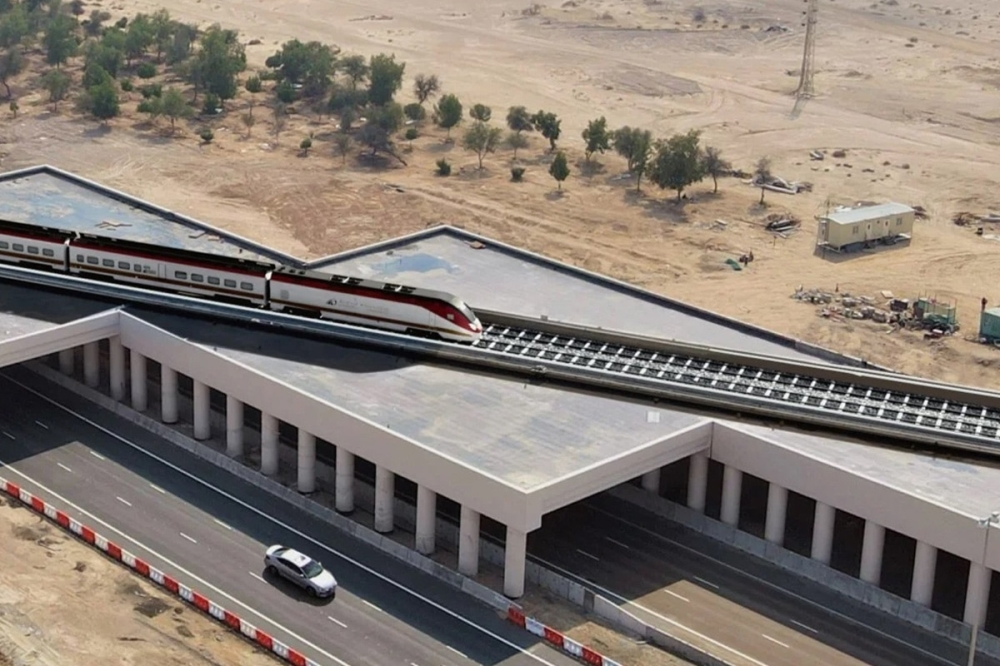
The Hafeet Rail Oman–UAE project is advancing steadily through its implementation phase, with overall construction more than halfway complete, and tunnelling works underway through the Al Hajar Mountains, as civil works progress on bridges, culverts, and access infrastructure.
Detailed designs have been completed, and track materials shipments are arriving at Sohar Port, paving the way for rail laying. The project is targeting initial freight testing and commissioning by early 2026, with phased operations expected to begin in 2026, including dedicated freight services.
Passenger operations are anticipated to follow thereafter, as systems integration, signalling, and safety testing are finalised. The railway is therefore moving from heavy construction toward operational readiness over the coming months.

Goals for the UAE, Oman Hafeet Rail System
Goals for Hafeet Rail line include enhancing cross-border connectivity and catalysing economic growth. Another major goal is job creation across diverse sectors in both countries. The project that connects the commercial ports to the rail network of both countries would make cross-border trade both efficient and easy.
The Hafeet Rail network will easily connect commercial ports to railway infrastructure. This will allow for cargo transportation, with a single goods train capable of hauling more than 15,000 metric tonnes of goods. This is equivalent to 270 conventional containers. The system is intended to have a favourable influence on the iron and steel, mining, and petrochemical industries. Agriculture and food are also included, as well as retail and e-commerce.
Furthermore, the passenger rail services will serve to connect population centres. This will foster social and familial cohesion while supporting the tourism sector. Travellers between the two countries enjoying an easy and smooth travel experience thanks to innovative solutions. The passenger train can reach speeds of up to 200kmph. It covers the distance between Sohar and Abu Dhabi in 100 minutes. Moreover, Sohar and Al Ain will only be 47 minutes away. The one train can accommodate up to 400 passengers.
Also Read: Construction Commences on the Mega $17 Billion Iron Ore Rail-and-Port Scheme in Guinea
Abdulrahman Al Hatmi, Chief Executive Officer of Asyad Group, highlighted the role of the project in reaffirming the strategic logistical hubs for import and distribution of good to regional and global markets in Oman and the UAE. This is in light of the current economic boom in the neighbouring countries and in the GCC. He also commended the strategic vision and economic foresight of Oman and the UAE. They are both aiming to foster an integrated transportation ecosystem that will reshape the logistics landscape in the region.
Origin of the Hafeet Rail name
The name of the system is drawn from Jebel Hafeet, a region that stretches between the Sultanate of Oman and the UAE. The region holds strategic significance and historical importance for both countries. It serves as a link between the two neighbours through its rugged terrain. Mountains, deserts, and unique limestone formations are all features of the region. It rises1,249 metres above sea level. Furthermore, the numerous picturesque natural landmarks have long captivated citizens and tourists alike from across the globe.
The President of Oman Investment Authority, Abdulsalam bin Mohammed stated that the joint railway network is a significant addition to the logistics sector. It will play a role in stimulating various industrial sectors and economic activities. The network also increases commercial and investment opportunities for the private sector and supports the integration of Omani port activities and linking them to regional and international markets. All this is in addition to its contribution to attracting national and foreign investments.
Project Fact Sheet
Project name: Hafeet Rail Oman–UAE Railway
Location: Oman–UAE cross‑border corridor (Sohar to UAE national rail network)
Route length: Approximately 238 km
Project value: Sector‑wide funding in the multi‑billion‑dirham class (UAE‑Oman contributions)
Sector: Transport infrastructure — rail (freight and passenger)
Scope: Cross‑border rail line supporting freight and eventual passenger traffic
Key features:
- Over 2,500 m of tunnels
- 36 viaducts, 21 over‑bridges, 39 underpasses
- 881 culverts
- European Train Control System signalling
- Rail speeds up to 200 km/h passenger, 120 km/h freight
Status: Construction in active phase; civil works and tunnelling ongoing; track shipments arriving; nearing mid‑to‑late construction stage
Expected operational timeline:
- Freight testing & commissioning: Early 2026 (initial freight operations)
- Phased freight service launch: 2026–2027
- Passenger services roll‑out: Following freight launch once safety and systems testing are complete
Project Team
Owner / Client: Hafeet Rail (joint venture)
Primary Stakeholders:
- Etihad Rail
- Asyad Group (Oman)
- Mubadala Investment Company (UAE)
Investors and financing:
- Government‑backed funds from Oman and UAE partners
- Equity support via Mubadala and Asyad strategic capital
Development Partners / Delivery Bodies:
- Hafeet Rail operating entity
- UAE and Oman transport authorities
Key Contractors (Civil Works):
- National Projects Construction (UAE)
- National Infrastructure Construction Company (UAE)
- Tristar Engineering & Construction (UAE)
- Galfar Engineering & Contracting
Major Suppliers:
- ArcelorMittal Rails and Special Sections — supplying rail tracks and structural steel for network deployment
Consultants / Advisors (typical roles):
- Railway systems design and signalling consultants
- Environmental and safety compliance advisors
- Logistics and operations specialists