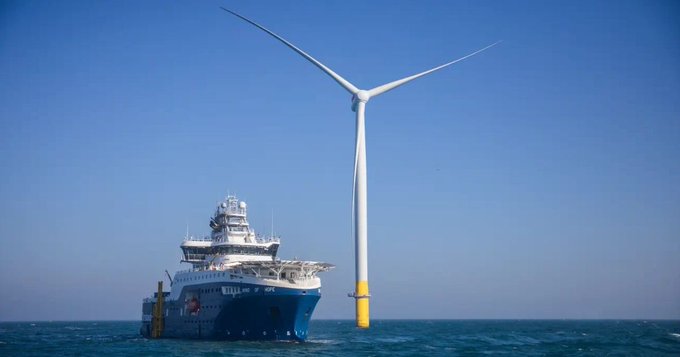
The Arcadis Ost 1 offshore wind farm is a 257 MW renewable energy project located in the German Baltic Sea, northeast of the island of Rügen, developed by Belgian company Parkwind in partnership with PMV and OstseeWindEnergie GmbH. Comprising 27 Vestas V174-9.5 MW turbines — the world’s first commercial deployment of that turbine model — the project pioneered a revolutionary floating Rotor Nacelle Assembly (RNA) installation method using semi-submersible crane vessels rather than traditional jack-up rigs, eliminating any seabed interaction during installation. The wind farm produced its first power and began feeding into the German grid in January 2023, and the project was officially inaugurated on December 5, 2023, supplying its full capacity to the German electricity transmission system and providing enough renewable energy to power the equivalent of 290,000 households. That offshore momentum is being matched onshore, where developers like Energiequelle GmbH have recently broken ground on projects such as the Lüben Wind Farm in Lower Saxony — five Enercon turbines rising to 160 metres and targeted to supply around 22,000 local households by 2027, illustrating how Germany’s wind buildout is advancing simultaneously across both offshore and onshore fronts.
Project Overview
Type: Offshore wind farm
Location: German Baltic Sea, northeast of the island of Rügen, Mecklenburg-Western Pomerania
Total capacity: 257 MW
Number of turbines: 27 × Vestas V174-9.5 MW (world’s first commercial deployment of this turbine model)
Rotor diameter: 174 metres
Foundation type: Monopile; floating RNA installation method (no jack-up vessels used)
Foundation installation began: Early summer 2022; first power to grid: Mid-January 2023
Final (27th) turbine installed: November 2023
Official inauguration: December 5, 2023
Households powered: Equivalent of ~290,000 German homes
Grid connection: Via 50Hertz’s Ostwind 1 system, with submarine and onshore cable running to the Lubmin substation
Notable: First offshore wind farm built in the German Baltic Sea in three years; first commercial use of floating RNA installation method; first time Heerema’s Thialf SSCV entered the Baltic Sea
Project Team
Developer/Owner: Parkwind (Belgian; now part of CS Wind Group as of December 2023)
Co-investors: PMV; OstseeWindEnergie GmbH (consortium of Oberhessische Versorgungsbetriebe AG, Stadtwerke Bad Vilbel, WV Energie AG)
Parkwind Co-CEO: Eric Antoons
Turbine supplier: Vestas (V174-9.5 MW)
Installation contractor: Heerema Marine Contractors (crane vessel: Thialf — world’s second-largest SSCV)
Heerema CTO: Ramon de Haas
Grid/Transmission operator: 50Hertz (offshore platform co-constructed with Parkwind)
Installation method innovation: Floating RNA lift — jointly developed by Parkwind, Heerema Marine Contractors, and Vestas; first tested on Heerema’s Sleipnir vessel in the Dutch North Sea
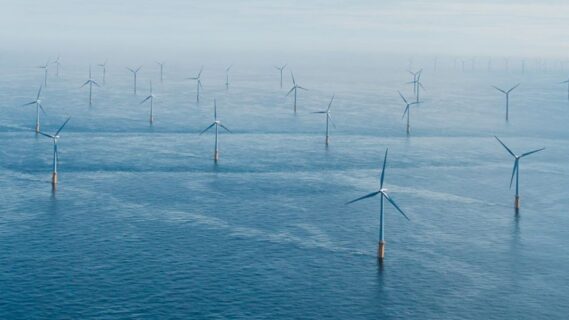
Published 6th December 2022: The first of 27 Vestas V174-9.5 MW wind turbines to be installed at the Arcadis Ost 1 offshore wind farm in the Baltic Sea is now done. Parkwind, a Belgian developer, developed and owns the offshore wind farm, which is its first project in Germany.
The 257 MW Arcadis Ost 1 has now also marked a few other ‘firsts’. It has become the first 9.5 MW Vestas turbine with a 174-meter rotor to be installed on a commercial project. It is also the first time Heerema Marine Contractors’ Thialf entered the Baltic Sea. Furthermore, it is the first time a wind turbine was installed using a novel floating installation method.
Vestas currently has two European projects in the works that will use the V174-9.5 MW technology,. These include Arcadis Ost 1 and the Baltic Eagle offshore wind farm. Both of them will be located in the German Baltic Sea.
The novel floating installation method at Arcadis Ost 1 begins with simultaneous assembly and lifting operations. It was first tested in the Dutch North Sea last year onboard Heerema’s crane vessel Sleipnir.
Read Also: First phase of sea cable installation completes in Netherlands
Vestas V174-9.5 MW wind turbines installation at Arcadis Ost 1
One of Thialf’s two main cranes lifts the pre-assembled wind turbine tower onto the foundation, while the second main crane is used to pre-assemble the wind turbine at the same time.
Heerema developed a method for wind turbine pre-assembly. Here, the Rotor Nacelle Assembly (RNA) lift takes place on a “support” tower on board the crane vessel. According to the developer, the support tower provides a stable platform for the fast and secure assembly of the nacelle and blades.
Once pre-assembled, the entire RNA is lifted in one piece onto the wind turbine tower. According to Parkwind, the reduced number of lifts between the vessel and the structure eliminates key risks associated with the floating installation. By developing new tools, Vestas has delivered RNA lift-feasible components to support the offshore floating installation at Arcadis Ost 1.
According to Parkwind, this method has two main advantages. These include zero seabed interaction. Thus, it is especially important in areas with significant water depth or difficult soil conditions. The other advantage is a shorter installation cycle.
Thialf, the world’s second-largest semi-submersible crane vessel (SSCV), recently made its first entrance into the Baltic Sea for wind turbine installation work, requiring modifications to the vessel’s A-frames to allow passage under the Storebaelt Bridge, known as the “gate to the Baltic Sea.”
Leave a Reply