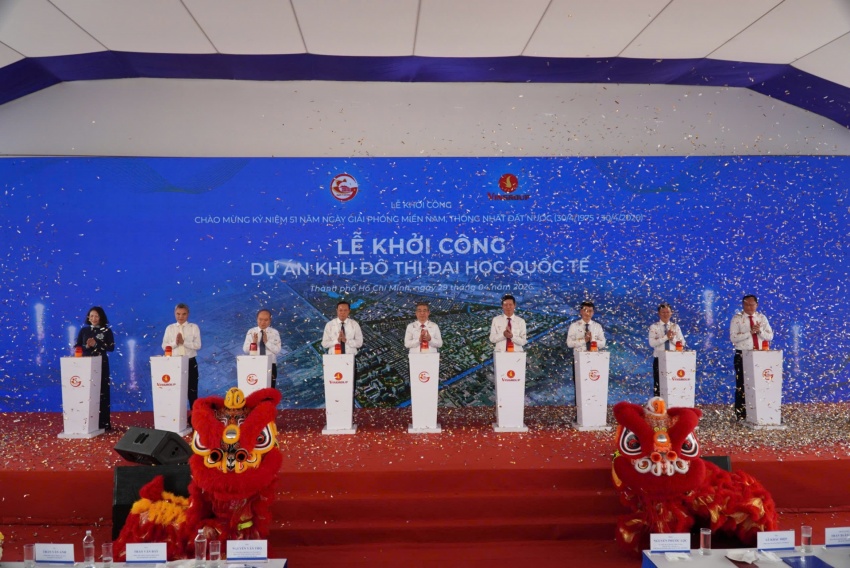
Vingroup, one of Vietnam’s largest conglomerates, broke ground on April 29, 2026, on the 880-hectare International University Urban Area in Xuan Thoi Son commune, in the northwestern part of Ho Chi Minh City, representing a total investment of approximately VND 59 trillion, equivalent to nearly $2.27 billion. The development is a joint initiative between Vingroup and its listed real estate subsidiary Vinhomes, and is conceived as an integrated urban model combining education, research, innovation and residential living, with the stated ambition of becoming a leading regional knowledge hub. The project is naturally bounded by four canal systems — An Ha Canal, Tay Ninh Boundary Canal, Canal No. 8 and Thay Cai Canal — which define its ecological edges and inform its open space strategy. Of the 880-hectare total, approximately 117 hectares are allocated for green space and water surfaces, 436 hectares for residential use, and more than 183 hectares specifically earmarked for education, training and research facilities. The development is designed to accommodate a combined population and student body of nearly 200,000 people at full build-out. Infrastructure connectivity is provided via National Highway No. 22, Ring Road 3 and the Ho Chi Minh City-Moc Bai Expressway, with further transit integration anticipated once Metro Lines 2 and 3 are extended to connect with the site. The project is aligned with Vietnam’s Resolution No. 57-NQ/TW, which identifies science, technology, innovation and digital transformation as core economic growth drivers, and with Ho Chi Minh City’s target for the digital economy to represent approximately 30 per cent of GRDP by 2026.
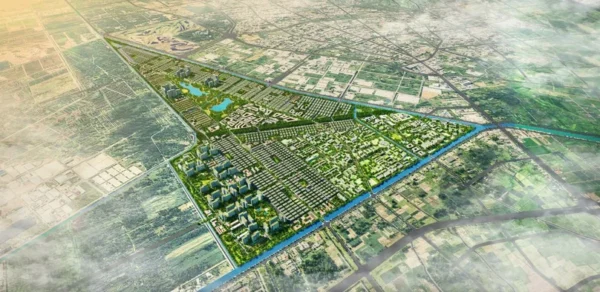
The International University Urban Area is arriving at a moment when Vietnam’s university city model is being tested across multiple fronts simultaneously. The Berjaya Vietnam International University Town in Hoc Mon district, Ho Chi Minh City, spent close to fifteen years in stagnation before finally moving toward construction commencement in 2024, a history that illustrates the structural difficulty of delivering large-scale, education-anchored urban development in Vietnam’s regulatory and land clearance environment. What distinguishes Vingroup’s project from prior attempts is the developer’s track record of completing large-scale integrated communities under the Vinhomes brand at speed. Vinhomes Smart City in Hanoi, Vinhomes Grand Park in Ho Chi Minh City and Vinhomes Ocean Park all demonstrate the conglomerate’s capacity to mobilise construction across multi-hundred-hectare sites with genuine pace, and the institutional confidence that comes from that track record is part of what has allowed the International University Urban Area to attract municipal political support. The education-led urban development model itself is gaining traction across Southeast Asia: Malaysia’s Educity in Iskandar Malaysia, Singapore’s one-north biopolis cluster and Thailand’s EECi Eastern Economic Corridor of Innovation have each demonstrated that anchoring a mixed-use urban district around knowledge institutions can generate a self-reinforcing demand loop for residential, retail and commercial space.
This broader momentum in Vietnam’s large-scale development pipeline is also reflected in industrial expansion projects, including THACO’s US$1.4 billion industrial park development, highlighting how the country is simultaneously pushing growth through both knowledge-driven urban districts and manufacturing-led investment zones. Vietnam’s challenge has historically been on the supply side of this equation, specifically in attracting and retaining anchor academic institutions with genuine international standing. If the International University Urban Area can solve that piece, the residential and commercial absorption will follow almost automatically given the northwest corridor’s growth trajectory and the project’s direct highway and future metro connectivity.
Land Programme, Education Allocation and Infrastructure Integration
- Total site area: 880 hectares, Xuan Thoi Son commune, Hoc Mon district, northwestern Ho Chi Minh City
- Site boundary: An Ha Canal (north), Tay Ninh Boundary Canal (west), Canal No. 8, Thay Cai Canal (east/south)
- Total investment: approximately VND 59 trillion ($2.27 billion)
- Land use allocation:
- Green space and water surfaces: approximately 117 hectares
- Residential use: 436 hectares
- Education, training and research facilities: more than 183 hectares
- Total planned population and student community: nearly 200,000 people
- Road connectivity: National Highway No. 22, Ring Road 3, Ho Chi Minh City-Moc Bai Expressway (all direct access)
- Future transit: Metro Lines 2 and 3 to be extended to connect to the project, significantly increasing transit-oriented catchment
- Urban model: integrated education, research, innovation and ecological residential precinct
- Policy alignment: Vietnam’s Resolution No. 57-NQ/TW on science, technology, innovation and digital transformation; Ho Chi Minh City 1/2,000-scale approved zoning plan for the International University Urban Area
Project Fact Sheet
- Project Name: International University Urban Area (Khu Đô Thị Đại Học Quốc Tế)
- Developer: Vingroup Joint Stock Company and Vinhomes Joint Stock Company
- Location: Xuan Thoi Son Commune, Hoc Mon District, Ho Chi Minh City, Vietnam
- Groundbreaking Date: April 29, 2026
- Total Investment: approximately VND 59 trillion (~$2.27 billion)
- Total Site Area: 880 hectares
- Education and Research Land Allocation: more than 183 hectares
- Residential Land Allocation: 436 hectares
- Green Space and Water Surfaces: approximately 117 hectares
- Planned Population: nearly 200,000 people (residents and students combined)
- Project Type: Integrated university urban area — education, research, innovation and residential mixed-use
- Road Connectivity: National Highway No. 22; Ring Road 3; Ho Chi Minh City-Moc Bai Expressway
- Future Metro Access: Metro Lines 2 and 3 (planned connection)
- Zoning Status: 1/2,000-scale zoning plan approved by Ho Chi Minh City People’s Committee
- Policy Framework: Vietnam Resolution No. 57-NQ/TW; Ho Chi Minh City digital economy and GRDP targets
- Comparable Precedent: Berjaya Vietnam International University Town, Hoc Mon (previously stalled; moving toward construction from 2024)
Project Team
- Developer (Parent Conglomerate): Vingroup Joint Stock Company — one of Vietnam’s largest private conglomerates with diversified interests across real estate, technology, retail, healthcare and automotive (VinFast); listed on the Ho Chi Minh Stock Exchange (HoSE: VIC)
- Developer (Real Estate Arm): Vinhomes Joint Stock Company — Vingroup’s listed real estate subsidiary and Vietnam’s largest residential developer by scale, with completed mega-projects including Vinhomes Smart City (Hanoi), Vinhomes Grand Park and Vinhomes Ocean Park; listed on HoSE (VHM)
- Vice Chairman, Vingroup: Le Khac Hiep — represented Vingroup at the groundbreaking ceremony and articulated the project’s vision as a new landmark integrating ecological living with a global knowledge ecosystem aligned with Resolution 57
- Government Representative: Tran Van Bay, Vice Chairman of Ho Chi Minh City People’s Committee — presided over the groundbreaking ceremony; reaffirmed municipal government support and committed relevant authorities to work with the developer to resolve any implementation obstacles
- Policy Framework Authority: Ho Chi Minh City People’s Committee — approved the 1/2,000-scale zoning plan for the International University Urban Area and integrated the project into the city’s northwest urban development and knowledge economy strategy

Leave a Reply