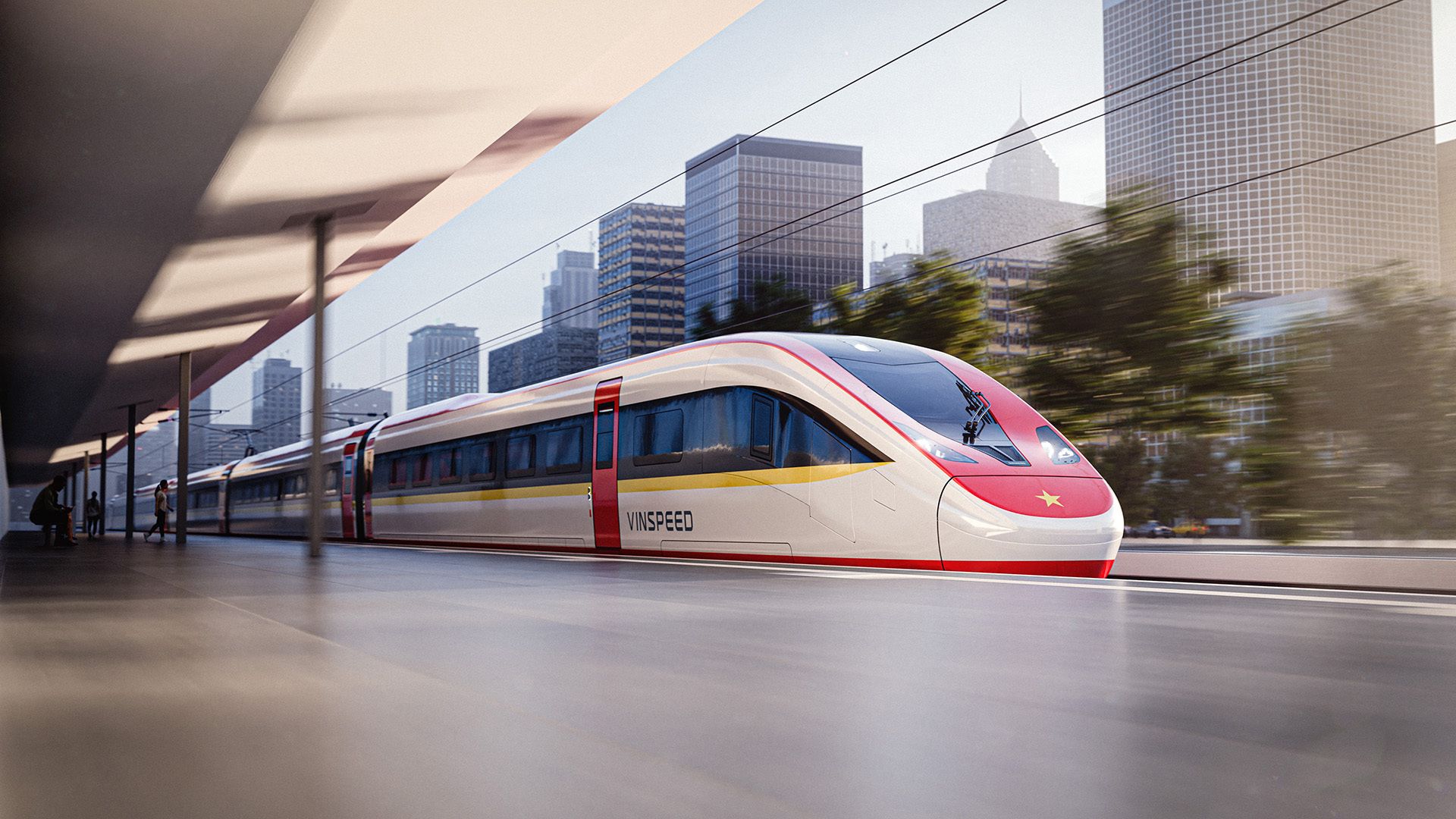
Vietnam’s Prime Minister Le Minh Hung and other government representatives, local officials, and business leaders attended the groundbreaking ceremony of the Hanoi–Quang Ninh High-Speed Railway on April 12. The high speed rail is designed for a maximum speed of 350 km/h. Additionally, the high-speed railway is expected to cut travel time between Hanoi and Quang Ninh to approximately 23 minutes. This is a significant reduction of five to seven times compared to current travel options.
Furthermore, the railway is being invested by VinSpeed High-Speed Railway Investment and Development under Vingroup. Its total investment is approximately VND147 trillion (over $5.6 billion). Also, land clearance costs, estimated at VND10.27 trillion ($396 million), will come from the state budget.
Features
The 120.2 km high-speed rail line spans Hanoi, Bac Ninh, Haiphong, and Quang Ninh. It consists of a double-track system with a 1,435 mm gauge and will be fully electrified. It will boast a maximum speed of 350 km/h, except for the section through Hanoi where speeds will be limited to 120 km/h.

Additionally, the project will utilise modern high-speed trains with signalling and equipment systems supplied by Siemens Mobility. Technology will be gradually transferred to VinSpeed during operation.
Route and Stations
The high-speed rail line will start at Co Loa station near Hanoi’s Vietnam Exhibition Centre and end at Halong station in Quang Ninh. Also, it will pass through three transfer stations namely: Gia Binh (Bac Ninh), Ninh Xa (Haiphong), and Yen Tu (Quang Ninh). It will also have a depot located at Halong station.
Bui Van Khang, Chairman of Quang Ninh People’s Committee, described the railway as a strategic infrastructure project connecting the four provinces and cities.
“This project holds special significance, contributing to the concretisation of the Central Party Committee’s action programme implementing the Resolution of the 14th National Party Congress,” he said. “It also aligns with Resolution No.30 of the Politburo on socioeconomic development and ensuring national defence and security in the Red River Delta region.”
This project holds special significance, contributing to the concretisation of the Central Party Committee’s action programme implementing the Resolution of the 14th National Party Congress,” he said. “It also aligns with Resolution No.30 of the Politburo on socioeconomic development and ensuring national defence and security in the Red River Delta region.”
Additionally, Khang sated that the initiative represents a breakthrough in modern transportation infrastructure. Also, he highlighted that it would boost regional and inter-regional connectivity. This is especially for the Northern key economic region and the Red River Delta. “The route forms a high-speed connecting axis, shortening travel time, enhancing connectivity, and spreading development,” he said.
Significance of the Project
The high-speed rail project is expected to reshape the development landscape. This will be achieved by creating conditions for provinces and cities to leverage their comparative advantages. This will form economic corridors and value chains that connect regions while enhancing competitiveness and international integration. Also, it boosts Vietnam’s transport infrastructure alongside the North-South Expressway in enabling connectivity in the country.
The Hanoi-Quang Ninh line is the second railway venture being implemented by VinSpeed. In December, the company broke ground on the Ben Thanh-Can Gio railway line in Ho Chi Minh City. This is scheduled for completion in the fourth quarter of 2028
Hanoi–Quang Ninh High-Speed Railway Project Factsheet
Total Length: 120.2 km
Design Speed: 350 km/h (Max); 120 km/h in Hanoi urban section
Travel Time: 23 minutes (Reduced from over 2 hours by road)
Total Investment: VND 147 trillion ($5.6 billion USD)
Funding Model: Public–Private Partnership (PPP)
Technical Standard: Double-track, 1,435 mm standard gauge, fully electrified
Key Partners: Siemens Mobility (Signaling, rolling stock, and tech transfer)
Project Developer: VinSpeed (Vingroup)
Groundbreaking: April 12, 2026
Expected Completion: Late 2028



Leave a Reply