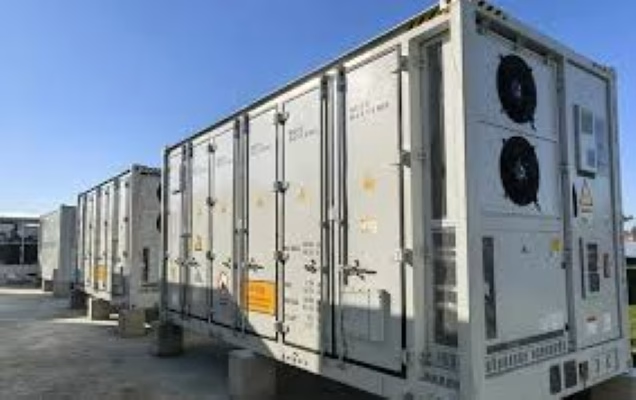
Waaree Energy Storage Solutions (WESSPL) has raised ₹1,003 crore in capital to build a 20 GWh lithium-ion cell and battery pack manufacturing plant in India. This development makes Waaree one of the most vertically integrated energy storage players in India. The capital raise supports the broader ₹10,000 crore capex plan aimed at localizing battery supply for grid-scale storage, electric vehicles and distributed energy applications in India.
Latest Details on Waaree Battery Manufacturing Plant in India
The capital raise was completed by Waaree Energy Storage Solutions, a subsidiary of Waaree Energies Ltd. This was with participation from investors, family offices and institutional backers. The project forms part of Waaree’s long-term plan to build a domestic battery ecosystem alongside its established solar module manufacturing facility in Gujarat. Additionally, while the company has not disclosed a final site location or commissioning date, management has confirmed the facility will be developed in phases as market demand scales. Scaling of the latter also continues to pick pace as India-based ChemVolt signs MoU to build its 5 GWh lithium-ion manufacturing gigafactory in Andhra Pradesh.
Project Factsheet
Developer: Waaree Energy Storage Solutions
Project: Lithium-ion cell and battery pack manufacturing facility
Planned Capacity: 20 GWh
Capital Raised: ₹1,003 crore
Total Planned Capex: ₹10,000 crore
Target Markets: Utility-scale BESS, EVs, and commercial and industrial customers.
Status: Capital secured. Project development and site planning underway.
Outlook on Waaree Lithium-Ion Battery Manufacturing Plant in India
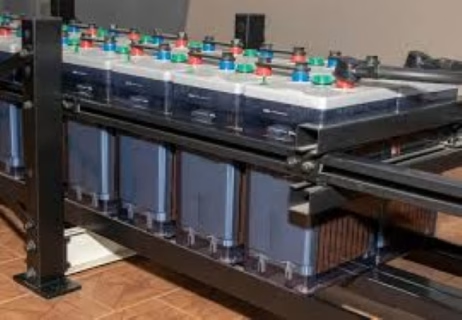
The success of Waaree’s lithium-ion battery manufacturing facility hinges on technology use and yield outlook. Cost competitiveness against established Asian cell manufacturers is also at play. However, with storage demand forecast to grow rapidly through the late 2020s and policy support increasingly aligned with domestic manufacturing, the long-term strategy appears feasible. If delivered on schedule and scaled to 20 GWh efficiently, the plant could become a key manufacturing asset in India’s storage value chain.
Industry data also shows BESS tender volumes expanding rapidly. This is driven by renewable generation requirements, peak-shaving mandates and transmission-constrained regions. A 20 GWh domestic facility in India would reduce import dependence and improve delivery timelines for developers. The plant will also support India’s renewable energy industrial policy. For Waaree, the capital raise allows for a bundled renewable offering. This spans solar modules, inverters, and now, batteries. A move that positions Waaree to compete not just on price, but also on supply certainty.
Leave a Reply