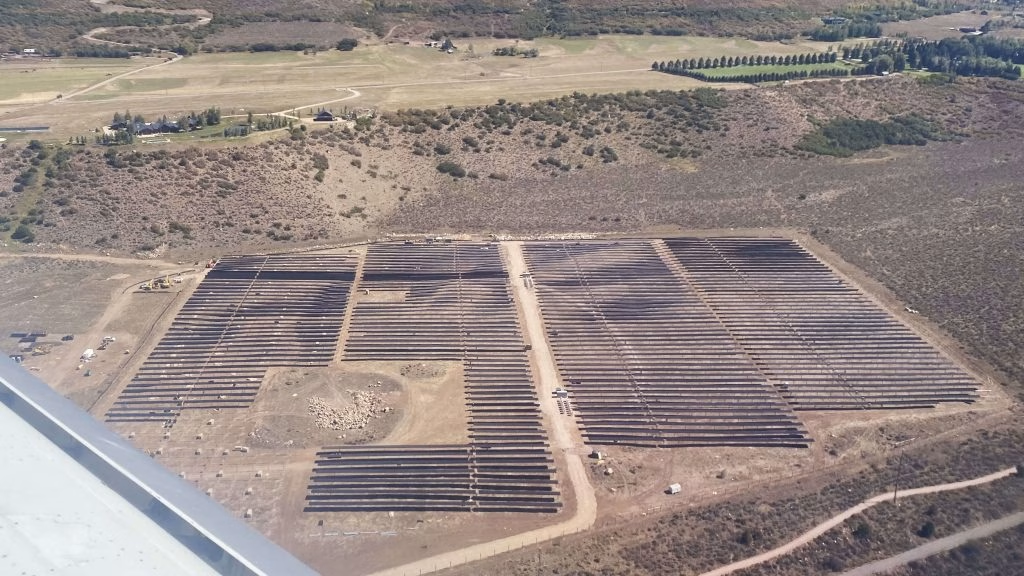
Washington Governor Bob Ferguson has officially approved the Carriger Solar project, a significant renewable energy development located in Klickitat County, just west of Goldendale. The decision, announced on Thursday, marks the first utility-scale energy facility authorized by Ferguson since he assumed office in January. Developed by Cypress Creek Renewables, the project will feature a 160-megawatt solar generation facility paired with a 63-megawatt battery energy storage system.
This approval comes after a prolonged review process that saw the Governor initially remand the proposal back to the Energy Facility Site Evaluation Council (EFSEC) in August, urging further consultation with the Yakama Nation regarding the protection of cultural resources. The final green light signals the state’s continued commitment to expanding its clean energy infrastructure while attempting to navigate complex land-use conflicts in rural Washington.
Balancing Energy Goals with Cultural Preservation
The approval process for Carriger Solar was defined by a delicate negotiation between state energy targets and tribal sovereignty. The Yakama Nation had vigorously opposed the project, citing potential disruptions to “Traditional Cultural Properties” and crucial hunting grounds within the 2,108-acre development site. In response to the Governor’s August directive for improved engagement, the final site certification agreement includes reinforced mitigation measures.
Cypress Creek Renewables is now required to provide a $100,000 grant to the Yakama Nation’s Cultural Resources Program to fund the documentation of archaeological history in the project’s vicinity. Furthermore, the site layout has been adjusted to include setbacks and visual screening, such as earthen berms and native vegetation. This will minimize the industrial footprint on the landscape, though tribal leaders maintain that the protections remain insufficient.
Carriger Solar Project: Factsheet
Location: Klickitat County, WA (approx. 2 miles west of Goldendale)
Developer: Cypress Creek Renewables
Approval Date: December 4, 2025
Authority: Governor Bob Ferguson / EFSEC
Total Capacity: 160 MW Solar + 63 MW Battery Storage (BESS)
Site Area: 1,326 acres (within a 2,108-acre lease boundary)
Homes Powered: ~32,500 annually
Key Deadlines: Construction start by July 4, 2026 (Federal Tax Credit cutoff)
Mitigation Measures:
$100,000 grant to Yakama Nation Cultural Resources Program.
Visual screening (berms/vegetation) along state-owned parcels.
Setbacks to protect Traditional Cultural Properties.
Strategic Impact:
First major energy approval under Gov. Ferguson.
Contributes to WA Clean Energy Transformation Act targets.
Connects to Bonneville Power Administration (BPA) grid.
Leveraging Federal Incentives for Local Impact
Economic feasibility played a pivotal role in the timing of this approval. Governor Ferguson emphasized the urgency of the project schedule, noting that construction must commence by July 4, 2026. In doing so, it will qualify for critical federal clean energy tax credits. These credits are essential not only for the project’s financial viability but also for keeping the resulting electricity rates affordable for Washington consumers.
Once operational, Carriger Solar will generate enough carbon-free electricity to power approximately 32,500 homes. Further, contributing significantly to the state’s statutory greenhouse gas reduction targets. Additionally, the construction phase will inject millions into the local economy through property tax revenues and the creation of hundreds of temporary construction jobs, providing a much-needed economic boost to the rural Goldendale community.
Navigating the “Siting Bottleneck” in Washington
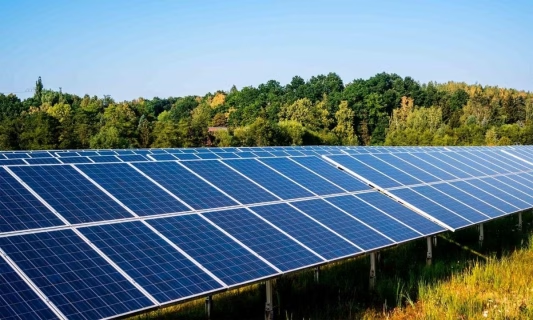
The approval of Carriger Solar highlights a broader trend in the Pacific Northwest’s energy transition: the increasing friction between renewable development and local conservation values. While Washington is a national leader in climate policy—momentum sustained as the 260 MW Royal Slope Energy Center secures a 20-year PPA with Grant County, Washington—it has struggled to deploy renewable infrastructure at the pace required to meet its Clean Energy Transformation Act goals. Carriger Solar sits at the heart of this “siting bottleneck,” where high-voltage transmission access attracts developers to agricultural lands that are culturally significant to Indigenous communities.
By successfully permitting this facility, the state is attempting to set a precedent for how future projects can proceed by incorporating tangible financial and physical mitigations for tribal stakeholders. As Cypress Creek prepares to break ground, the project will likely serve as a case study for the gigawatts of solar capacity still in the state’s permitting queue, balancing the urgent need for electrons with the permanent alteration of the rural landscape.
Leave a Reply