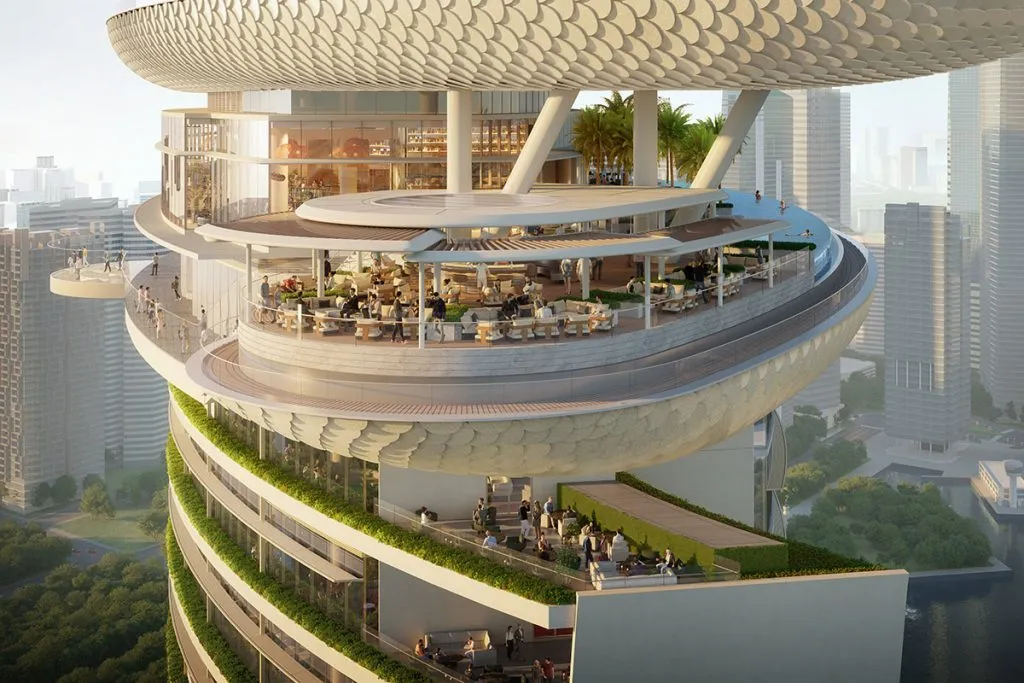
Las Vegas Sands has awarded a multi-billion-dollar construction contract to Woh Hup Private Limited — one of Singapore’s largest and most respected privately owned construction and civil engineering companies — for the main works on the Marina Bay Sands IR2 expansion, the US$8 billion (S$10.2 billion) luxury resort and entertainment complex being developed adjacent to the iconic existing Marina Bay Sands (MBS) integrated resort. The announcement, made on 20 March 2026, comes nine months after the groundbreaking ceremony of 15 July 2025 attended by Prime Minister Lawrence Wong, with some 5,000 workers already on site working round the clock. Construction is scheduled for completion in June 2030, with the resort expected to open to guests in early 2031 subject to regulatory approvals. The appointment of a Singaporean home-grown contractor for the largest single construction contract in Las Vegas Sands’ Singapore history signals a deliberate commitment to local industry participation in a project of global significance.
What IR2 Will Deliver: Skyloop, 570 Suites, and Asia’s Premier Arena
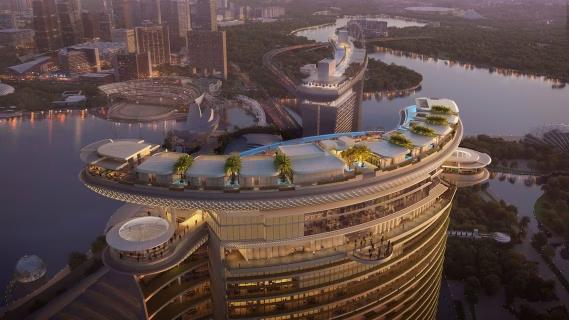
The Marina Bay Sands IR2 development is an entirely new, standalone resort — not an extension of the existing three-tower MBS complex — designed on an adjacent plot of reclaimed land immediately next to the original resort. In Robert Goldstein’s words at the groundbreaking, those who came expecting a fourth tower extension came to the wrong party. At the heart of IR2 is a 55-storey all-suite hotel tower containing 570 luxury keys, each larger on average than the suites available in the existing MBS hotel. The tower is rotated 45 degrees relative to the original three-tower geometry and features triple-height garden terraces that increase in width as they climb the building — a design gesture by Safdie Architects that reduces solar heat gain while maintaining the proportional vocabulary established by the first three towers.
Project Fact Sheet: Marina Bay Sands IR2
Project Name: Marina Bay Sands IR2 (New Marina Bay Sands Resort and Entertainment Complex)
Location: Marina Bay, Singapore (adjacent to existing Marina Bay Sands, on plots next to the original resort)
Developer: Las Vegas Sands Corp
Total Investment: US$8 billion (S$10.2 billion)
Original Cost Estimate (2019): US$3.3 billion
Groundbreaking: 15 July 2025 (officiated by Prime Minister Lawrence Wong)
Main Contract Award (Woh Hup): March 2026
Target Structural Completion: June 2030
Target Opening: Early 2031 (subject to regulatory approvals)
Construction Workforce: ~5,000 workers on site (24/7 operations, as of March 2026)
Key Components: 55-storey all-suite hotel tower (570 suites); Skyloop rooftop (76,000 sq ft); 15,000-seat entertainment arena; 200,000 sq ft MICE space; premium gaming area; luxury retail; dining; wellness
Sustainability: Low-carbon concrete; recycled steel; construction waste management plan
Architect (Hotel + Podium): Safdie Architects (led by Moshe Safdie)
Arena Architect: Populous
Predecessor Project: Marina Bay Sands Phase 1 (completed 2010, US$5.6 billion; main contractor Ssangyong E&C)
Project Team: Marina Bay Sands IR2
Developer / Owner: Las Vegas Sands Corp
LVS Chairman & CEO: Patrick Dumont
LVS Co-Founder: Dr Miriam Adelson
LVS President / COO (at groundbreaking): Robert Goldstein
Main Contractor: Woh Hup Private Limited (Singapore)
Architect (Hotel Tower + Podium): Safdie Architects — Moshe Safdie (founder)
Arena Architect: Populous
Singapore Government: Prime Minister Lawrence Wong (officiated groundbreaking); Minister Grace Fu
Key Government Programme Context: Greater Southern Waterfront (30 km, 20–30 year transformation); Singapore Tourism 2040 strategy
Woh Hup Notable Prior Projects: Jewel Changi Airport; Gardens by the Bay; Marina Bay Residences; W Residences Marina View
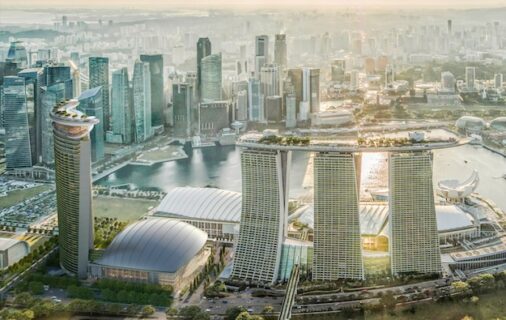
Crowning the tower is Skyloop — a 76,000-square-foot rooftop experience characterised by overlapping elliptical columns spiralling in opposing directions. Skyloop will sit slightly higher than the adjacent Sands SkyPark, providing 360-degree views of Singapore’s city skyline, Marina Bay, and the Strait of Singapore. Its public and guest amenities include an observatory, restaurants, gardens, infinity-edge pools, and private hotel-guest cabanas. Adjacent to the tower and connected by a shared podium, the 15,000-seat live entertainment arena — designed by Populous, the world’s leading specialist sports and entertainment venue architect — is positioned to fill what Patrick Dumont, Las Vegas Sands’ president and incoming CEO, described as a critical gap in Singapore’s MICE and entertainment ecosystem: a purpose-built venue capable of hosting the highest-calibre international touring acts and large-scale productions. The podium also delivers 200,000 square feet of premium meeting and convention space, a new gaming area, curated luxury retail boutiques, high-end dining and nightlife, and comprehensive wellness facilities. Low-carbon concrete, recycled steel, and a construction waste management plan have been embedded in the design from the outset, reflecting Singapore’s Tourism 2040 sustainability requirements and Las Vegas Sands’ own ESG commitments.
Woh Hup: The Builder Behind Singapore’s Landmarks
Woh Hup Private Limited’s appointment as main contractor for IR2 was the outcome of a competitive and comprehensive tender process in which Las Vegas Sands evaluated candidates on technical capability, track record in complex projects, and depth in engineering and design management. The result was a decision that resonates strongly across Singapore’s construction industry: Woh Hup, founded in 1927, has been the builder behind some of Singapore’s most celebrated and technically demanding built landmarks, and its appointment signals that the country’s privately owned construction sector is capable of anchoring a project of the highest global complexity and profile.
Woh Hup’s portfolio includes Jewel Changi Airport — the biophilic mixed-use retail and attractions landmark that has been widely recognised as one of the most complex building projects ever completed in Southeast Asia — and Gardens by the Bay, which required the integration of major horticultural, structural, and environmental engineering challenges across multiple building typologies. In the Marina Bay precinct specifically, Woh Hup has delivered Marina Bay Residences and W Residences Marina View, giving the company direct prior experience with the ground conditions, logistics, and stakeholder environment of the exact location now being transformed by IR2. The original MBS integrated resort, completed in 2010 at an estimated US$5.6 billion, was built by South Korean contractor Ssangyong Engineering & Construction — Woh Hup’s appointment thus represents a deliberate shift from an international contractor to a Singapore home-grown company for the expansion, consistent with Las Vegas Sands CEO Patrick Dumont’s stated commitment to ensuring that Singaporean firms continue to benefit from the company’s long-term presence and growth in the city-state.
5,000 Workers and Singapore’s Southern Waterfront Vision
With 5,000 workers already on site operating 24 hours a day, seven days a week since the July 2025 groundbreaking — and construction now formally anchored by Woh Hup’s appointment as main contractor — the IR2 project is entering its most intensive construction phase. The project faces the technical challenges inherent to building at scale on reclaimed land in a dense urban waterfront environment: managing settlement, coordinating crane operations and deliveries in proximity to an operating world-class resort, maintaining the visitor experience at the existing MBS throughout construction, and sequencing the arena, hotel tower, and podium works to meet the June 2030 structural completion target. The project’s original cost estimate, first announced in 2019 at approximately US$3.3 billion, has grown to US$8 billion following pandemic delays and scope enhancements — a trajectory that underscores both the ambition of the final programme and the inflationary headwinds that have affected major construction internationally. Singapore’s broader built environment pipeline is absorbing these pressures across multiple landmark projects simultaneously, including the SG$639.5 million new Science Centre Singapore in the Jurong Lake District — a 55,000-square-metre Zaha Hadid-designed facility timed to open on the Centre’s 50th anniversary in 2027, reflecting the city-state’s continued investment in world-class public institutions alongside its landmark commercial and hospitality developments.
Prime Minister Lawrence Wong’s presence at the groundbreaking and his characterisation of IR2 as a “new chapter” for Marina Bay place the project within a much larger urban transformation narrative. Singapore’s Greater Southern Waterfront programme — announced as a 20-to-30-year project to transform approximately 30 kilometres of coastline from Gardens by the Bay East to Pasir Panjang — positions IR2 as a critical anchor for the initial phase of that transformation, alongside residential, commercial, recreational, and entertainment development that will reshape the city-state’s relationship with its southern shoreline for the coming generation. For Las Vegas Sands, the investment is simultaneously a statement of confidence in Singapore’s long-term economic trajectory and a bet on the sustained growth of ultra-luxury tourism, MICE, and live entertainment demand from Asia’s rapidly expanding high-net-worth traveller base.

Leave a Reply