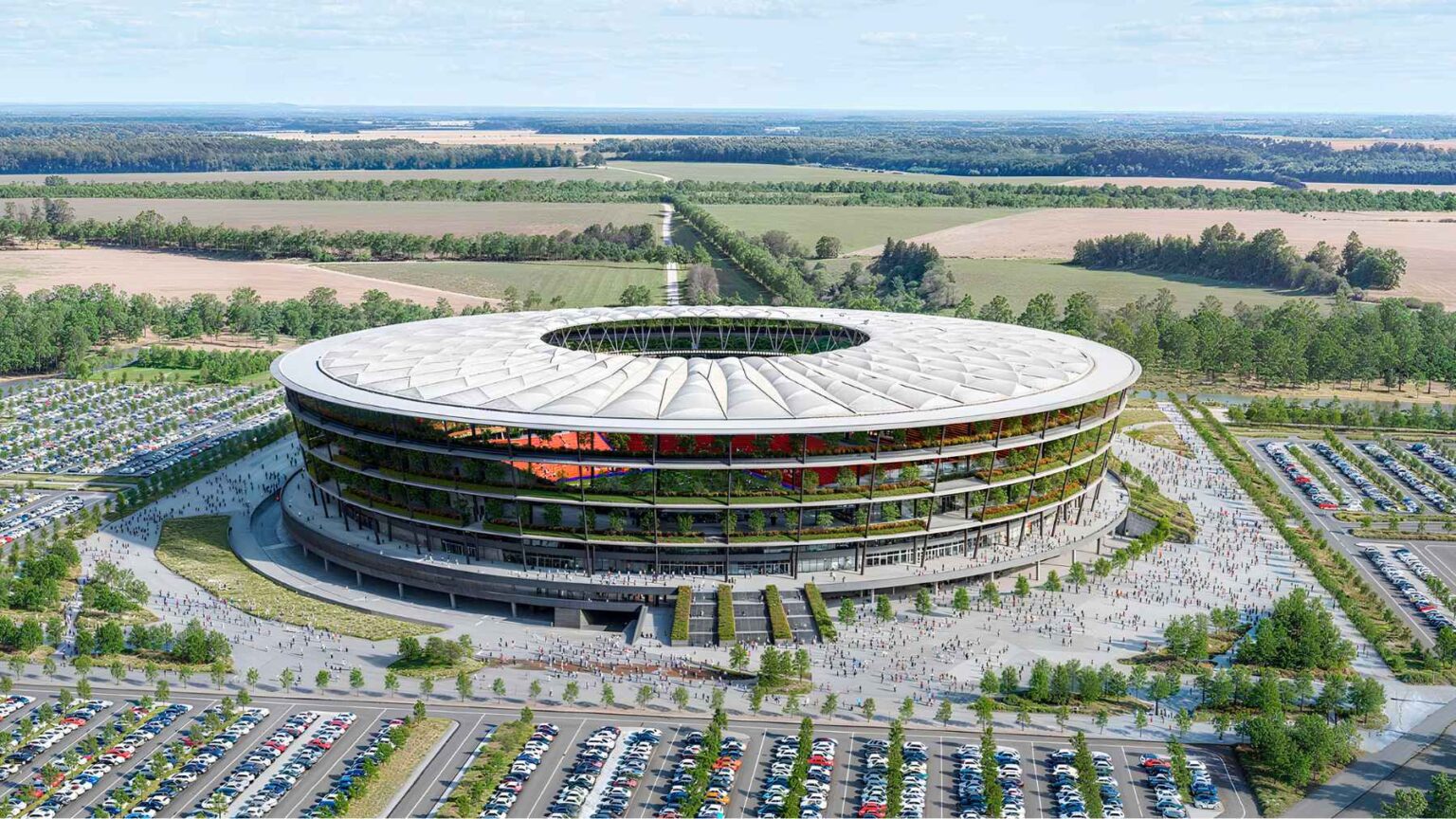
Serbia National Stadium project has reached a major construction milestone after China State Construction Engineering Corporation (CSCEC) completed the first lift of its massive steel structure in Belgrade. The $1.1 billion development now advances into its main superstructure phase, bringing Serbia closer to delivering the world’s first garden stadium. Moreover, the project combines large-scale sports infrastructure with suspended landscape systems, making it one of Europe’s most ambitious and visually distinctive stadium developments.
Located in Surčin on the outskirts of Belgrade, the Serbia National Football Stadium will serve as the new home of Serbia’s national football team. The venue will host more than 52,000 spectators and meet FIFA and UEFA requirements for elite competitions. Consequently, the stadium plays a central role in Serbia’s strategy to modernize national sports infrastructure and attract international events.
The first steel lift marks a critical transition from foundation works to vertical construction. Furthermore, it confirms steady progress on a project that has drawn global attention due to its engineering complexity and architectural ambition. The development stands out for its “garden stadium” concept, which integrates suspended greenery into the external structure. As a result, the stadium will function as both a sports arena and an urban landscape landmark.
Serbia National Stadium project enters complex steel erection phase
The steel erection phase represents one of the most technically demanding stages of the Serbia National Stadium project. Engineers designed the structure as a cable-supported system requiring extreme precision during fabrication and assembly. The stadium uses approximately 12,600 tones of steel. However, total steel demand may reach about 13,900 tones depending on final structural elements and support systems. The design includes 44 compression ring beams that form the core structural backbone. Therefore, each component must align precisely to support both the roof system and suspended garden loads.
To achieve this precision, engineers deployed laser tracking systems, BIM modelling, and full-scale pre-assembly tests. Furthermore, critical connections underwent verification before installation to reduce construction deviation. The project achieved a recorded alignment accuracy of minus 0.43 millimeters across key ring elements. As a result, the steel structure demonstrates exceptional engineering control for a stadium of this scale. Construction teams will continue steel erection over the coming months. Subsequently, contractors will move toward roof installation and façade development.
Serbia National Stadium project introduces suspended green architecture
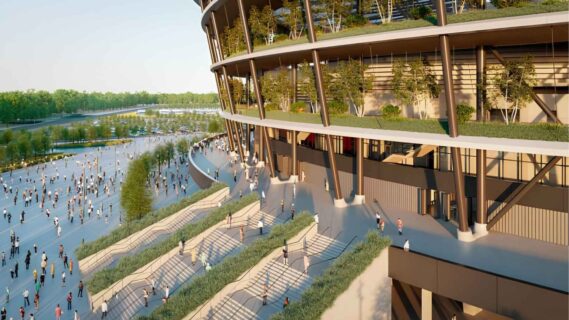
The Serbia National Stadium project introduces a rare architectural concept that blends sport and landscape design. The stadium features four suspended circular garden rings surrounding the main structure. These elevated gardens will support trees, shrubs, walkways, and recreational zones. Consequently, the stadium will operate as both a sporting venue and a public green space.
The engineering challenge is significant. Designers must account for vegetation weight, soil systems, irrigation networks, wind loads, and long-term maintenance conditions. The suspended gardens will create the visual impression of floating green terraces around the stadium. Moreover, this design enhances environmental integration and urban identity.
Industry observers describe the project as one of the most innovative stadium developments currently under construction. The combination of cable-supported engineering and large-scale greenery sets a new benchmark for sports architecture. The garden concept also supports environmental objectives. Therefore, the stadium is expected to improve biodiversity and expand public recreational space in Belgrade.
Serbia National Stadium supports Serbia’s long-term sporting and economic ambitions
The Serbia National Stadium serves as a strategic infrastructure investment for national development. Government authorities expect the venue to strengthen Serbia’s capacity to host major international football events. Upon completion, the stadium will comply with FIFA and UEFA standards. Consequently, it will qualify to host elite-level competitions and major sporting tournaments.
The project also delivers strong economic implications. Construction activity supports jobs, supply chains, and specialized engineering services across multiple sectors. Furthermore, the completed stadium is expected to boost tourism, hospitality, and entertainment industries. The venue will attract international visitors for football matches, concerts, and large-scale events.
Its location within the Belgrade metropolitan region enhances long-term urban development potential. Therefore, planners view the project as both a sporting asset and a catalyst for wider city growth. With the first steel lift completed, the Serbia National Stadium project continues its steady progression toward becoming one of Europe’s most distinctive sports landmarks.
The Serbia National Football Stadium development also reflects a wider global trend where elite football clubs are investing in next-generation mega stadiums that combine capacity expansion, commercial regeneration, and architectural identity.
In Manchester, for instance, a new 100,000-seater stadium for Manchester United, is still under planning. The iconic stadium is positioned as a future “world-class football landmark” integrated into a wider Old Trafford regeneration programme.
Like Serbia’s garden stadium concept, the Manchester project also focuses on transforming the stadium into more than a sporting venue, with emphasis on urban redevelopment, fan experience, and long-term economic impact. Both projects highlight how modern stadium construction is shifting toward mixed-use, city-shaping infrastructure rather than standalone sports facilities.
While Serbia advances its cable-supported “garden stadium” vision with suspended green architecture, Manchester United is pursuing a massive capacity-led redevelopment strategy anchored in a new-build approach. Together, they underline a global shift in stadium engineering priorities where scale, sustainability, and urban integration now define elite football infrastructure.
Project Fact Sheet
Project Name: Serbia National Football Stadium
Location: Surčin, Belgrade, Serbia
Project Value: $1.1 billion
Client: Government of Serbia
Main Contractor: China State Construction Engineering Corporation (CSCEC)
Capacity: 52,000+ spectators
Gross Floor Area: ~76,000 sqm
Steel Requirement: 12,600–13,900 tonnes
Structural System: Cable-supported steel structure
Compression Rings: 44 primary elements
Key Feature: Four suspended garden rings
Status: First steel lift completed
Completion Target: 2026
Compliance: FIFA and UEFA standards
Primary Use: National football stadium
Project Team
Client: Government of Serbia
Investor: Republic of Serbia
Main Contractor: China State Construction Engineering Corporation (CSCEC)
Steel Contractor: China Construction Steel Structure Corporation
Engineering Support: Power Construction Corporation of China (PowerChina)
Structural Engineering: CSCEC technical division
BIM & Digital Modelling: CSCEC engineering teams
Survey & Precision Control: CSCEC laser tracking specialists
Landscape Design Consultants: International green infrastructure specialists
Government Oversight: Serbian Ministry of Construction, Transport and Infrastructure
Future Operator: Football Association of Serbia
End User: Serbia National Football Team
Leave a Reply