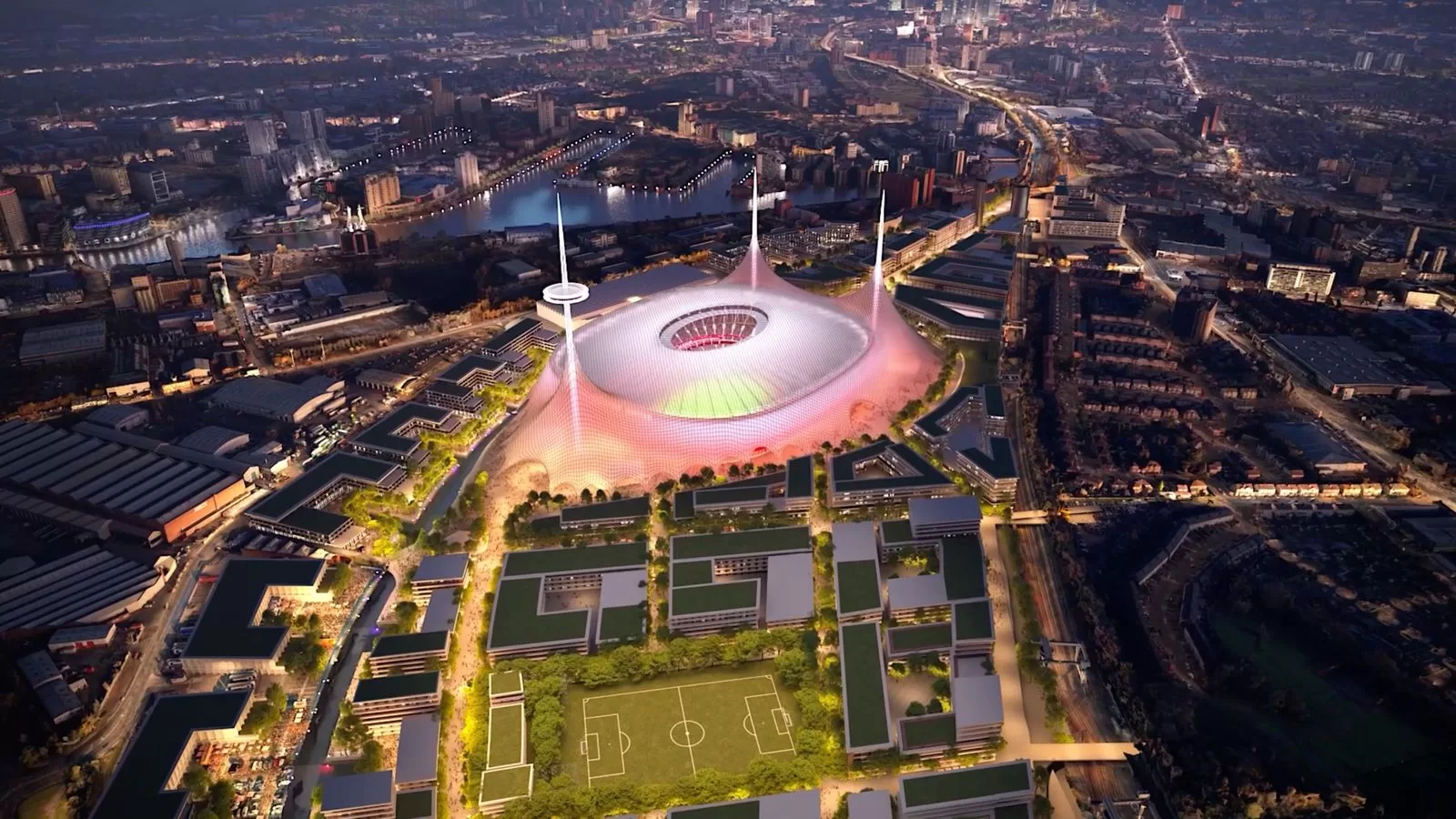
Manchester United’s proposed 100,000-seater Old Trafford regeneration project continues to move through early development stages as the club progresses planning, funding discussions, and land assembly work in Manchester. The £2 billion redevelopment forms part of a wider Old Trafford regeneration strategy designed to transform the stadium district into a mixed-use sporting and commercial hub. Moreover, the project remains one of the most significant stadium developments in Europe, with completion timelines still targeting the early 2030s depending on approvals and financing structures.
The stadium plan, designed by Foster + Partners, aims to replace the existing Old Trafford or be built alongside it depending on final design and land decisions. Additionally, the project is expected to integrate transport upgrades, public spaces, and commercial zones as part of a broader urban renewal framework supported by local authorities.
Despite limited visible construction activity in 2026, Manchester United confirms that technical design refinement and stakeholder negotiations continue behind the scenes. Consequently, the project remains in its pre-construction phase while key infrastructure and funding decisions are resolved.
Old Trafford regeneration project advances through planning and funding phase
The Manchester United’s Old Trafford regeneration project remains in a complex pre-construction stage focused on land acquisition, financing structure, and regulatory approvals. Club executives confirm that construction cannot begin until property consolidation around Old Trafford is complete.
The stadium is expected to cost approximately £2 billion, with private financing identified as the primary funding model. Furthermore, the club continues engaging potential investors and stakeholders while assessing long-term revenue models linked to naming rights, hospitality expansion, and surrounding real estate development.
Design proposals from Foster + Partners outline a 100,000-seat arena featuring a large canopy structure, expanded fan zones, and a commercial district integrated into the stadium footprint. Therefore, the project is positioned not only as a sporting facility but also as a major economic regeneration scheme.
According to current planning assumptions, construction could take four to five years once commenced. However, land negotiations and planning approvals remain key variables influencing final timelines.
Old Trafford regeneration project aligns with global mega stadium developments
The Manchester United stadium initiative forms part of a wider global shift toward large-scale, multifunctional stadium infrastructure. Clubs and governments increasingly pursue developments that combine sports, entertainment, retail, and urban regeneration within a single district.
The project mirrors other international stadium ambitions in scale and complexity. In comparison, the Serbia National Football Stadium is already advancing into its superstructure phase following completion of its first steel lift, marking tangible construction progress on a $1.1 billion development designed as the world’s first “garden stadium.”
That project demonstrates how modern stadium construction is increasingly integrating engineering innovation with environmental and architectural identity. Consequently, Manchester United’s redevelopment is being positioned within the same global evolution of stadium design, albeit at an earlier planning stage.
The UK project also benefits from broader government and local authority backing for regeneration around Old Trafford. Furthermore, planners expect the development to deliver significant economic uplift through job creation, housing expansion, and long-term commercial investment in the surrounding district.
Old Trafford regeneration project supports long-term club and regional strategy
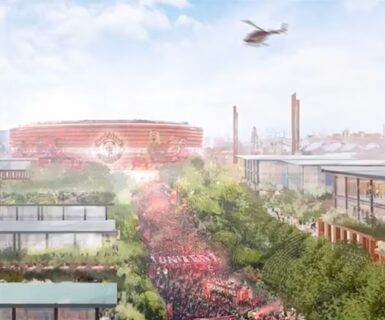
The proposed Old Trafford regeneration project forms a central pillar of Manchester United’s long-term infrastructure and commercial strategy. Club leadership views the development as essential to maintaining global competitiveness and modernizing match day experience for supporters.
Beyond football operations, the project is expected to transform the Old Trafford district into a year-round destination for sport, entertainment, and business activity. Therefore, the redevelopment aligns with broader city-region economic objectives targeting regeneration and investment attraction.
However, key constraints remain, particularly around land acquisition complexity and financing finalization. As a result, the timeline remains flexible, with completion still projected for the early 2030s depending on approval progress.
Despite these challenges, the club continues to position the project as a long-term investment in infrastructure renewal rather than a short-term construction program. Consequently, Manchester United’s stadium plans remain one of the most closely watched sports infrastructure projects in Europe.
Where Will United Play During Construction?
Manchester United plan to continue playing at Old Trafford while their new £2 billion stadium is being built on an adjacent site.
“By building alongside the existing stadium, we will be able to preserve the feel of Old Trafford while creating a truly state-of-the-art stadium that transforms the fan experience mere steps from our historic home,” said co-owner Sir Jim Ratcliffe.
With Old Trafford serving United as the home venue for the past 115 years and now having seating capacity of nearly 74,000 spectators, the club is certain to maintain its match schedule at Old Trafford throughout the construction process.
How Is the New Stadium to Be Financed?
The club, which is in debt for more than £1 billion, hasn’t yet announced how the project is to be financed.
“If the government really gets behind the scheme, we will create a iconic football stadium,” Ratcliffe said, referencing possible public sector investment in subsidizing the lofty project.
What Is the Expected Economic Impact?
Manchester United’s own estimate is that the new stadium and general re-development of the Old Trafford area would contribute another £7.3 billion annually to the UK economy. The development will also generate 92,000 new jobs and lead to the construction of over 17,000 new homes.
How Long Will It Take to Complete the Stadium?
Part of the primary reason for expediting the process is that the stadium is sited close to the Manchester Ship Canal. The club plans to adopt a “modular” construction process, building large sections off-site and transporting them by boat directly to the stadium complex.
What will the New Stadium Be Like?
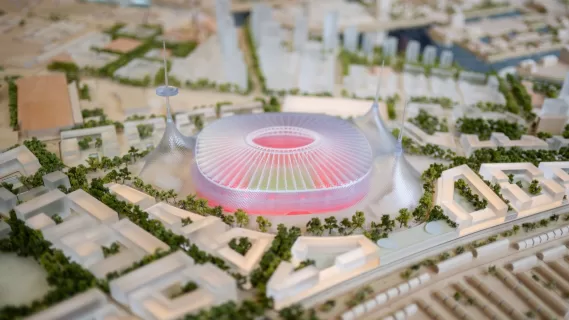
Nicknamed ‘New Trafford’ in blueprint documents, the stadium will have an imposing umbrella-formed roof which will harness solar energy and harvest rainwater.
Major design aspects of the Foster and Partners report are:
The tallest mast will be 200m, Manchester’s tallest building, taller than the 169m Beetham Tower.
New Trafford will be the European second-largest stadium, behind Barcelona’s Camp Nou.
The storied Stretford End will have 23,500 seats.
Hospitality seating will occupy 15.5% of the stadium’s capacity.
The stadium will be visible from the Peak District, Cheshire, and even the outskirts of Liverpool.
With these ambitious plans, Manchester United aims to re-write its history without losing the character of Old Trafford for future generations.
Manchester United’s New Stadium: Project Factsheet
Project Overview
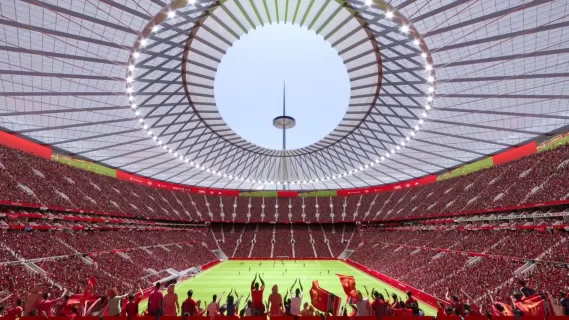
Manchester United has unveiled plans for a new 100,000-seater stadium on March 11, 2025, designed by renowned architect Lord Norman Foster. Manchester United will construct the £2 billion project, unofficially dubbed ‘New Trafford’, on land adjacent to the current Old Trafford site.
Key Facts
Location & Construction
Site: Adjacent to the existing Old Trafford stadium
Timeline: 5-year construction period (accelerated from typical 10 years)
Current Status: Planning phase
Match Continuity: Club will continue playing at Old Trafford during construction
Stadium Specifications
Capacity: 100,000 seats
Size Ranking: Will become Europe’s second-largest football stadium (behind Barcelona’s Camp Nou)
Stretford End: 23,500 capacity
Hospitality Seating: 15.5% of total capacity
Height: Main mast will reach 200m, becoming Manchester’s tallest structure (exceeding the 169m Beetham Tower)
Visibility: Will be visible from the Peak District, Cheshire, and Liverpool outskirts
Manchester United’s new stadium Design Features
Umbrella-style roof designed to harvest solar energy
Rainwater collection system
“Modular” construction approach with components assembled off-site
Utilizes Manchester Ship Canal for materials transport
Economic Impact
Total Economic Contribution: Estimated £7.3 billion annually to UK economy
Job Creation: Expected to generate 92,000 new jobs
Housing Development: Plans include over 17,000 new homes
Government Involvement: Potential public sector participation indicated
Financing
Project Cost: £2 billion
Current Club Debt: Exceeds £1 billion
Funding Model: Not yet disclosed, with hints at potential government support
Read also: Manchester United Plans to Build UK’s Largest Stadium Instead of Redeveloping Old Trafford
Project Fact Sheet
Project Name: Manchester United Old Trafford Regeneration Stadium Project
Location: Old Trafford, Manchester, United Kingdom
Project Value: £2 billion
Stadium Capacity: 100,000 seats
Architect: Foster + Partners
Project Type: New-build / regeneration-linked stadium development
Current Status: Planning and pre-construction phase
Construction Timeline (Estimated): 4–5 years once started
Expected Completion: Early 2030s (subject to approvals and funding)
Primary Use: Manchester United FC home stadium
Development Scope: Stadium + surrounding regeneration district
Funding Model: Private investment with stakeholder financing discussions
Key Feature: Large canopy structure and integrated commercial zones
Strategic Goal: Replace or supplement Old Trafford infrastructure
Project Team
Client: Manchester United Football Club
Owner: Manchester United PLC
Lead Architect: Foster + Partners
Stadium Developer: Manchester United Stadium Development Team
Main Contractor (Planned): To be appointed
Project Management: Manchester United Infrastructure & Capital Projects Division
Structural Engineering: Foster + Partners Engineering Consultants
Urban Regeneration Partner: Old Trafford Regeneration Authority (proposed framework)
Local Authority: Trafford Council
Regional Authority: Greater Manchester Combined Authority (GMCA)
Government Support: UK Government infrastructure and regeneration stakeholders
Funding Partners: Private investors and institutional stakeholders (in negotiation stage)
End User: Manchester United Football Club
Community Stakeholders: Old Trafford district redevelopment consultative bodies


Leave a Reply