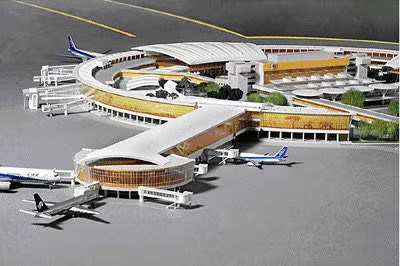
The $1.2 Billion JKIA expansion project has advanced after Kenya appointed Trade and Development Bank (TDB) and Africa Finance Corporation (AFC) as financial arrangers. The JKIA expansion project aims to transform Jomo Kenyatta International Airport in Nairobi into a major regional aviation hub. Additionally, the initiative will significantly increase passenger capacity and modernize critical airport infrastructure.
The project targets growth from 7.5 million to 22 million passengers annually. Furthermore, Kenya has structured financing around airport revenue streams to ensure long-term sustainability. The development follows renewed efforts to reposition Nairobi amid rising regional aviation competition. Consequently, the project is now moving toward accelerated implementation after prior delays.
JKIA expansion project financing structure and recovery strategy
The project financing structure relies on TDB and AFC to mobilize a diversified funding pool. Kenya has assigned both institutions to attract development finance institutions and commercial banks. Additionally, the model reduces exposure to sovereign borrowing pressures. Instead, airport-generated revenues will support repayment obligations over time.
Moreover, the financing strategy reflects a shift in approach after the 2024 cancellation of the Adani Group deal. That cancellation forced Kenya to reassess procurement and funding frameworks. Therefore, authorities adopted a more transparent and competitive financing arrangement. Meanwhile, lenders will coordinate risk-sharing mechanisms to ensure stability during implementation. Consequently, the JKIA expansion project financing structure supports phased capital deployment aligned with construction milestones.
Furthermore, international competitive bidding for construction has already concluded. However, the government has not formally confirmed the winning contractor. Reports indicate China Communication Construction Company may have secured the contract. Still, official confirmation remains pending.
JKIA expansion project scope and infrastructure transformation
The project scope focuses on comprehensive airport modernization and capacity expansion. The project includes a new passenger terminal designed to handle increased traffic. Additionally, existing runways and aprons will undergo rehabilitation and upgrades.
The expansion will nearly triple passenger handling capacity. It will also improve cargo processing infrastructure to strengthen Nairobi’s logistics role. Furthermore, advanced digital systems will enhance passenger processing and security efficiency. Consequently, airport operations will become more streamlined and resilient.
Meanwhile, construction will proceed in phases to maintain uninterrupted airport services. This approach minimizes operational disruption during upgrades. Additionally, airside improvements will optimize aircraft movement and turnaround times. Therefore, the JKIA expansion project will improve both capacity and efficiency simultaneously.
Regional aviation competition and JKIA expansion project outlook
The project unfolds amid intensifying regional aviation competition. Ethiopia and Rwanda continue investing heavily in airport infrastructure development. Therefore, Kenya aims to maintain Nairobi’s dominance as East Africa’s primary aviation hub. Additionally, improved infrastructure will attract more international airlines and cargo operators.
Construction is expected to take approximately three years once financing is fully secured. However, final financial closure remains essential before full mobilization. Meanwhile, Kenya continues engaging lenders and development partners to finalize agreements. Consequently, early works may begin shortly after funding completion.
Furthermore, the project aligns with Kenya’s broader infrastructure modernization agenda. It supports trade, tourism, and logistics expansion across the region. Ultimately, the JKIA expansion project will strengthen Kenya’s aviation competitiveness and economic connectivity.
The JKIA expansion project aligns closely with Kenya’s broader aviation infrastructure strategy, which also includes parallel airport developments such as the Maasai Mara International Airport project. Both initiatives reflect Kenya’s effort to strengthen tourism, regional connectivity, and aviation competitiveness.
Additionally, while JKIA focuses on transforming the country’s primary international gateway into a high-capacity regional hub, the Maasai Mara project targets direct international tourist access to Kenya’s flagship wildlife destination. Furthermore, the combined projects highlight a coordinated national approach to decentralising air transport infrastructure and boosting economic zones across key regions.

Also read: $2.9bn JKIA Upgrade Project, China Communications Construction Company to Develop Kenya’s Airport
Project fact sheet
Project Name: JKIA Expansion Project
Location: Jomo Kenyatta International Airport (JKIA), Nairobi, Kenya
Project Value: $1.2 Billion (approx. KSh 154.2 billion)
Sector: Aviation Infrastructure / Transport Construction
Client: Government of Kenya
Financing Arrangers: Trade and Development Bank (TDB), Africa Finance Corporation (AFC)
Objective: Expand airport capacity and modernize aviation infrastructure
Capacity Expansion: From 7.5 million to 22 million passengers annually
Key Components:
- New passenger terminal construction
- Runway and apron rehabilitation
- Cargo facility expansion and upgrades
- Airside infrastructure modernization
- Passenger processing system enhancement
- Security and digital systems integration
Financing Model: Revenue-linked airport funding structure
Procurement Status: Competitive bidding completed; contractor awaiting official confirmation
Implementation Timeline: Approximately 3 years
Project team
Client: Government of Kenya (Ministry of Roads and Transport; National Treasury)
Airport Operator: Kenya Airports Authority (KAA)
Aviation Regulator: Kenya Civil Aviation Authority (KCAA)
Financing Arrangers:
- Trade and Development Bank (TDB)
- Africa Finance Corporation (AFC)
Development Finance Institutions: To be engaged through arranged syndication
Commercial Lenders: Local and international banks participating in financing pool
Engineering Consultants: To be appointed under final procurement and design packages
Project Delivery Unit: Kenya Airports Authority infrastructure and planning division
Environmental Advisors: Independent consultants aligned to aviation compliance standards




Leave a Reply