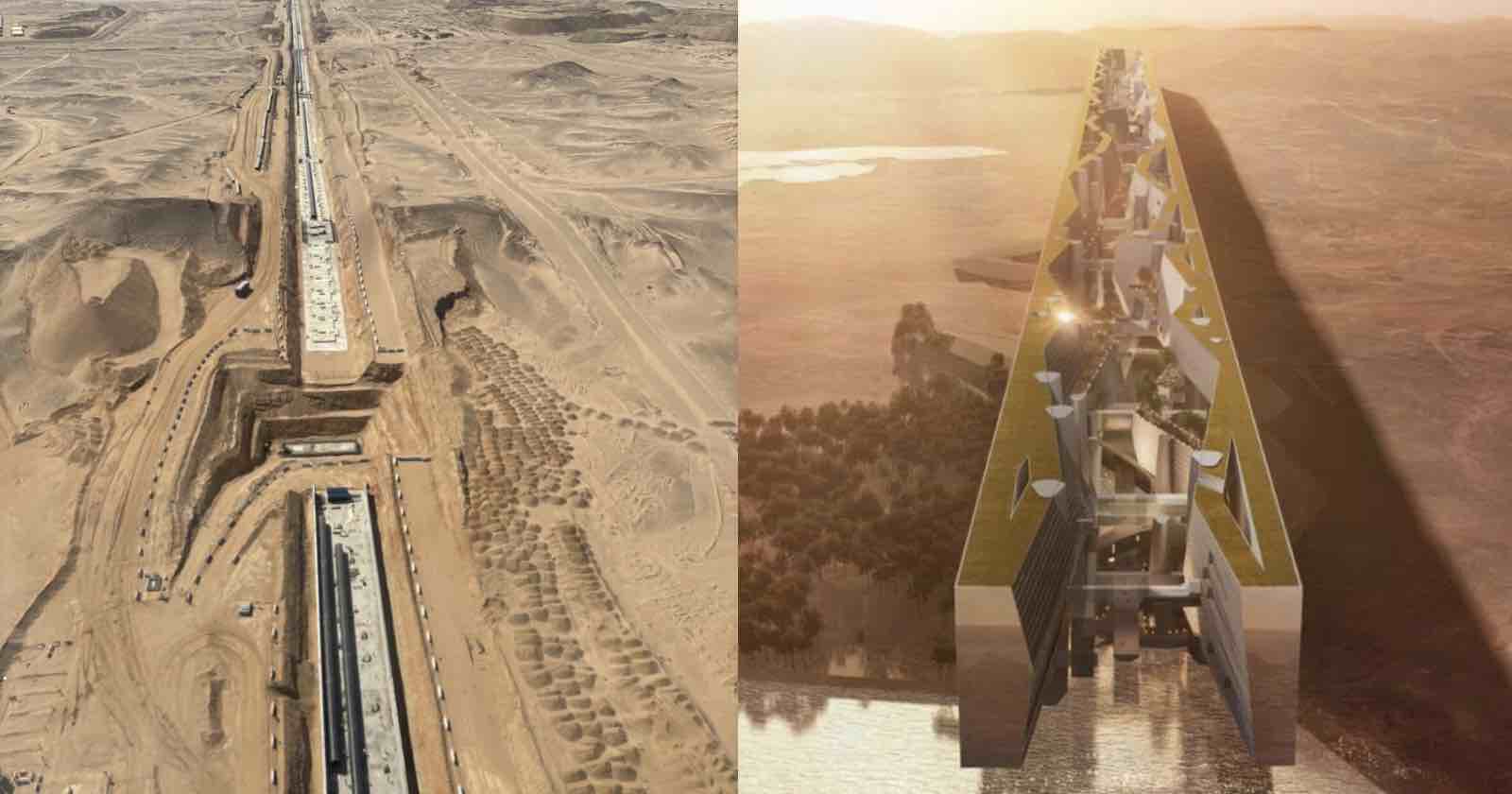
Saudi Arabia’s NEOM has delayed further work on The Line. This is a planned 170-kilometer long dual skyscrapers that was once projected to cost over $1 trillion. The delay will see works resume on the project at least after 2030. This delay comes in as as the kingdom’s sovereign wealth fund shifts spending toward other projects. The kingdom now wants to focus on developing infrastructure like ports and data centers.
Neom Postpones Other Projects
Also, NEOM, the company developing the northwest corner of Saudi Arabia which is controlled by Public Investment Fund and chaired by Crown Prince Mohammed bin Salman, has postponed plans to build tourism destinations along the Red Sea coast. The projects along the Red Sea will also resume after 2030. This information was revealed by people who are familiar with the matter. Projects like Trojena, the mountain resort had earlier been due to host the 2029 Asian Winter Games. However, the Trojena project will not receive new investments until after 2030. This was also revealed by the people.
NEOM Leans More Towards Ports and Data Centers Development
What is left of NEOM are the more immediately practical, productive bits. NEOM plans to spend about $3 billion further developing OXAGON. OXAGON is the nascent industrial city that hosts a port on the Red Sea. That port has become a key part of Saudi Arabia’s efforts to create new trade routes. The efforts to establish the new trade route is attributed to the current closure of the Strait of Hormuz. Additionally, the kingdom is investing in utilities and data connectivity. This is in bid to attract AI firms to construct data centers.
The decisions are the result of a strategic review conducted by NEOM’s Chief Executive Aiman al-Mudaifer. These come after his appointment to the position last year. Also, as part of that review, NEOM has further scaled down ambitions for how many people will live in NEOM by 2030: the target is now up to 100,000 people. At one point, NEOM executives had envisioned 1.5 million residents by the end of the decade before revising the forecast down to 300,000 two years ago.
Why NEOM Decided to Delay and Downscale The Line
Pushing back work on The Line back until after 2030, and also significantly redesigning its twin mirrored skyscrapers, is part of efforts to make NEOM less costly to develop. However, it’s unclear when the redesign will be completed or when the project would get any new funding allocated to it, the people said.
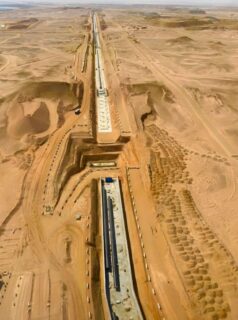
Postponing development of one of the kingdom’s most iconic projects is the latest sign that Saudi Arabia is taking a more pragmatic view of its ambitions. Earlier in May, Public Investment Fund said it will stop funding LIV Golf after putting $5 billion into trying to make the breakaway league sustainable, and a few months earlier, plans to build a giant cube in Riyadh, known as the Mukaab, were also put on hold.
Widening budget deficits, lower-than-expected foreign investment, and questions about the feasibility of some of the PIF’s projects forced authorities to reassess priorities even before the Iran war hit economic confidence.
Saudi Finance Minister Mohammed al-Jadaan said last year that the government isn’t concerned with “ego” when it comes to making decisions about projects. “If we announce something and we need to adjust it, accelerate it and make it a priority more than others, or defer or cancel it, we will without blinking,” he said.
Project Factsheet
Location: Tabuk Province, Northwest Saudi Arabia (NEOM Region)
Original Length: Target 170 kilometers (105 miles)
Restructured Phase 1 Length: 1.5 to 2.4 kilometers
Structural Height: 500 meters (1,640 feet), taller than the Empire State Building
Structural Width: 200 meters (656 feet)
External Aesthetic: Continuous, twin-mirrored glass facades reflecting the surrounding desert and mountains
Urban Concept: “Zero Gravity Urbanism” stacking residential, commercial, and green spaces vertically
Transport Infrastructure: Zero cars, zero streets, and zero carbon emissions on the surface.
The Spine Layer: A subterranean high-speed rail and utility corridor designed for end-to-end travel
The 5-Minute Rule: All daily essential services and amenities located within a 5-minute walk
Energy Infrastructure: Powered by 100% renewable energy
Environmental Preservation: Designed with a hyper-dense footprint to preserve 95% of the surrounding nature
Original Population Target: 9 million residents at full completion
Phase 1 Population Target: 300,000 residents
Revised Completion Horizon: 2034 for Phase 1 (aligned with the FIFA World Cup) / 2080 for full completion
Baseline Phase 1 Cost: Estimated at $320 billion to $370 billion
Projected End-State Cost: Internal estimates scale up to $8.8 trillion for the full 170 km
Current Execution Status: Superstructure work on the broader 170 km layout is paused. Massive underground piling and foundation work are complete only for the initial 2.4 km stretch.

Leave a Reply