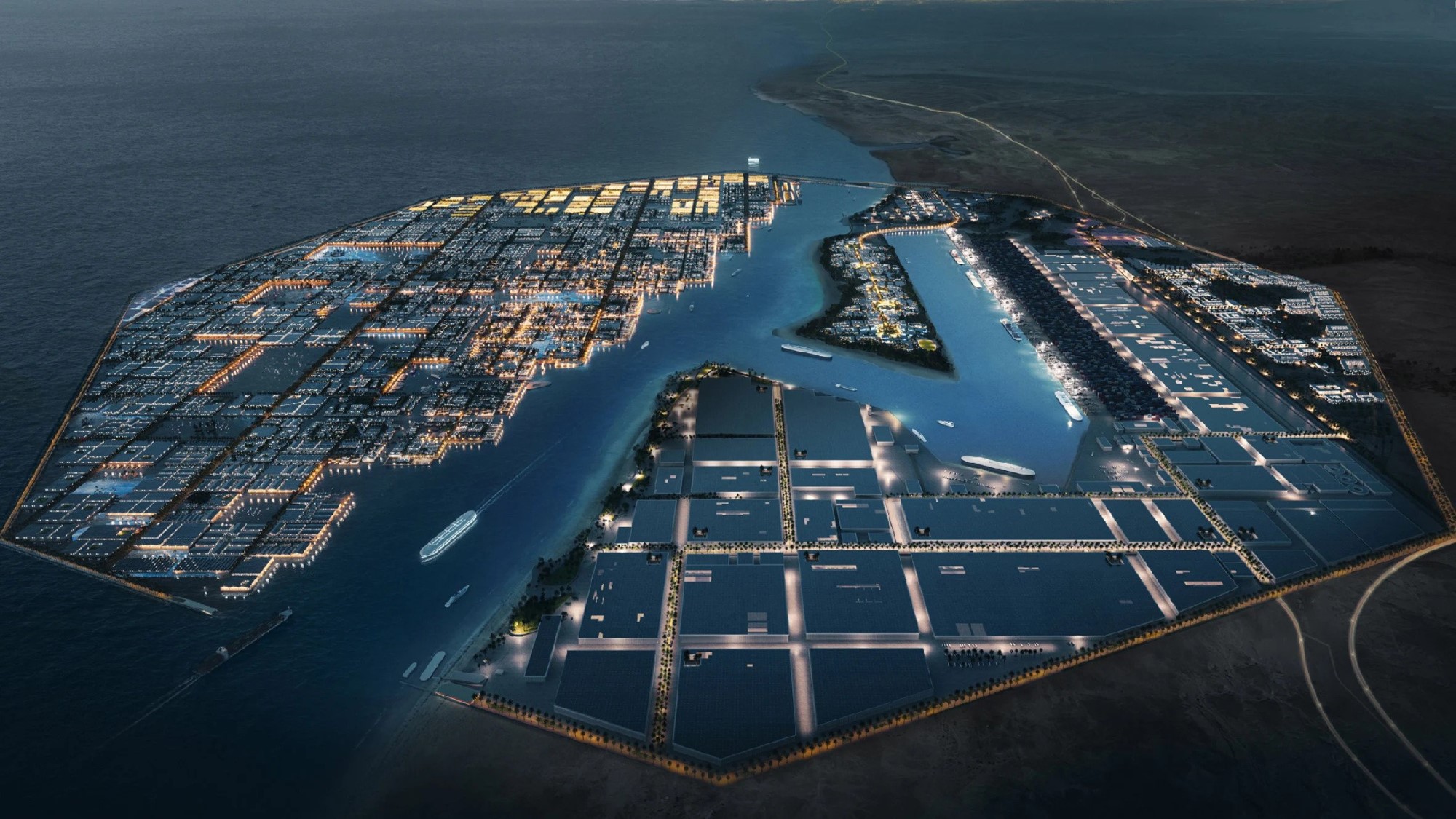
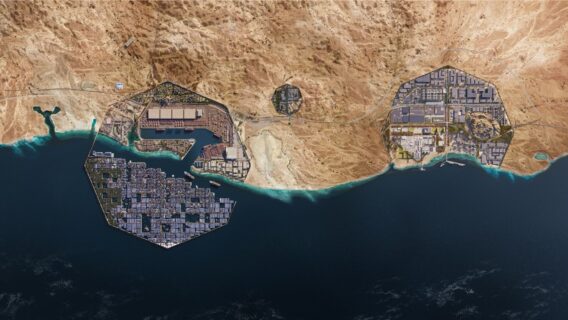
Oxagon is a 48-square-kilometer coastal industrial and logistics hub situated on the Red Sea. It is designed to serve as the economic engine of Saudi Arabia’s broader NEOM ecosystem. The project is built as a floating city operating on 100% renewable energy. The development incorporates advanced automation, robotics, and circular economy principles to create a next-generation manufacturing quarter. Crucially, its deep-water port has become an indispensable alternative trade route for the kingdom amid regional maritime disruptions, especially from the Strait of Hormuz. To capitalize on its strategic coastal position, Saudi Arabia is actively investing billions to build out utility networks and data connectivity designed to attract global tech corporations.
Faced with widening budget deficits and the immense economic reality of a multi-trillion dollar price tag, the Saudi Public Investment Fund (PIF) has officially halted development on the iconic 170-kilometer residential skyscraper project, The Line, until at least after 2030. In a major shift toward pragmatic financial management, authorities have canceled over $8 billion in heavy civil engineering and tunneling contracts, redirecting the capital into immediately productive assets. The primary beneficiary of this fiscal pivot is Oxagon, where the kingdom has deployed a $5 billion partnership with DataVolt to build a massive, state-of-the-art artificial intelligence data center campus. By exploiting the Red Sea’s coastal seawater for net-zero, fresh-water-free cooling, Saudi Arabia is converting the physical site of its most ambitious residential dream into a high-powered compute factory for global GPU server infrastructure.
August 14, 2024
Egyptian-based Hassan Allam Holdings has announced that its subsidiary has been awarded an EPC contract to construct one of the world’s largest ports. A partnership between the Saudi unit of Egypt’s Hassan Allam Construction Saudi, Riyadh-based El Seif Engineering Contracting, and China Harbour Engineering Arabia has won a construction contract for the Port of NEOM in Oxagon. The project scope includes an engineering, procurement, and construction (EPC) contract for developing Port of NEOM’s container terminal 1. It also includes construction of the marine services area (MSA), Hassan Allam Holding said in a statement on Sunday. The port of NEOM is a crucial maritime hub on the Red Sea, offering many services, including containers, general cargo, bulk, and roll-on/roll-off ferry services. Its strategic location provides global and regional connectivity, thus bolstering Saudi Arabia’s maritime and economic vision.
The Significance of the Construction of One of the World’s Largest Ports
The construction of one of the world’s largest ports in Saudi poses a significant contribution as a major maritime hub in the Red Sea. Furthermore, the port will provide container, general cargo, bulk, and roll-on/roll-off ferry services. Additionally, the port of NEOM’s strategic location provides global and regional connectivity to support the Kingdom’s maritime and economic ambitions in line with Vision 2030. Saudi Arabia’s Vision 2030 targets economic diversification, tourism growth, and innovation. Additionally, the port plays a crucial role in importing the goods and materials necessary for NEOM’s construction phase.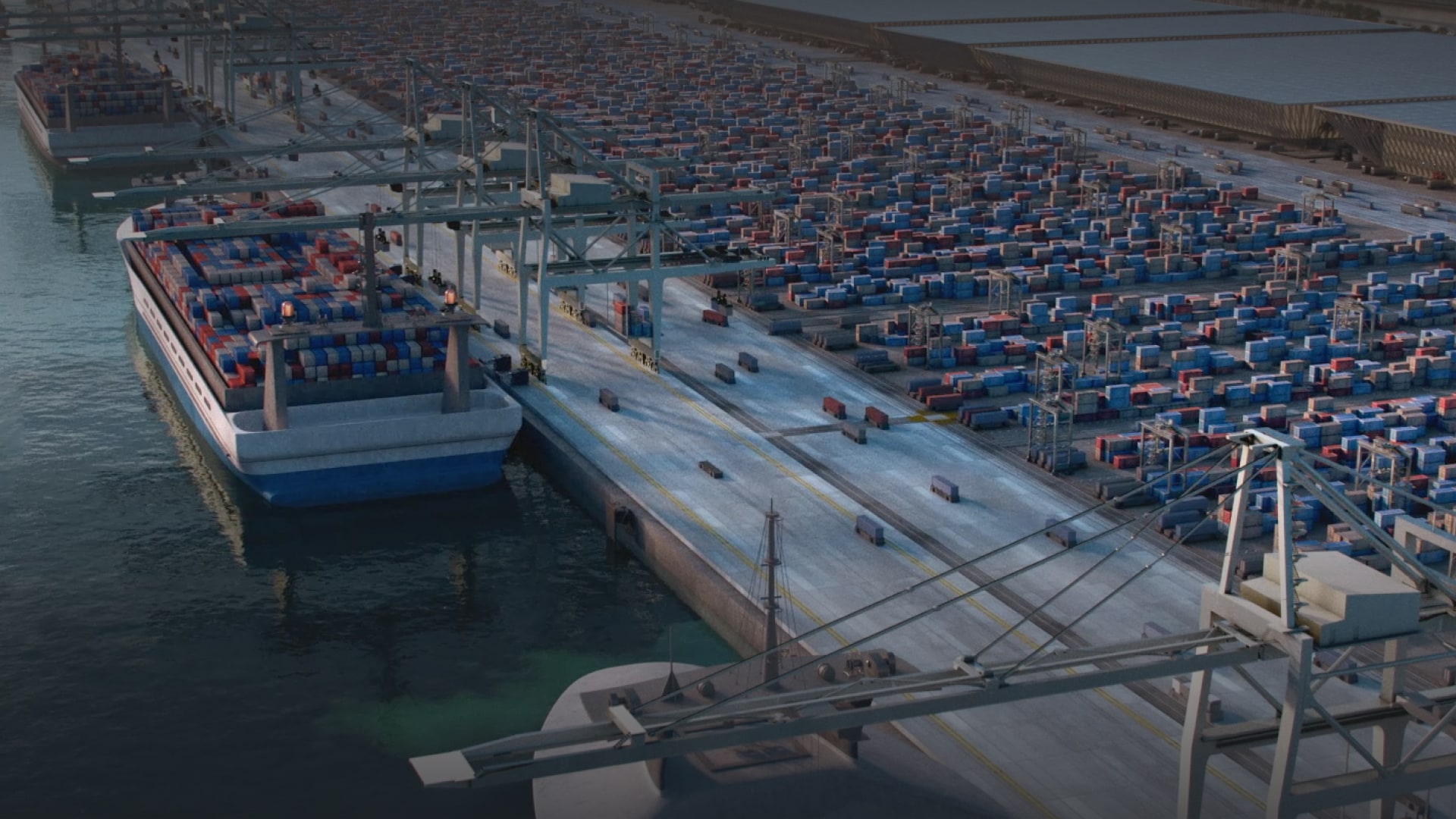
NEOM is a smart urban area built by Saudi Arabia in Tabuk. The construction of one of the world’s largest ports in the Red Sea includes astounding hallmarks, such as the integration of AI to operate the port. The port leverages automation, artificial intelligence, and Internet of Things (IoT) applications to boost productivity and reduce turnaround times, ensuring smooth and seamless services. The port also reduces operational costs while delivering benefits to its clients through advanced data analytics and smart logistics solutions.
Also read:
The State of Affairs Regarding the Port of NEOM
Saudi Arabia’s Neom allocated an estimated SR4bn ($1bn) design-and-build contract to deliver infrastructure and building works for Terminal 1 of one of the world’s largest ports. Construction and implementation of the project are supposed to commence immediately, with a focused timeline of 2025 in mind. The scope of work also entails the development of a flexible quay, constructing several new buildings, and infrastructure works. Contractors will be required to appoint a consultant for design execution.
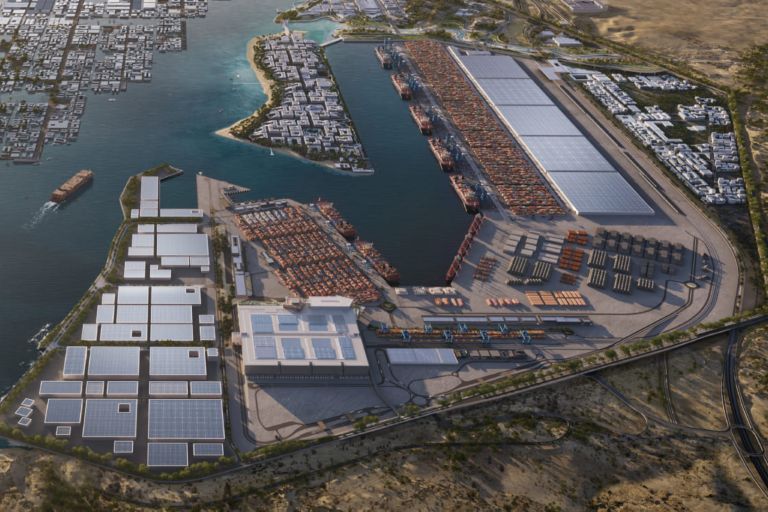
Jacobs is the lead design consultant for the port project. “The original SR12bn ($3.24bn) project went through several phases of de-scoping, where the client focussed on bringing efficiency and speeding up the delivery of the most critical elements of the project,” sources familiar with the scheme noted. The packages are the latest to be tendered for the port. In October, Neom selected the joint venture of Belgium’s Deme and Greece’s Archirodon for the estimated $1bn contract to complete the next phase of the Duba port expansion at Oxagon. The completion of one of the world’s largest ports is one that is anticipated by many, as it shows immense promise.
Project Factsheet
Location: Southwest corner of the NEOM region, Tabuk Province, Saudi Arabia (strategically positioned on the Red Sea coast).
Core Footprint Area: 48 square kilometers (18.5 square miles) of dedicated city development, embedded within a broader 200–250 square kilometer economic zone.
Unique Structural Design: Shaped as a massive, floating octagon, partially extending over the water. It is projected to become the world’s largest floating industrial and logistics complex
Strategic Trade Advantage: Situated directly on the Red Sea, a maritime channel that handles roughly 13% of all global trade.
Total Project Valuation: Estimated at $64 billion for the complete build-out of industrial, commercial, and utility facilities.
Primary Infrastructure Node: The Port of NEOM
- An advanced, fully automated deep-water port with an initial target capacity of 1.5 million TEUs (Twenty-foot Equivalent Units). It features an active multimodal European land bridge using synchronized trucking and ferry networks.
Energy Framework: 100% powered by renewable energy systems
The Green Hydrogen Anchor: Houses the NEOM Green Hydrogen Company facility which is an $8.4 billion joint venture (NEOM, Air Products, ACWA Power). The 4 GW plant is slated for completion to produce up to 600 tonnes of carbon-free hydrogen per day.
Industrial Architecture (Industry 4.0): A pure greenfield site designed to natively integrate Artificial Intelligence (AI), Internet of Things (IoT), advanced robotics, and circular economy waste principles into the manufacturing floor.
The Digital Pivot (Data Connectivity): Backed by a multi-billion dollar capital injection, the zone is being outfitted with massive, seawater-cooled AI data center campuses to house dense GPU server infrastructure for global tech firms.
Target Manufacturing Sectors
- Clean energy and green hydrogen production
- Advanced automated manufacturing & industrial technology
- Biotech and life sciences
- Autonomous, sustainable maritime logistics
Also read:
Construction of the $8.4B World’s Largest Green Hydrogen Plant Commences in Saudi Arabia
$500B World’s Largest Construction Work Programme Offers Contractors Bid for Oxagon Port Work