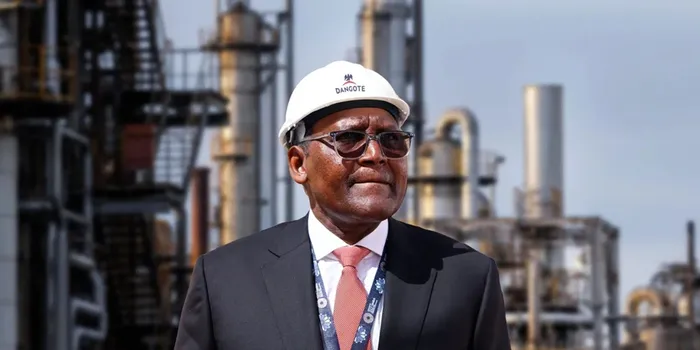
Aliko Dangote commenced the construction of a $16 billion oil refinery at Lamu on Kenya’s coast on Wednesday, Sept. 30. Kenya’s president President William Ruto attended the groundbreaking ceremony of the refinery.
Capacity and Size of the Dangote Lamu Refinery
The mega refinery is designed to process 700,000 barrels of crude a day. This processing capacity would make it the largest refinery in East Africa and the second largest in Africa after the one Dangote built at Lekki in Lagos.
Project Partners
He is developing it with the Africa Finance Corporation, the multilateral infrastructure investor, and Kenya’s government expects it to create around 60,000 jobs.
However, the real cost of the refinery has not been clarified yet agrees costs. Reuters puts the cost at $16 billion while the Kenyan government has used 2.2 trillion shillings, about $17 billion. On the other hand, Dangote himself has cited $20 billion. The gap turns on whether port infrastructure is counted.
About 70% of the money is being borrowed, roughly 1.45 trillion shillings, with the rest raised as equity.
1000MW Power Plant to be Included in the Refinery Complex
Dangote has offered Kenya more than fuel. He told Ruto in Lagos on Friday that the complex will feature a 1,000 megawatt power plant. Also, he stated that he would sell half that electricity to the Kenyan government.
Lamu Dangote Refinery Faces Opposition from Lamu Residents
However, two challenges on the refinery reached court and the streets before the machinery did. Approximately a hundred and thirty-three residents of Chandavai in Lamu sued the government, the LAPSSET Corridor Development Authority, Lamu County and Dangote Industries on Monday, citing they were pushed off ancestral land without compensation and that officers cleared one of the disputed parcels on Sept.
Furthermore, 10 of the residents told them it would host this ceremony. Justice Jane Onyango at the Malindi Environment and Land Court declined to certify the application as urgent. She refused to stop the groundbreaking, and issued a status quo order running to Oct.
According to, Dangote Group the ruling issued by the court would not stop the launch. However, the stated that it might affect activities at the site.
Also, in another demand, Ndindi Nyoro, who leads the People’s Party of Kenya, separately demanded on Saturday that the government publish all the names of everyone who will own a share of the refinery.
The Big Question
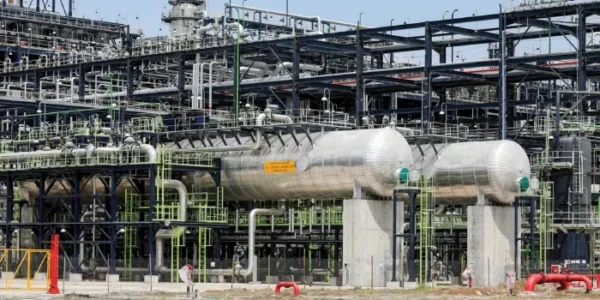
The commercial question is crude. The plant requires regional production above 600,000 barrels a day to run at capacity, against projections of 350,000 from South Sudan, 250,000 from Uganda and 120,000 from Kenya, whose own output is expected to begin towards the end of this year. Showing Kenya’s efforts to support the refinery, Ruto told Dangote that Kenya is working on a route to move oil from the Turkana fields to Lamu.14.
The refinery is meant to supply Kenya, Uganda, South Sudan, Rwanda, Burundi and the Democratic Republic of Congo, which together import almost all their fuel.
A Challenge to the East African Crude Oil Pipeline (EACOP)
The proposed Dangote Lamu Oil Refinery shifts regional dynamics and poses significant economic competition for the East African Crude Oil Pipeline (EACOP) by challenging its core feedstock supply and export strategy.
EACOP is a $5 billion, 1,443 km heated pipeline that runs from Uganda’s Lake Albertine basin to the Port of Tanga in Tanzania. The pipeline was solely constructed to export raw Ugandan crude oil (around 216,000–246,000 bpd) directly to international overseas markets. However, with Dangote’s refinery requiring over 600,000 barrels per day of regional crude to operate at full capacity, it relies heavily on Uganda’s projected 250,000 bpd alongside South Sudan’s and Kenya’s output.
By offering East African nations an internal mechanism to process their own unrefined oil into high-value fuel products locally, the Lamu mega-refinery incentives regional governments to retain and divert their crude domestic-bound rather than shipping raw petroleum out via Tanga, directly threatening to reduce throughput volumes, pipeline tariff revenues, and commercial returns expected by EACOP operators and investors.
Factsheet: Dangote East Africa Oil Refinery
Project Name: Dangote East Africa Oil Refinery
Location: Lamu (LAPSSET Corridor / Hindi-Manda Magogoni area), Coast Region, Kenya
Key Stakeholders and Developers: Dangote Industries (Anchor Owner), Africa Finance Corporation (AFC), Government of Kenya
Groundbreaking Date: Wednesday, September 30, 2026
Projected Cost / Valuation: $16 Billion – $20 Billion
Financing Structure: 70% Debt / 30% Equity
KSh 1.45 Trillion borrowed
Regional equity shares offered to East African states (Kenya target: 10%)
Refine Capacity: 700,000 barrels per day (bpd) (2nd largest in Africa after Lekki, Nigeria)
Integrated Assets: 1,000 MW Power Plant (500 MW offered to the Kenyan national grid)
Port & Petrochemical auxiliary facilities
Target Job Creation: 60,000 direct and indirect jobs
Key Offtake Markets: Kenya, Uganda, South Sudan, Rwanda, Burundi, Democratic Republic of Congo (DRC), Ethiopia, Tanzania
Required Regional Crude Input 600,000+ bpd needed for full capacity operations
Regional Projections: South Sudan (350k bpd), Uganda (250k bpd), Kenya (120k bpd via Turkana pipeline route)
Legal and Social Disputes, Land Rights: Lawsuit filed by 133 Chandavai/Manda Magogoni residents over displacement/lack of compensation; Malindi Environment Court issued status quo order through October.
Ownership Transparency: Political demands (Ndindi Nyoro / PPK) for full publication of beneficial ownership details.

Leave a Reply