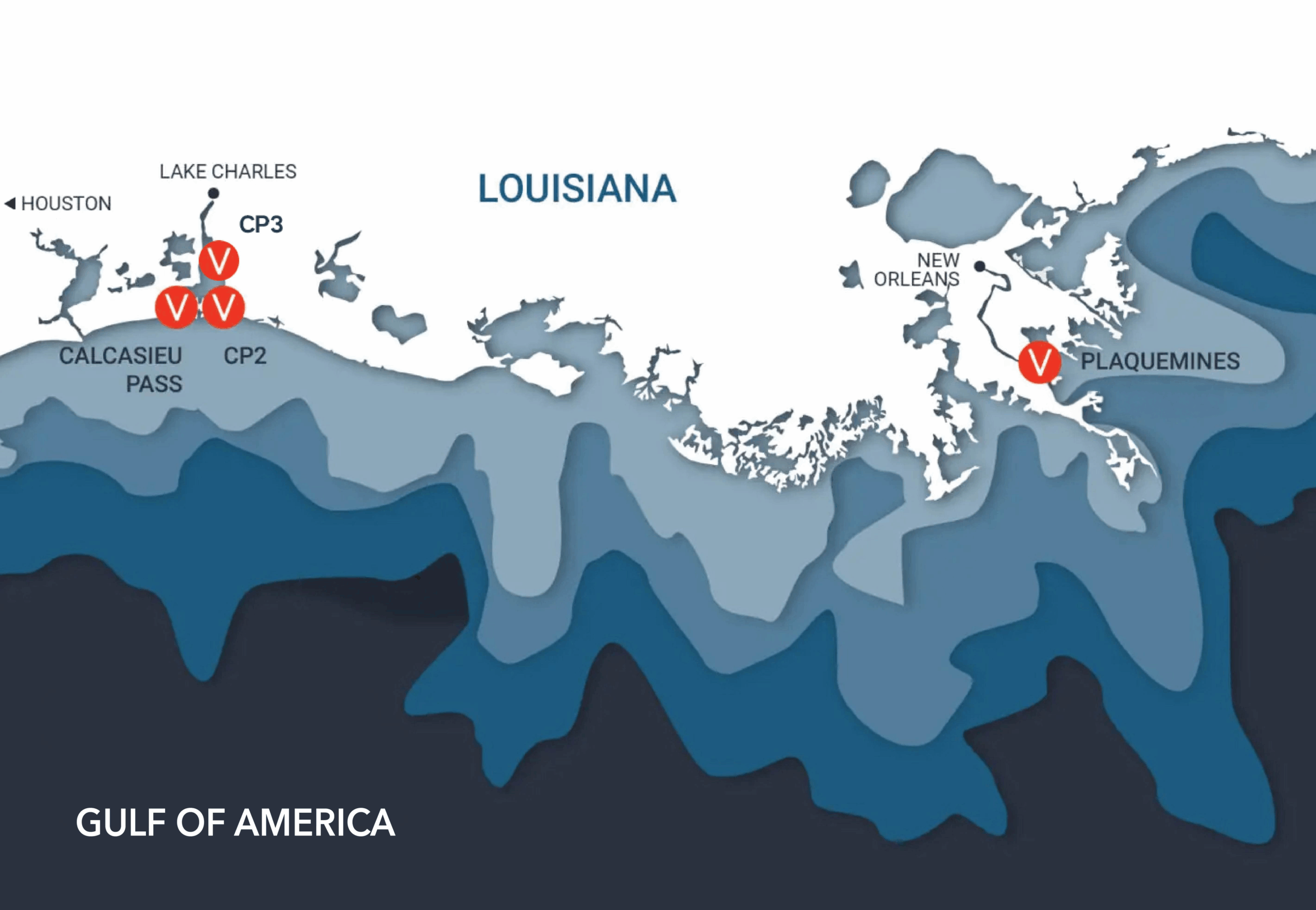
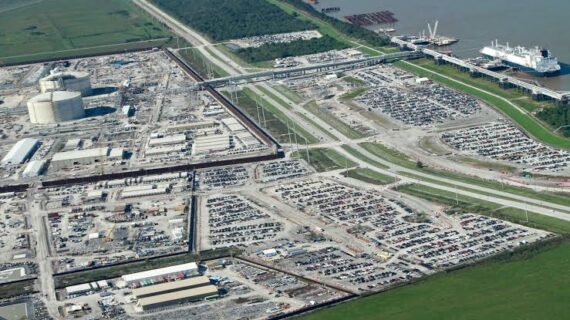
Plaquemines LNG is pursuing an $18 billion expansion that would make it North America’s largest liquefied natural gas export terminal under the Trump administration’s expedited “national energy emergency” permitting process. The facility is to be expanded from almost 590 acres to about 1,220 acres along the Mississippi River, more than doubling its size. The Plaquemines LNG expansion was approved by the Army Corps of Engineers in a matter of 10 days, instead of the usual 30-day public comment period. In the meantime, environmentalists say the expedited review could endanger up to 470 acres of wetlands and river bottoms in Central Plaquemines Parish in Louisiana.
Venture Global, the Virginia-based terminal owner, plans to increase production capacity from 1.4 trillion cubic feet of gas annually to around 2.3 trillion. In particular, the $18 billion Plaquemines LNG expansion involves dredging. It also includes in-water construction, and marsh filling in an area where coastal land loss is accelerating. The project is one of hundreds that could be expedited under Trump’s emergency energy declaration.
Another major LNG project is the Federal Energy Regulatory Commission’s Cameron LNG. The project is a planned expansion of the Cameron LNG export terminal near Hackberry, Louisiana. The project is intended to increase the facility’s LNG production capacity through the addition of a fourth liquefaction train and modifications to the existing facility.
Plaquemines LNG Expansion Threatens Wetlands in Disappearing Coastal Parish
Over the last 60 years, Plaquemines Parish has experienced a loss of over 250 square miles of land due to subsidence, sea level rise, and erosion. In particular, the state’s Coastal Protection and Restoration Authority estimates that another 300 square miles, about half of the remaining land in the parish, may be lost in the next 50 years. The $18 billion Plaquemines LNG expansion, which will cause 470 acres of wetland damage, exacerbates concerns about the coastal crisis.
“With the rate of land loss, destroying 400 more acres in Plaquemines Parish is ridiculous,” said Matt Rota, senior policy director with Healthy Gulf. In addition, the expanded facility could generate at least 9 million tons of greenhouse gases per year, and expansion could raise emissions from current 8.1 million tons per year, according to federal filings.
Plaquemines LNG Expansion Conflicts with Energy Independence Goals
The $18 billion Plaquemines LNG expansion is not for domestic energy use, but for export to Europe. Specifically, of the 833 billion cubic feet exported last year, most went to European markets with Germany receiving 19% of shipments. But critics say exporting natural gas overseas is not in line with Trump’s stated reason for emergency permitting: to make energy supplies more reliable at home. Venture Global will use carbon capture and sequestration to bury some of the emissions from the Plaquemines LNG expansion. However, additional natural gas exports abroad will contribute to climate change and sea level rise that pose a threat to the Louisiana coast.
Project Overview
- Project Name: Plaquemines LNG Expansion
- Project Value: $18 Billion
- Location: Port Sulphur, Central Plaquemines Parish, Louisiana
- Owner: Venture Global (Virginia-based)
- Status: Fast-tracked permitting approved, project advancement underway
Scope
- Facility expansion from 590 to 1,220 acres
- Production capacity increase: 1.4 to 2.3 trillion cubic feet annually
- Three ship berths operational
- Two gas-fired power plants
- 30 miles of natural gas pipeline
- Carbon capture and sequestration infrastructure
Project Highlights
- Largest LNG export terminal in North America upon completion
- Trump administration emergency permitting fast-track approval
- Current facility: 1.3 miles Mississippi River frontage
- 8.1 million tons annual greenhouse gas emissions (pre-expansion)
- Major Louisiana industrial facility and economic contributor
Key Developments
- Army Corps of Engineers granted fast-track permitting summer 2026
- Public comment period reduced from 30 to 10 days
- Expansion approval under Trump national energy emergency declaration
- 470 acres of wetland damage anticipated
- Nine million tons annual emissions projected post-expansion
Key Challenges
- 470 acres of wetland and river bottom damage
- Coastal erosion and land loss acceleration
- Greenhouse gas emissions at 9+ million tons annually
- Climate change and sea level rise acceleration
Outlook
- Fast-tracked approval expected imminently
- Construction beginning on 630-acre expansion site
- Production capacity doubling to 2.3 trillion cubic feet annually


Leave a Reply