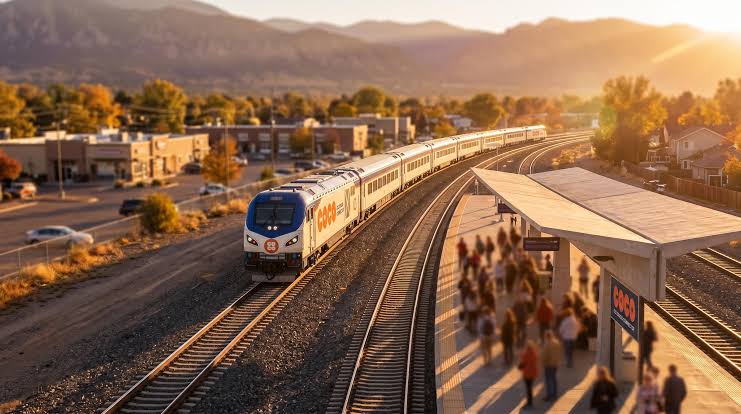
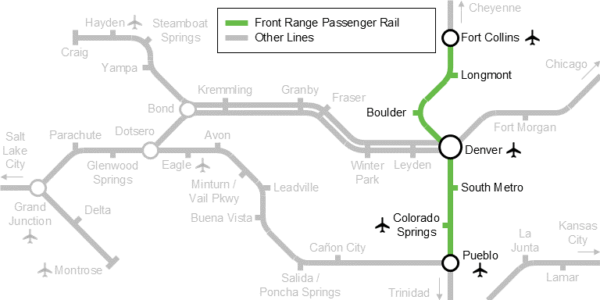
The $4.7bn Front Range Passenger Rail by the Colorado Rail District advanced with a phased delivery plan for its long-planned rail system. This begins with a $332 million starter line between Denver and Fort Collins. Moreover, it outlines an implementation strategy for what could become a roughly $4bn+ intercity rail network. It will extend from Fort Collins in the north, running south through Denver as the regional hub, and terminating at Pueblo. The district’s Executive Committee unanimously voted to send Resolution 2026-27 to the FRPR board with a recommendation for approval.
Called the Colorado Connector, or “CoCo,” the program is divided into three major phases spanning roughly 190 miles between termini. Initial service would also launch in 2029 with three daily round trips over the 72-mile segment between Denver Union Station and Fort Collins. A second phase, estimated at approximately $1.7 billion, would extend the line about 75 miles south to Colorado Springs. Moreover, another 44 miles will extend to Pueblo, all within five years after securing dedicated funding. Longer-term expansion over roughly 20 years would bring total capital investment to about $4.7 billion. With its cost and scale, the project could easily top as one of the major ongoing rail projects in the U.S.
Scope of Implementation on the Front Range Passenger Rail Delivery Plan
The Front Range Passenger delivery plan plans that the Colorado Connector will not rely on new tracks. Instead, it will leverage existing freight corridors with construction focusing on different aspects. These include increased capacity, such as new and extended passing sidings, track and roadbed upgrades, crossovers, signal and communications improvements etc. North of Denver, trains would operate over Regional Transportation District infrastructure (RTD) before joining BNSF Railway’s Front Range Subdivision. Later phases would extend south over the BNSF-Union Pacific Joint Line and Consolidated Main Line.
Project planners told committee members that the second phase would add additional infrastructure needed to increase service north of Denver from three to four daily round trips,. It will also support operations south to Pueblo. The work would include station sidings that allow trains to leave the main line. Moreover, there will be additional capacity for passenger-train meets and changes needed to preserve railroad maintenance windows.
Those improvements also would support later service expansion. The proposed $332-million starter phase would be financed through existing commitments from the Colorado Transportation Investment Office and RTD, with Amtrak serving as the initial operator. The district says the first phase would require no new taxes or additional federal funding. Expansion south of Denver would depend on voter approval of a proposed regional sales tax that could appear on the ballot this November.
Project Overview
- Project Value: $4.7B
- Location: Colorado, USA
- Developer: Front Range Passenger Rail District
- Status: Phased delivery plan advancing
Scope
- Rail line from Fort Collins to Pueblo
- $332M Denver–Fort Collins starter line
- Three delivery phases
- About 190 miles of rail service
Project Highlights
- Initial service planned for 2029
- Three daily round trips initially
- Existing rail corridors to be used
- Amtrak to operate first phase
Key Infrastructure
- Track capacity upgrades
- New passing sidings
- Signal improvements
- Station and roadbed upgrades
Funding
- Starter phase funded by existing commitments
- No new taxes for Phase 1
- Southward expansion needs voter approval
- Long-term investment totals $4.7B
Outlook
- Board approval process underway
- First phase targets 2029 launch
- Future expansion depends on funding
- Project aims to improve statewide rail travel

Leave a Reply