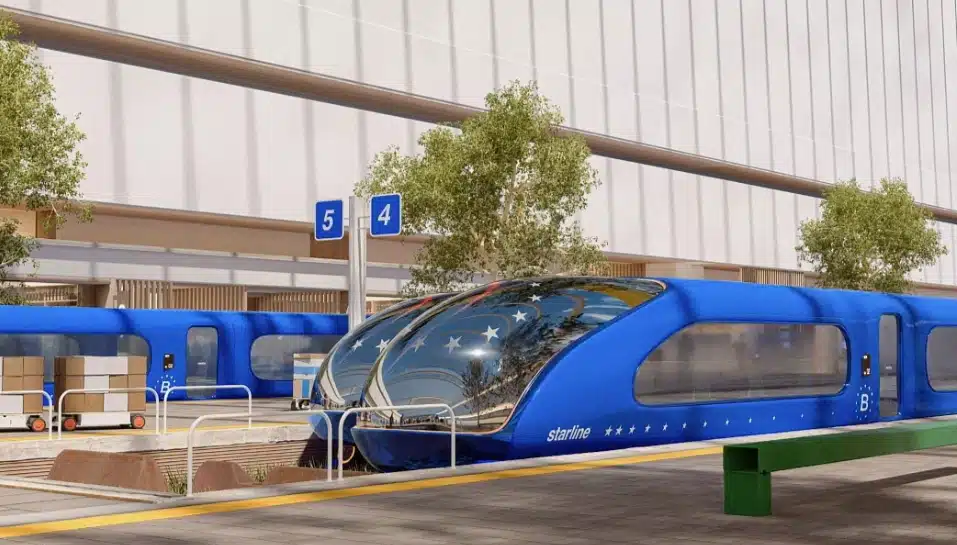
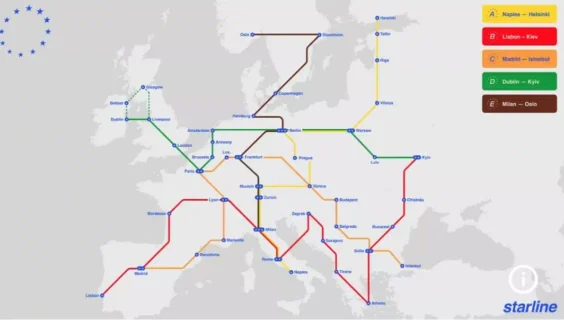
The Starline Project has emerged as one of the world’s most ambitious transport construction proposals. The estimated $490 billion scheme aims to connect 39 destinations across 22 countries through a continent-wide high-speed rail system operating like a metro network. Developed by Copenhagen-based think tank 21st Europe, the proposal seeks to reshape Europe’s fragmented rail infrastructure while reducing dependence on short-haul flights. The network would stretch roughly 22,000km and connect cities from Dublin to Kyiv and from Lisbon to Helsinki.
The proposal positions Starline as a strategic infrastructure project rather than a conventional rail expansion. Moreover, planners intend to integrate national rail systems into one coordinated network with unified ticketing, synchronized schedules and standardized passenger services. According to 21st Europe, the network could operate at speeds between 300km/h and 400km/h, making it around 30% faster than current rail and road connections across Europe.
Starline Project aims to transform Europe’s rail construction sector
The Starline Project would require major civil engineering works across the continent. New rail corridors, tunnels, bridges, digital signaling systems and large intermodal stations would support the network. In addition, the proposal calls for newly built transport hubs outside major cities, with direct links to existing urban transit systems.
The stations would function as mixed-use developments instead of traditional rail terminals. Therefore, planners envision commercial areas, restaurants, museums, event venues and public spaces within the stations. The project also proposes a unified architectural identity for trains and terminals to strengthen cross-border travel integration.
The network could significantly reduce travel times between major European cities. For example, travelers could reportedly move from Helsinki to Berlin in just over five hours. Likewise, the journey between Kyiv and Berlin could shift from an overnight trip to a seamless same-day connection. Meanwhile, Milan and Munich would gain a faster high-frequency rail corridor supporting business and tourism activity.
The construction concept also introduces redesigned train interiors. Instead of first and second-class compartments, carriages would feature dedicated spaces for families, quiet work areas and social seating sections. Consequently, the proposal aligns rail design with changing passenger expectations across Europe’s transport market.
Starline Project supports Europe’s net-zero infrastructure goals
The Starline Project also carries a strong environmental focus. Transport currently accounts for nearly 29% of greenhouse gas emissions within the European Union. However, high-speed rail can emit up to 90% less CO2 per journey compared to short-haul aviation. Therefore, 21st Europe argues that large-scale rail investment could help Europe achieve its 2050 net-zero targets.
Several European countries already limit short-haul flights where rail alternatives exist. Nevertheless, fragmented ticketing systems and inconsistent cross-border operations continue to discourage wider rail adoption. The Starline proposal attempts to address those barriers through centralized coordination and standardized operations.
The project would operate under a publicly funded franchise structure. National rail operators would run services under oversight from a proposed European Rail Authority. Additionally, the framework would harmonize technical standards, labor agreements and safety systems across participating countries.
Despite growing interest, the proposal still faces major financial and political challenges. Large-scale infrastructure approvals across Europe often encounter delays linked to environmental reviews, land acquisition and funding negotiations. Furthermore, industry analysts note that the proposal currently remains a strategic vision rather than a fully financed construction program.
Even so, the Starline Project has already sparked debate across Europe’s construction and transport sectors. If implemented, the network could become the world’s largest metro-style rail system and one of the biggest infrastructure programs ever attempted on the continent.
Several cross-border rail megaprojects already support Europe’s wider high-speed transport ambitions, including the Brenner Base Tunnel (BBT) Project in Austria and Italy, which will form part of the Scandinavian–Mediterranean transport corridor once completed. Furthermore, across Europe, major rail infrastructure schemes continue advancing alongside urban transit upgrades, including the proposed West London Orbital project after feasibility study, which aims to expand orbital rail connectivity across London through new stations and upgraded freight corridors.
Project Fact Sheet
Project Name: Starline Project
Estimated Cost: Approximately $490 billion
Project Type: High-speed rail and transport infrastructure network
Network Length: Approximately 22,000km
Coverage Area: 22 European countries
Destinations Connected: 39 cities and regional hubs
Proposed Train Speeds: 300km/h–400km/h
Lead Concept Developer: 21st Europe
Proposed Completion Vision: 2040 and beyond
Funding Model: Publicly funded franchise system
Operations Structure: National rail operators under centralized European coordination
Key Features: Unified ticketing, metro-style connectivity, mixed-use stations, and integrated urban transport links
Environmental Goal: Reduction of short-haul aviation emissions and support for Europe’s 2050 net-zero targets
Planned Station Design: New multimodal stations outside major cities with commercial and cultural facilities
Project Team
Project Owner: Proposed pan-European public transport infrastructure consortium involving participating European governments and rail authorities
Sponsor: 21st Europe
Vision and Strategic Development Lead: 21st Europe
Proposed Regulatory Authority: Proposed European Rail Authority
Potential Infrastructure Partners: National rail infrastructure agencies across participating European countries
Potential Rail Operators: Approved national rail companies operating under a unified European framework
Potential Funding Structure: Public-sector funding supported by participating European governments and regional infrastructure programs
Potential Financiers: European Investment Bank (EIB), European Union infrastructure funding mechanisms and national transport investment agencies
Potential Engineering and Construction Scope: Civil works contractors for high-speed rail corridors, tunnels, bridges, stations and signaling systems
Potential Urban Integration Partners: Municipal transit authorities and metropolitan planning agencies across connected cities
Technology and Systems Integration Scope: Rail signaling providers, digital ticketing system developers and interoperability specialists
Environmental and Sustainability Stakeholders: European climate policy institutions and regional sustainable mobility agencies
Rolling Stock Supply Scope: High-speed train manufacturers and rail systems engineering firms across Europe
Station Development Scope: Mixed-use urban development partners, station architects and commercial infrastructure developers



Leave a Reply