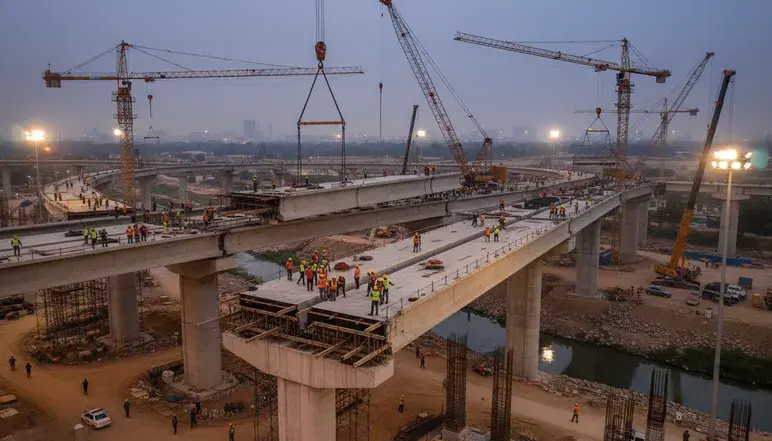
The Delhi–Mumbai 8-lane expressway project has crossed 929km of operational sections in 2026, bringing it close to completion; however, authorities have pushed full delivery to 2027–2028 due to delays in critical segments. The project is transforming India’s transport landscape across 1,350 kilometers of high-speed roadway. It directly connects New Delhi and Mumbai, cutting travel time from 24 hours to nearly 12 hours. Notably, the corridor already has 929 kilometers operational across multiple sections. Moreover, this ₹90,000 crore ($54 billion) investment ranks among the largest highway construction programs globally. As a result, the project is redefining long-distance mobility and logistics efficiency across India’s busiest economic axis.
Delhi–Mumbai 8-lane expressway project accelerates nationwide connectivity
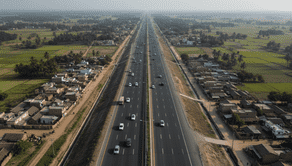
The Delhi–Mumbai 8-lane expressway project spans six states: Haryana, Rajasthan, Madhya Pradesh, Gujarat, Maharashtra, and Delhi. It follows a Greenfield alignment that avoids congested urban corridors. Consequently, it enables uninterrupted high-speed travel across regions that previously experienced severe bottlenecks.
Additionally, planners divided the corridor into four sections and 52 construction packages to speed up execution. This strategy allows contractors to build multiple segments simultaneously. Therefore, progress has remained steady despite terrain and weather challenges.
Importantly, the expressway links major cities such as Jaipur, Indore, Bhopal, Ahmedabad, and Vadodara. These cities now gain direct access to India’s primary economic corridor. As a result, industrial zones along the route are attracting fresh investment and logistics activity.
Furthermore, the toll for a full journey stands at about ₹2,700 for passenger vehicles. Although this cost reflects premium infrastructure, it delivers significant time savings. For freight operators, reduced transit time directly translates into higher fleet productivity and lower fuel consumption.
Delhi–Mumbai 8-lane expressway project construction progress and engineering scale
The Delhi–Mumbai 8-lane expressway project has achieved substantial progress, with over 929 kilometers already operational. In February 2023, Prime Minister Narendra Modi inaugurated the 246-kilometer Delhi–Dausa–Lalsot section. This segment reduced travel time between Delhi and Jaipur from five hours to three.
Subsequently, authorities opened another 244 kilometers in Madhya Pradesh in September 2023. In addition, the Vadodara–Bharuch stretch became operational in February 2024. By mid-2024, construction teams had completed more than 80% of the total work.
Meanwhile, the Delhi–Vadodara section reached nearly 99% completion by early 2026. However, the Mukundra Hills Tunnel remains under construction due to environmental and geological complexity. Engineers are building this tunnel through a protected reserve while minimizing ecological disruption.
The expressway features eight lanes from the outset and allows expansion to twelve lanes. It integrates hundreds of bridges and viaducts to eliminate crossings and improve safety. Moreover, access-controlled entry ensures smooth traffic flow without interruptions.
Designers also included intelligent transport systems to monitor traffic and manage incidents. Therefore, the corridor will deliver both speed and safety improvements compared to conventional highways.
Economic transformation driven by the Delhi–Mumbai 8-lane expressway project
The expressway is driving structural changes in India’s logistics and industrial sectors. Freight that once required up to three days now moves in less than 14 hours. Consequently, businesses can reduce inventory costs and improve delivery timelines.
Moreover, the corridor connects agricultural regions to major consumption and export markets. Farmers and producers gain faster access to urban centers and ports. As a result, supply chains become more efficient and competitive.
In addition, real estate and industrial development is expanding along the route. Logistics parks, warehouses, and manufacturing clusters are emerging near key interchanges. Therefore, the expressway is acting as a catalyst for regional economic growth.
Despite delays caused by monsoon seasons and land acquisition challenges, construction continues at pace. The Delhi–Vadodara section is expected to open fully by December 2026. Meanwhile, the more complex Vadodara–Mumbai stretch will likely reach completion between 2027 and 2028.
Ultimately, the project demonstrates India’s capacity to deliver large-scale infrastructure within tight timelines. It also highlights the strategic importance of connecting political and financial capitals through modern transport corridors.
The Delhi–Mumbai 8-lane expressway project also aligns with India’s broader push to expand high-capacity road corridors, including the Mumbai–Bangalore 14-lane expressway project. This separate greenfield corridor, estimated at about ₹40,000 crore, aims to cut travel time between Mumbai and Bengaluru from roughly 18 hours to six while easing congestion on existing routes. Consequently, both projects highlight a coordinated strategy to modernize long-distance transport, strengthen logistics efficiency, and support economic growth across major urban and industrial hubs.
Project Fact Sheet
Project Name: Delhi–Mumbai 8-Lane Expressway Project
Total Length: 1,350 kilometers
Investment Value: ₹90,000 crore (approx. $54 billion)
Operational Length: 929+ kilometers completed
Remaining Sections: Under construction, including tunnel works
States Covered: Delhi, Haryana, Rajasthan, Madhya Pradesh, Gujarat, Maharashtra
Configuration: 8 lanes, expandable to 12 lanes
Design Speed: Up to 120 km/h
Travel Time Reduction: 24 hours to approximately 12 hours
Toll Estimate: ₹2,700 for passenger vehicles (end-to-end)
Key Structures: Mukundra Hills Tunnel, major bridges, and viaducts
Completion Timeline: 2026 (Delhi–Vadodara), 2027–2028 (full corridor)
Project Team
Project Owner: Government of India
Lead Authority: Ministry of Road Transport and Highways (MoRTH)
Implementing Agency: National Highways Authority of India (NHAI)
Program Framework: Bharatmala Pariyojana
Delivery Models: Engineering, Procurement and Construction (EPC) and Hybrid Annuity Model (HAM)
Key Contractors (package-based execution):
- Larsen & Toubro (L&T) – Major civil works and expressway sections
- IRB Infrastructure Developers – Toll and highway development packages
- Dilip Buildcon – Road construction and segment delivery
- Apco Infratech – EPC execution across multiple packages
Consultants and Oversight:
- Independent Engineers – Quality assurance and compliance monitoring
- Design Consultants – Detailed engineering design and alignment planning
- Environmental Specialists – Mitigation planning for sensitive zones including Mukundra Hills


Leave a Reply