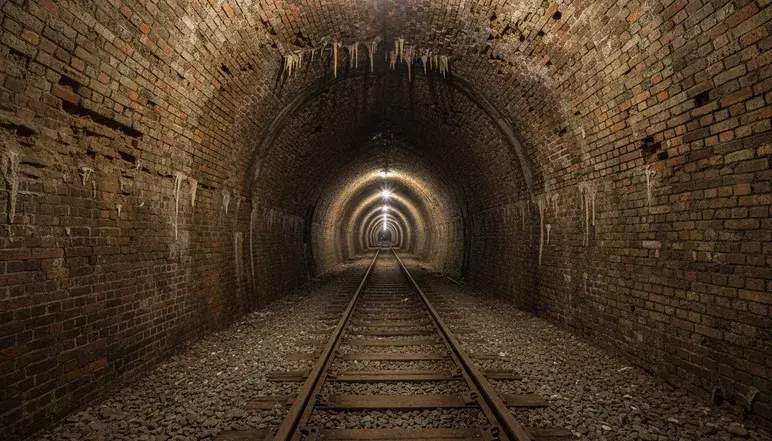
Frederick Douglass Tunnel Project is advancing beneath Baltimore while trains continue running across one of the busiest rail corridors in the United States. The $6 billion construction replaces the 150-year-old Baltimore & Potomac Tunnel, which still carries about 14 million passengers annually. However, the aging structure restricts speed and reliability. Therefore, engineers are building a modern parallel tunnel without stopping a single train, ensuring uninterrupted service along the Northeast Corridor.
The original tunnel, completed in 1873, was designed for steam locomotives. Today, modern electric trains must pass through the same confined space, which forces drastic speed reductions. Consequently, delays and maintenance disruptions have become frequent. As a result, the Frederick Douglass Tunnel Project aims to eliminate this bottleneck while maintaining continuous operations throughout construction.
Frederick Douglass Tunnel Project resolves critical Northeast Corridor bottleneck
The existing tunnel connects Baltimore’s Penn Station to Washington, D.C., and Virginia. Therefore, it forms a key segment of the Northeast Corridor linking Boston, New York, and Philadelphia. Millions of passengers depend on this route each year. Consequently, any disruption affects rail services across the entire East Coast.
Moreover, the tunnel’s outdated design limits efficiency and capacity. Trains slow significantly inside the tunnel, although other sections allow speeds exceeding 200 km/h. In addition, frequent maintenance increases operational risks. Therefore, Amtrak considers the tunnel a single point of failure.
The Frederick Douglass Tunnel Project directly addresses these constraints. By introducing a new tunnel alongside the old one, the project ensures service continuity while modernizing infrastructure. This approach supports reliability during construction and long-term network resilience.
Frederick Douglass Tunnel Project delivers modern high-speed infrastructure
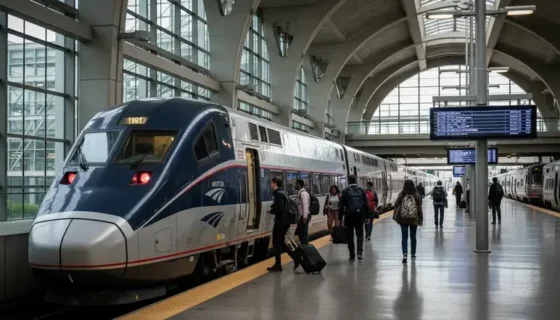
The new tunnel will consist of two parallel tubes designed for electric passenger trains. Each tube will support speeds up to 160 km/h, which is significantly higher than current limits. Consequently, travel times between Baltimore and Washington will decrease.
In addition, the project extends beyond the tunnel to cover 16 km of corridor upgrades. These works include bridge replacements, track realignments, and a new accessible MARC station in West Baltimore. Furthermore, engineers are installing advanced fire safety and emergency evacuation systems, which improve passenger safety.
The project also honors Frederick Douglass, an abolitionist who lived in Baltimore. Meanwhile, planners are integrating modern infrastructure within a dense urban environment. Therefore, coordination with multiple agencies remains essential.
Frederick Douglass Tunnel Project overcomes complex construction challenges
The project’s greatest challenge involves building a new tunnel without halting existing rail operations. Closing the old tunnel would disrupt the entire Northeast Corridor. Therefore, engineers are constructing the new tunnel in parallel.
In January 2026, teams completed geotechnical investigations to assess soil conditions and protect surrounding structures. These studies ensure safe excavation beneath a built-up city. Meanwhile, construction continues in phases to reduce risks.
The main contract was awarded to the Kiewit/J.F. Shea joint venture in February 2024. Additionally, the UIT Infrastructure/JFSHA consortium is carrying out tunneling works. Three emergency evacuation facilities are also planned, thereby improving safety standards.
Funding comes primarily from the Infrastructure Investment and Jobs Act. Federal agencies, Amtrak, and the state of Maryland contribute resources. Moreover, a $50 million community investment program supports development in West Baltimore.
The project is expected to be completed by 2035, although timelines may shift. Once finished, passengers will benefit from faster journeys and improved reliability. Therefore, the Frederick Douglass Tunnel Project will unlock the most critical bottleneck in the Northeast Corridor.
The progress of the Frederick Douglass Tunnel Project in Baltimore reflects a broader wave of major infrastructure approvals across the United States, including energy and transport developments moving through state-level regulatory frameworks. This aligns with trends seen in other large-scale projects such as the West Virginia MVP pipeline initiative, which highlights how federal and state coordination continues to shape critical infrastructure delivery; more details can be found in the related update on the West Virginia MVP project approval.
Project Fact Sheet
Project Name: Frederick Douglass Tunnel Project
Location: Baltimore, Maryland, USA
Project Length: 16 km corridor modernization
Tunnel Length: Approximately 3.2 km (two parallel tubes)
Existing Tunnel: Baltimore & Potomac Tunnel (2.2 km, built in 1873)
Estimated Cost: $6 billion
Objective: Replace aging tunnel and improve capacity, speed, and safety
Key Features:
- Dual high-capacity tunnel tubes for electric trains
- Maximum operating speeds up to 160 km/h
- Replacement of bridges along the corridor
- New fully accessible MARC station in West Baltimore
- Advanced fire safety and emergency evacuation systems
Construction Strategy: Parallel tunnel construction without interrupting train services
Timeline: Ongoing; estimated completion by 2035
Funding Sources:
- Infrastructure Investment and Jobs Act
- Federal Railroad Administration
- Amtrak
- State of Maryland
Economic Impact:
- Tens of thousands of jobs during construction
- Improved regional connectivity
- Reduced long-term maintenance costs
Project Team
Project Owner: Amtrak
Oversight Authorities:
- U.S. Department of Transportation
- Federal Railroad Administration
- Maryland Department of Transportation
Main Contractors:
- Kiewit/J.F. Shea Joint Venture
- UIT Infrastructure/JFSHA Consortium
Engineering and Technical Scope:
- Geotechnical investigations and soil stabilization
- Tunnel structural design and excavation planning
- Rail systems, electrification, and signaling design
- Safety systems including fire protection and evacuation
Project Management:
- Integrated teams overseeing design and construction phases
- Coordination with federal, state, and city authorities
- Compliance monitoring and risk management
Key Stakeholders:
- Amtrak and MARC commuter rail operators
- City of Baltimore
- Local communities in West Baltimore
- Transportation and infrastructure agencies


Leave a Reply