
Vietnam north-south railway construction will now target December 2027, delaying physical works by one year under Vietnam’s revised schedule. The $67.34 billion project previously targeted construction commencement by December 2026. However, preparations have taken longer than authorities initially expected. The delay highlights the complexity of delivering Vietnam’s largest railway infrastructure investment. The 1,541km corridor will connect Hanoi with Ho Chi Minh City through a new high-speed railway.
The revised timeline follows slower progress across several critical pre-construction activities. These include land clearance, consultancy procurement, surveying and feasibility study preparation.
Vietnam North-South Railway Preparations Drive New Construction Timeline
Vietnam’s Ministry of Construction now wants agencies to target December 2027 for groundbreaking. Construction Minister Tran Hong Minh issued the directive following a September 8 implementation meeting.
The minister ordered project management boards to prepare detailed implementation schedules. Those schedules must identify responsibilities, individual tasks and deadlines for every major activity.
The Thang Long Project Management Board has already signed a project support consultancy contract. The consultant has prepared requirements and cost estimates for the feasibility study package.
Authorities are also preparing consultant selections covering surveys and feasibility study development. Additional packages will cover survey supervision and environmental impact assessment.
Meanwhile, land clearance is progressing through separate projects managed by local authorities. The railway requires approximately 10,827 hectares of land along its planned corridor. Around 120,836 people could require resettlement during the land acquisition process.
These preparations must advance before major construction packages can move forward. Consequently, the government now faces pressure to maintain momentum toward the revised groundbreaking date.
The ministry has also reviewed legal frameworks, technical standards, construction norms and applicable cost estimates. Officials consider these measures important for reducing implementation obstacles.
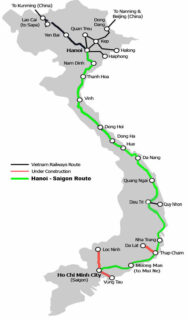
Vietnam North-South Railway Construction Will Cover Major Corridor
The railway will run from Ngoc Hoi Station in Hanoi to Thu Thiem Station in Ho Chi Minh City. The current route covers approximately 1,541km across 15 provinces and centrally governed cities.
The project will use double tracks with a standard 1,435mm gauge. Its design speed will reach 350km/h, while the maximum axle load will reach 22.5 tonnes.
The railway will primarily transport passengers while supporting national defence and security requirements. It will also accommodate freight services when necessary.
The planned system includes 23 passenger stations and five freight stations. The government expects the completed railway to cut Hanoi-Ho Chi Minh City travel time to approximately 5.5 hours.
Construction will proceed through separate sections rather than across the entire corridor simultaneously. The Hanoi-Vinh and Nha Trang-Ho Chi Minh City sections are expected to begin first.
The Vinh-Nha Trang section will follow during 2028 and 2029. Vietnam aims to complete the entire railway by 2035.
The investment will therefore generate substantial demand for civil engineering, railway systems and construction services. It will also require rolling stock, stations, bridges, tunnels, electrical systems and supporting infrastructure.
Earlier project studies estimated that about 60% of the route could run on bridges. Another 10% could pass through tunnels, with the remainder constructed on land.
The ministry is also encouraging domestic production within the project’s procurement strategy. Officials want suitable local products and services to support Vietnamese manufacturing and economic activity.
Vietnam’s North-South Railway is part of a wider expansion of major rail infrastructure across Asia. Taiwan’s Kaohsiung MRT Yellow Line similarly combines large-scale construction with advanced railway systems and international engineering expertise. The $1.4 billion Yellow Line contract involves ST Engineering, Siemens Mobility and Stadler Rail across systems integration, signaling and rolling stock.
The Kaohsiung project provides a useful regional comparison as Vietnam prepares its own high-speed railway construction program. Its 22.8km route will include 22 underground stations and one elevated station, connecting six major areas of Kaohsiung.
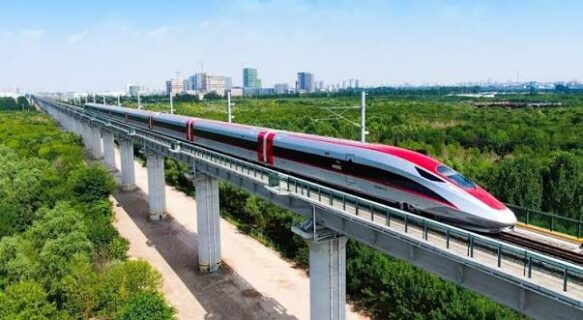
Project Fact Sheet
Project: Vietnam North-South Railway
Location: Vietnam
Route: Ngoc Hoi Station, Hanoi, to Thu Thiem Station, Ho Chi Minh City
Total length: Approximately 1,541km
Estimated investment: $67.34 billion
Revised construction target: December 2027
Original construction target: December 2026
Completion target: 2035
Design speed: 350km/h
Track configuration: Double track
Track gauge: 1,435mm standard gauge
Maximum axle load: 22.5 tones
Passenger stations: 23
Freight stations: 5
Land requirement: Approximately 10,827 hectares
Estimated resettlement: Approximately 120,836 people
Primary function: High-speed passenger transport
Additional function: Freight transport when necessary
Target Hanoi-Ho Chi Minh City journey: Approximately 5.5 hours
First construction sections: Hanoi-Vinh and Nha Trang-Ho Chi Minh City
Subsequent section: Vinh-Nha Trang
Current status: Pre-construction preparation and consultancy
Major activities underway: Land clearance, surveying, consultancy and feasibility preparation
Project Team
Owner: Thang Long Project Management Board
Government authority: Vietnam Ministry of Construction
Project minister: Tran Hong Minh, Minister of Construction
Land clearance authorities: Local authorities along the railway corridor
Railway sector coordination: Vietnam Railways Corporation
National oversight: Vietnam Ministry of Construction
Construction coordination: Thang Long Project Management Board and relevant project management agencies



Leave a Reply