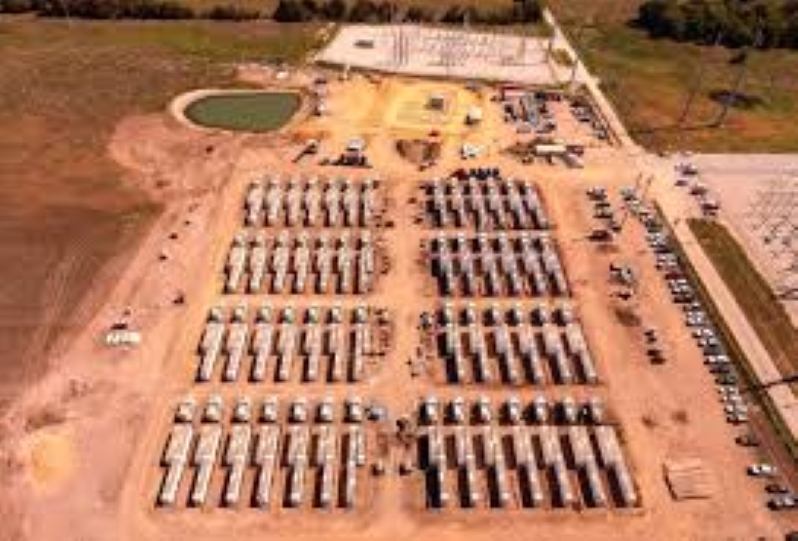
When the 150 MW / 300 MWh Riverina and Darlington Point Energy Storage System switched on in late 2023, it was the largest battery connected to the grid in New South Wales — a milestone moment for a state betting heavily on storage to replace its retiring coal fleet. Less than three years later, that record looks almost quaint. Australia’s big-battery build-out has accelerated so fast that Riverina, once a headline-grabbing first, is now a comparatively modest entry in a field of giants.
How quickly the benchmark moved
By early 2026 there were close to 50 large-scale batteries operating across Australia, with many more in construction, commissioning and advanced development. Battery cell prices have fallen more than 80% since the country’s first grid battery — the 100 MW / 129 MWh Hornsdale “Tesla big battery” — was built in South Australia, and that cost collapse has unleashed projects an order of magnitude larger. Where Hornsdale once seemed implausibly big, most of today’s leading projects carry more than ten times its storage capacity; one will have more than thirty times.
Riverina itself, developed by Edify Energy with Federation Asset Management (which owns 90% of the complex, with Edify operating it and holding 10%), remains a capable grid-forming asset on Wiradjuri Country, using Tesla Megapacks that mimic conventional generators to steady the grid. But its 300 MWh now sits well down the order as multi-gigawatt-hour systems come online.
The new giants reshaping the grid
The scale of what is now being built dwarfs those early projects. Origin Energy’s Eraring battery, being delivered in four stages by Wärtsilä next to the country’s biggest coal generator, is on track to become Australia’s largest battery around 2027 — the coal plant itself is now slated to close in early 2029. In a February 2026 tender, the NSW Government awarded Neoen the 300 MW / 3,500 MWh Great Western battery at the shuttered Wallerawang coal site near Lithgow, billed as the biggest in the country to date and one of six long-duration projects that must be built by the end of the decade.
Other heavyweights underline the trend. Neoen’s Collie battery in Western Australia (560 MW / 2,240 MWh) was briefly the nation’s largest operating system, while the Waratah Super Battery in NSW (850 MW / 1,680 MWh) and Queensland’s staged Supernode project — which has planning approval to expand beyond 1 GW and 4 GWh — show how storage is scaling toward gigawatt territory. Eight-hour systems such as the 275 MW / 2,200 MWh Richmond Valley battery point to the next frontier: longer-duration storage able to shift solar deep into the evening peak.
Why storage is suddenly everywhere
The surge is being driven by the same structural shift across the National Electricity Market: ageing coal plants are closing, variable wind and solar are filling the gap, and the grid needs fast, flexible capacity to firm that output. Batteries increasingly do more than store energy — grid-forming inverters, like those pioneered at Riverina and now standard on the biggest projects, can provide system strength and synthetic inertia once supplied only by spinning coal and gas turbines.
That role is especially critical in renewables-rich regions. In South Australia — which regularly runs on some of the world’s highest levels of variable renewable generation — the newly operational 150 MW / 300 MWh Bungama battery near Port Pirie is the first stage of a larger multi-stage development helping the state push toward net 100% renewables by 2027. Across the NEM, projects of this kind are being deployed at pace precisely because the grid can no longer lean on coal for stability.
What comes next
The trajectory is firmly toward bigger and longer. Federal and state mechanisms — from the Capacity Investment Scheme to state long-duration storage tenders — are underwriting projects that combine ever-larger power ratings with multi-hour durations, while developers race to secure sites, grid connections and offtake deals. For a system shedding coal faster than almost any comparable economy, the question is no longer whether storage can do the job, but how quickly it can be built.
Riverina helped prove the model. The projects now following it are writing the next, far larger chapter — and on current trends, today’s record-holders will look modest soon enough, too.
Snapshot: Australia’s evolving battery landscape
Riverina & Darlington Point (NSW): 150 MW / 300 MWh; operational 2023; Edify Energy / Federation Asset Management; once NSW’s largest
Hornsdale (SA): 100 MW / 129 MWh; Australia’s first big battery (2017); benchmark since dwarfed
Bungama Stage 1 (SA): 150 MW / 300 MWh; commercial operations 2026; Revera Energy / Wärtsilä; first stage of a multi-stage project
Eraring (NSW): Up to 700 MW / 2,800 MWh over four stages; Origin Energy / Wärtsilä; on track to be Australia’s biggest (~2027)
Great Western / Wallerawang (NSW): 300 MW / 3,500 MWh; Neoen; NSW tender winner (Feb 2026); ~2029
Waratah Super Battery (NSW): 850 MW / 1,680 MWh
Collie (WA): 560 MW / 2,240 MWh; Neoen
Richmond Valley (NSW): 275 MW / 2,200 MWh; eight-hour duration
Key drivers: Coal retirements, falling battery costs (down ~80% since 2017), grid-forming technology, and federal/state storage underwriting

Leave a Reply