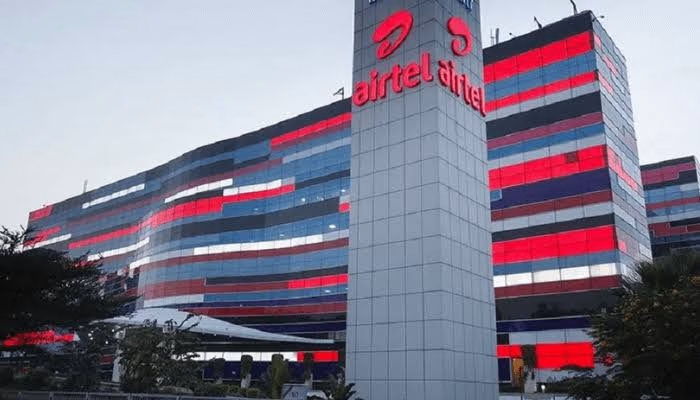
The latest news on the Nxtra by Airtel data centre in Eko Atlantic, Lagos, highlights its role as a cornerstone of Nigeria’s digital sovereignty and AI ambitions. Construction is progressing steadily on the 38-megawatt (MW) hyperscale facility — known internally as EKO1 — which recently underwent a high-level inspection by Airtel Nigeria CEO Dinesh Balsingh and Nxtra by Airtel Africa CEO Yashnath Issur. Airtel initially projected a 2026 launch, but the facility is now being delivered in four phases, with full service targeted for 2028 — a date Balsingh reaffirmed during the inspection.
The facility is uniquely positioned to address the local “compute gap” by hosting high-performance GPUs for AI model training — early GPU shipments were delivered in late 2025 — reducing Nigeria’s dependence on offshore data centres and providing high-density environments for hyperscalers and local fintechs.
This data centre project reinforces Nigeria’s position as a leading AI infrastructure developer in Africa. Countries such as Kenya and Morocco are also developing data centres. While Kenya recently suspended plans to develop a massive Microsoft data center citing power needs, Airtel’s own Nxtra arm is pressing ahead in Kenya with a 44 MW facility at Tatu City near Nairobi — its second hyperscale build after Lagos.
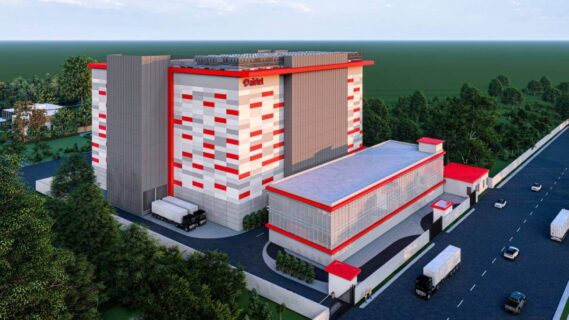
While early projections aimed for a 2026 launch, the operational timeline for full service is targeted for 2028.
August 7, 2025
Airtel Nigeria has revealed that it will be investing an additional $120 million on building its data centre in the country. This investment in the Airtel Nigeria Eko Atlantic Data Centre comes while doubling its investment on network expansion in Nigeria.
The data centre will become the largest in the country after its completion. Furthermore, it has an Information Technology load of 38 megawatts. It will be one more facility in Africa’s growing list of data centres.
Also read: MTN Nigeria Launches Sifiso Dabengwa Data Centre, West Africa’s Largest Tier III Data Centre
Part of a continent-wide Nxtra hyperscale network
The Lagos build is the first hyperscale data centre in an ambitious Nxtra by Airtel programme to roll out high-capacity infrastructure in major cities across Airtel Africa’s footprint. The second is already under way in Kenya: a 44 MW facility at Tatu City near Nairobi — billed as the largest of its kind in East Africa — which Nxtra announced in September 2025 and expects to commission in the first quarter of 2027. The multi-country rollout is supported by a multi-year partnership with Vertiv, which is supplying critical infrastructure including advanced thermal management and uninterruptible power supply (UPS) systems, plus maintenance services, across markets such as Kenya, Uganda and Tanzania.
Backed by Airtel Africa’s record 2026 results
The data-centre drive sits within a strong year for parent company Airtel Africa. In its annual report for the year ended 31 March 2026, the group reported record revenue of $6,415 million, up 29.5% in reported currency, and a total customer base of 183.5 million, including 84.2 million data customers. Group capital expenditure rose to $884 million, from $670 million the previous year. Airtel Africa explicitly frames data centres as a growth priority, noting that demand for data centres, enterprise services and home broadband is “surging,” and that it intends to “unlock further growth potential through fibre and data centre investment” across its 14 sub-Saharan markets. The strategy is being carried forward under chief executive Sunil Taldar, with chair Sunil Bharti Mittal due to step down at the July 2026 AGM.
Airtel Nigeria Eko Atlantic Data Centre Project Factsheet
Project name: Nxtra by Airtel Data Centre (EKO1), Lagos
Location: Eko Atlantic, Lagos, Nigeria
Delivery: Four phases; full service targeted for 2028 (initially projected for Q1 2026)
Purpose: To serve hyperscale cloud providers, large enterprises, small and medium-sized businesses (SMEs), and governments.
Strategic importance: Positioned in Eko Atlantic for its security, access to reliable power, and proximity to cable landing stations and dense fibre networks.
Capacity: 38 megawatts
Built-up area: Approximately 300,000 sq. ft.
Structure: G+5 (Ground plus five floors) with two data halls on each floor.
Rack capacity: Over 3,000 racks
Power density: High power density, with racks supporting up to 25 KW. This is designed to accommodate next-generation compute workloads which include GPU-powered infrastructure for AI applications.
Power Usage Effectiveness (PUE): The data centre is designed to achieve a PUE of less than 1.4. This indicates high energy efficiency.
Key supplier: Vertiv (thermal management and UPS systems, multi-market)
Connectivity: Carrier-neutral, with interconnection to global gateways and major traffic exchanges. The location provides connectivity to multiple 33 KVA power lines from different substations, ensuring redundancy.
Also read: Data Center construction projects are springing up in Africa the new frontier
Location of the Data Center
The data centre is sited at Eko Atlantic in Lagos Island. Additionally, the Airtel data centre would also boost the capacity of the telco’s data network and improve its service. This was revealed by Airtel Nigeria CEO, Dinesh Balsingh.
Challenges Affecting Good Quality Networks in Nigeria Currently
Balsingh, during a roundtable with journalists in Lagos on Tuesday, also stated that disruption to fibre cables during road construction still affects good quality networks of operators. Also, the Airtel CEO praised the federal government’s digital policies and urged the FG to do more to tackle vandalism.
Also read: Visa’s Nigeria Data Center Plans Unveiled
Meanwhile, Airtel has launched an AI-powered, future-ready software platform that will help telcos all around the world rid themselves of underlying complexity, focus on the customer, helping improve experience, lower churn and raise ARPU.
Also read: Kenyan Airtel Data Center to be Constructed in Nairobi



Leave a Reply