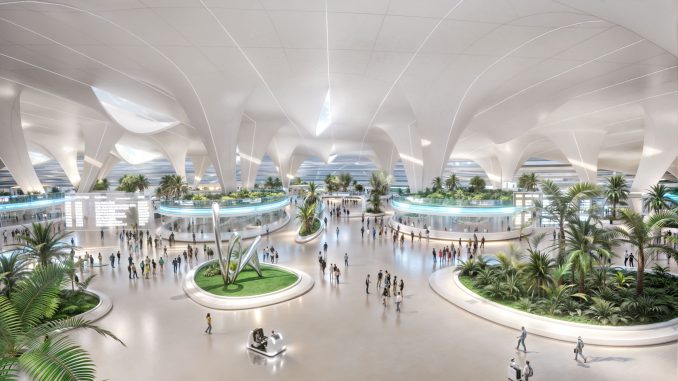
The Al Maktoum Airport APM project will advance Dubai’s airport transit construction under a major new systems contract. Larsen & Toubro (L&T) and Mitsubishi Heavy Industries (MHI) secured the Design-and-Build contract. The consortium will deliver Phase 1 of the Automated People Mover system at Al Maktoum International Airport. The award falls within L&T’s “Large” order category, valued between INR 2,500 crore and INR 5,000 crore. That translates to approximately $280 million to $560 million.
The project forms part of Dubai’s planned expansion of Al Maktoum International Airport. Dubai Aviation Engineering Projects oversees the airport’s development and associated infrastructure packages.
The new APM will provide automated passenger connections between the airport’s terminals and concourses. Therefore, the system will become an important component of the airport’s internal transportation infrastructure.
Al Maktoum Airport APM construction covers major transit systems
The L&T-MHI consortium will deliver the APM under a turnkey Design-and-Build contract. Its responsibilities cover design, construction, supply, and testing, commissioning and operational readiness.
L&T will deliver several major infrastructure and systems components. These include guideways, DC traction substations and power distribution infrastructure.
The contractor will also provide signaling and telecommunications systems throughout the APM network. Additionally, its scope includes onboard vehicle communication systems and platform screen doors.
The package also covers depot equipment required to support APM operations. These systems will allow the airport to manage automated passenger transportation efficiently.
The APM will operate underground beneath the airport apron and terminal areas. It will connect passengers between major airport facilities through a dedicated automated transit network.
Phase 1 will include four underground APM stations. These stations will serve the West Terminal and Concourse 1 development.
Concourse 1 will include 100 contact gates when the first phase becomes operational. The APM will consequently provide critical passenger circulation between these facilities.
The eventual system will expand beyond the initial four stations. Dubai’s master plan provides for a 14-station APM network across the completed airport.
Al Maktoum Airport APM supports Dubai’s $35 Billion expansion
The Al Maktoum Airport APM forms part of Dubai’s $35 billion airport expansion program. Dubai approved the broader expansion plan in April 2024.
The completed airport will accommodate more than 260 million passengers annually. It will also handle up to 12 million tones of cargo each year.
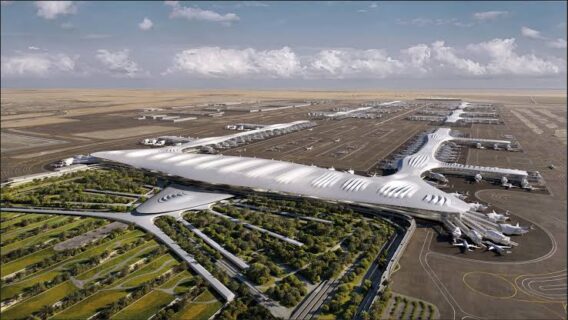
Five parallel runways will support the airport’s ultimate aviation operations. Meanwhile, four satellite concourses will support passenger processing and aircraft operations.
Phase 1 will establish the West Terminal and Concourse 1. The first stage will provide capacity for approximately 130 million passengers annually.
Subsequent phases will expand the terminal complex and APM network. Concourse 2 will add three more APM stations and additional passenger capacity.
The final development will include Concourses 3 and 4 and an East Terminal. The completed APM will then provide a 14-station network across the airport.
Dubai expects Phase 1 airport operations to begin in 2032. The APM delivery schedule must therefore align closely with terminal construction.
The system will also need integration with power, communications and other airport infrastructure. Such coordination will remain critical as construction progresses across the wider airport development.
Dubai’s airport expansion also reflects a wider regional push to improve aviation infrastructure and passenger connectivity. Saudi Arabia is pursuing a similar strategy through the $5.3 billion Mecca Airport Project, which aims to improve access for millions of Hajj and Umrah pilgrims. The two developments demonstrate how major Gulf airport projects increasingly integrate passenger transport with wider urban infrastructure.
Al Maktoum Airport APM strengthens Dubai’s aviation infrastructure
The APM project supports Dubai’s strategy to develop Al Maktoum International into a global aviation hub. The airport will combine aviation facilities with extensive ground transportation infrastructure.
The development will also connect with Dubai’s wider road and public transport networks. Consequently, the APM will form part of a broader multimodal transportation system.
For L&T, the contract expands its international transportation infrastructure portfolio. The company has delivered major rail and transportation projects across several international markets.
MHI brings specialized automated people-mover technology and systems expertise to the consortium. Its involvement complements L&T’s infrastructure, construction and systems integration capabilities.
The partnership therefore combines major civil infrastructure expertise with specialized automated transit technology. That combination will support the complex requirements of the airport’s internal transportation network.
The award also signals growing construction activity around Dubai’s long-term aviation infrastructure program. More airport contracts are expected as the expansion progresses through successive development stages.
Project fact sheet
Name: Al Maktoum International Airport Automated People Mover System.
Location: Dubai, United Arab Emirates.
Development phase: Phase 1.
Contract type: Design-and-Build.
Contract value: INR 2,500 crore to INR 5,000 crore.
Estimated contract value: Approximately $280 million to $560 million.
Broader airport expansion value: $35 billion.
Initial APM stations: Four underground stations.
Ultimate APM stations: 14 stations.
Phase 1 passenger capacity: Approximately 130 million passengers annually.
Ultimate passenger capacity: More than 260 million passengers annually.
Ultimate airport runways: Five.
Phase 1 facilities: West Terminal and Concourse 1.
Ultimate cargo capacity: Up to 12 million tonnes annually.
Phase 1 contact gates: 100.
APM configuration: Underground automated passenger transportation system.
Major systems: Guideways, traction power, power distribution and signalling.
Communications: Telecommunications and onboard vehicle communication systems.
Passenger systems: Platform screen doors.
Support infrastructure: APM depot equipment.
Planned Phase 1 operations: 2032.
Project team
Developer: Dubai Aviation City Corporation.
Project authority: Dubai Aviation Engineering Projects.
Main contractor: Larsen & Toubro.
Consortium partner: Mitsubishi Heavy Industries.
L&T business division: Transportation Infrastructure.
Contract structure: L&T-MHI consortium.
L&T scope: Design, construction, procurement and systems integration.
Infrastructure scope: Guideways, traction substations and power distribution.
Rail systems scope: Signaling and telecommunications.
Passenger systems scope: Platform screen doors and onboard communications.
Depot scope: Depot equipment and associated infrastructure.
Consortium scope: Complete APM design, construction, testing and commissioning.
Operational scope: System integration and operational readiness.




Leave a Reply