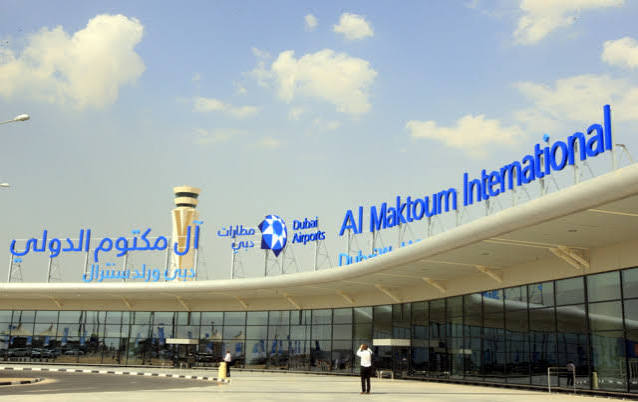
Al Maktoum international airport expansion is gathering pace as Dubai advances a $35 billion construction program targeting the world’s largest aviation hub. The project will eventually handle more than 260 million passengers annually and 12 million tones of cargo. Moreover, the development will create additional aviation capacity as Dubai International Airport approaches its long-term limits.
Al Maktoum International airport currently operates on a smaller scale at Dubai World Central. However, its planned transformation will establish a major aviation and logistics hub south of Dubai. The airport will ultimately span about 70 square kilometers within the wider Dubai South development.
Al Maktoum international airport expansion reaches key runway milestone
Construction progress is accelerating ahead of the next major operational milestone. The airport’s second runway is scheduled to become operational in 2027.
According to Dubai Airports chief executive Paul Griffiths, development remains on schedule despite regional disruption. The second runway will support capacity growth as terminal construction advances.
The first phase is expected to become operational in 2032. It will provide capacity for 150 million passengers annually, according to current project plans.
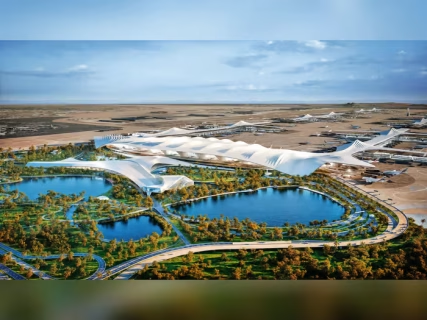
The airport will eventually feature five parallel runways operating independently. The third and fourth runways will follow as terminal capacity expands.
Meanwhile, the fifth runway will provide contingency capacity when another runway undergoes maintenance. This configuration will strengthen operational resilience as traffic volumes increase.
The wider construction programme also includes two passenger terminals and seven concourses. More than 430 aircraft stands will support the airport’s ultimate configuration.
The scale of Dubai’s airport construction programme contrasts sharply with Abu Dhabi’s earlier Midfield Terminal development. The $2.94 billion terminal spans 700,000 square metres and accommodates up to 30 million passengers annually. Its construction faced a six-year delay before opening preparations advanced in 2023.
That experience highlights the complexity of delivering major UAE aviation infrastructure. Al Maktoum International now moves forward with a substantially larger $35 billion construction programme and a 260-million-passenger annual target.
Al Maktoum airport expansion builds technology-led passenger infrastructure
Beyond capacity, the Al Maktoum airport expansion will introduce technology-driven passenger processing across the new airport.
The development will incorporate automated people movers and advanced baggage-handling systems. It will also connect air, rail and road networks through integrated transport infrastructure.
Facial recognition technology will support passenger identification and flight processing. The planned system aims to reduce conventional check-in, immigration and security procedures.
Passengers could eventually purchase tickets while submitting required identity information digitally. They would then drop their baggage before proceeding directly toward departure gates.
The airport’s transport infrastructure will also expand alongside aviation facilities. Planned connections include metro and rail infrastructure supporting access from Dubai and surrounding areas.
The final configuration will include 400 contact gates and an automated people mover system. The system will eventually comprise 14 stations connecting major airside facilities.
Al Maktoum international airport expansion supports Dubai’s next growth phase
The project will progressively shift aviation activity away from Dubai International Airport. Emirates and flydubai are expected to transfer operations as Al Maktoum International expands.
Flydubai could begin moving some operations in phases from next year. The airline is also expanding its fleet beyond 100 aircraft.
Meanwhile, Dubai Airports plans additional construction contracts worth Dh55 billion, equivalent to about $14.9 billion. The operator had already awarded Dh13 billion in contracts during 2026.
The expansion will also strengthen Dubai’s logistics ecosystem. Its proximity to Jebel Ali could improve cargo transfers and reduce logistical bottlenecks.
Furthermore, the development will support commercial, industrial, hospitality and residential growth across Dubai South. Analysts also expect the airport to stimulate employment, tourism and regional trade.
The project nevertheless faces significant delivery challenges. Aviation specialists stress extensive planning, testing and coordination before the 2032 opening.
Construction must therefore progress alongside roads, metro links, terminals, runways and support facilities. This integrated approach will determine whether the airport achieves its planned capacity efficiently.
Project Fact Sheet
Project: Al Maktoum International Airport expansion.
Location: Dubai World Central, Dubai, United Arab Emirates.
Value: $35 billion.
Ultimate passenger capacity: More than 260 million passengers annually.
Ultimate cargo capacity: 12 million tones annually.
Phase One capacity: 150 million passengers annually.
Phase One opening: Targeted for 2032.
Runways: Five parallel runways at ultimate development.
Aircraft stands: More than 430 planned.
Passenger terminals: Two planned terminals.
Concourses: Seven planned concourses.
Ultimate contact gates: 400.
Development area: Approximately 70 square kilometers.
Transport systems: Automated people mover, metro, rail and road connections.
People mover: Planned 14-station system at ultimate development.
Current role: Existing secondary airport supporting passenger and cargo operations.
Strategic purpose: Provide long-term capacity as Dubai International Airport approaches operational limits.
Project Team
Strategic direction and investment: Dubai Government.
Aviation infrastructure development and project delivery: Dubai Aviation Engineering Projects.
Airport operations and expansion program oversight: Dubai Airports.
Chief executive and project spokesperson: Paul Griffiths, Dubai Airports.
Phased airline transition to Al Maktoum International: flydubai.
Aviation advisory services: JLS Consulting.
Future major airline operator: Emirates.
Aviation consultancy and strategic analysis: Aviation Advocacy.
Aviation market research and analysis: StrategicAero Research.

Leave a Reply