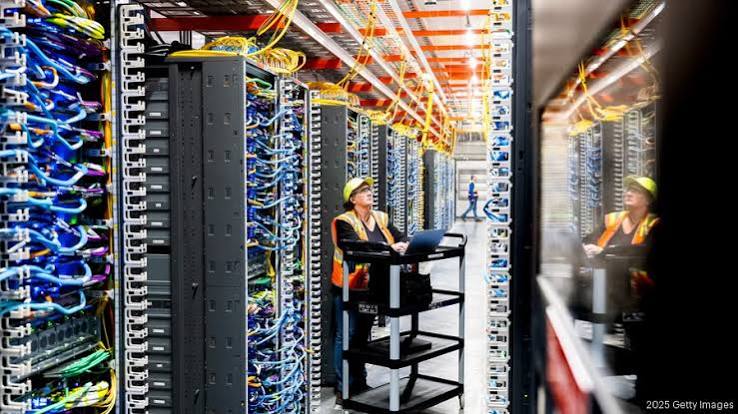
Amazon has confirmed plans to power a new AI data center campus in Pecos County, Texas, with electricity from a privately developed natural gas plant large enough to rank among the biggest single sources of greenhouse gas emissions in the country.
The company confirmed it acquired the GW Ranch site and plans to buy power from the plant, a facility being developed by Pacifico Energy, drawing electricity directly from it rather than from the state grid, at least in the near term.
Project Scope and Emissions
State permit filings show the GW Ranch plant would run 35 gas turbines with a combined generation capacity of 7.65 gigawatts, making it one of the largest gas-fired plants ever proposed in the United States. Texas has permitted the facility to emit upward of 30 million metric tons of carbon dioxide annually — a ceiling that, if reached, would place it among the single largest emissions sources in the country. Operators typically run well below their permitted maximums, and Amazon has signaled the plant is designed to eventually connect to the grid as interconnection timelines allow.
A larger 9.2-gigawatt facility already planned in Ohio, backed by a public-private partnership involving SoftBank, would both feed the grid and supply a data center directly, unlike the fully off-grid GW Ranch arrangement.
Company Response
Contacted by Construction Review Online, an Amazon spokesperson provided the following statement on the project:
“Amazon believes in paying the full costs of powering our operations. Our new planned data center campus in Pecos County does just that: it’s powered by new on-site generation that won’t raise electricity costs for Texas families and is designed to transition to grid-connected service as interconnection timelines allow. We’re also exploring opportunities for solar energy and battery storage on site. To ensure we don’t put stress on the local watershed, we’ll use water that isn’t suitable for drinking or irrigation, custom cooling technology that minimizes water use wherever possible, and we’ll explore the beneficial use of produced water as an additional non-potable source. This new data center campus in Pecos County is a long-term commitment that we expect will create thousands of new jobs.”
Amazon said it is also evaluating solar and battery storage for the site, and that the plant will draw on non-potable water rather than sources used for drinking water or irrigation. Separately, Pacifico Energy has outlined plans for up to 750 megawatts of on-site solar generation and 1.8 gigawatts of battery storage capacity at GW Ranch. Amazon maintains its target of net-zero emissions by 2040 under its Climate Pledge and points to roughly 10 gigawatts of carbon-free energy projects it has already backed in Texas.
Part of a Broader Industry Shift
GW Ranch is Amazon’s first major bet on off-grid, “behind-the-meter” power for a data center, a strategy pioneered at scale by xAI’s gas-turbine buildout in Memphis. Cleanview’s research puts the current industry-wide pipeline of behind-the-meter gas projects — spanning Amazon, Microsoft, Google, Meta, and Oracle — at roughly 90 gigawatts of announced capacity since the start of 2025, with combined emissions potentially exceeding 200 million tons of CO2 a year if fully built out.
Amazon’s Pecos County plans also sit close to a rival project: Microsoft announced a partnership with Chevron in June to build a data center campus about 30 miles away, powered by 2 gigawatts of off-grid gas. Amazon is separately in discussions tied to a 4.5-gigawatt gas plant proposed in Homer City, Pennsylvania, suggesting GW Ranch is unlikely to be its last off-grid power commitment as AWS works to close a persistent gap between compute demand and available data center capacity.
Texas has emerged as the epicenter of this buildout beyond Amazon and Microsoft alone. Galaxy Digital’s 5.7-gigawatt Helios data center pipeline is advancing in parallel, underscoring how the state’s combination of available land, permissive permitting, and gas infrastructure has made it the default staging ground for hyperscale AI power deals.
Additionally, Texas’ growing demand for large-scale digital infrastructure is also driving major investment in new power generation. Japan and the U.S. Department of Commerce recently released $3.3 billion to advance NextEra gas projects in Texas and Pennsylvania, including the proposed $16 billion Project Anderson in Anderson County, which could add up to 5.2 GW of natural gas-fired generation to support up to 5 GW of large-load demand.
Project Factsheet: GW Ranch
- Location: Pecos County, Texas
- Developer: Pacifico Energy
- Capacity: 7.65 GW across 35 gas turbines
- Grid status: Off-grid initially; designed for future grid interconnection
- Permitted emissions: Upward of 30 million metric tons of CO2/year
- On-site renewables planned: Up to 750 MW solar, 1.8 GW battery storage
- Water source: Non-potable water (unsuitable for drinking or irrigation); produced water being explored as an additional non-potable source
- Context: Amazon’s first major off-grid data center power deal; follows similar moves by Microsoft, Google, Meta, and xAI

Leave a Reply