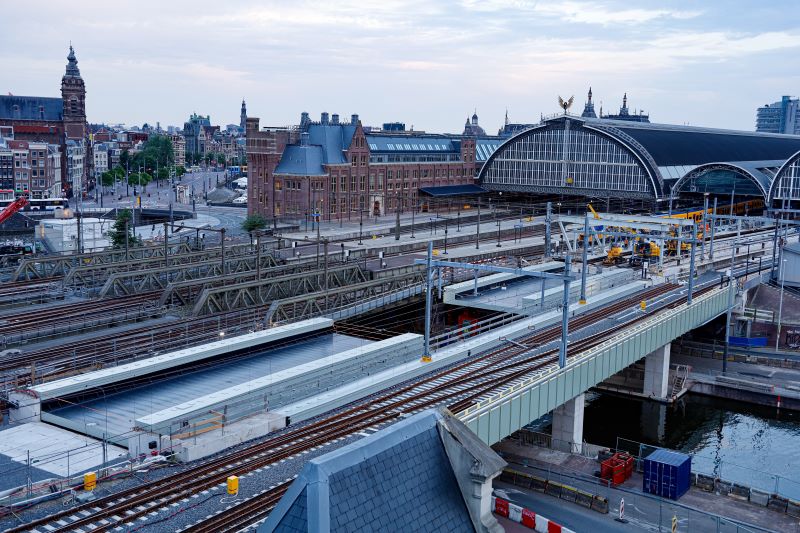
Amsterdam Centraal Station has reached a fresh milestone in its multi-year overhaul, with the second of five major bridges now replaced as the Dutch capital works to run more trains through one of its busiest transport hubs, according to a press release from heavy-lifting company Mammoet.
The bridge programme is part of the High-Frequency Rail Transport (PHS) Programme led by national rail manager ProRail. The wider scheme combines track optimisation, infrastructure adjustments and civil works inside the station building, all aimed at increasing the number of trains that can run to and from Amsterdam Centraal in the years ahead. Replacing the station’s ageing bridges is a central piece of that effort, and four of the five are still to come.
The newly installed bridge is made up of three steel deck sections fabricated by Hollandia Infra — two outer components of 28.5 metres weighing 275 tonnes each, and a middle section of 21 metres weighing 175 tonnes. The work was carried out by Mammoet alongside construction company Dura Vermeer, which handled the load-out, transport and installation of the spans.
Delivering the sections into the heart of a busy capital posed a significant engineering and logistical challenge. To keep the station open and limit disruption, the components were moved by water rather than road. Each section travelled to the Oostertoegang side of the station on a flat-top barge, which was partially submerged so it could pass beneath a low footbridge before reaching its position.
The tight site — wedged between the old bridges still in place and the new bridge installed in 2025 — dictated a more constrained installation method than the first replacement. Rather than lifting and rotating the deck sections on the barge, crews first manoeuvred and rotated each section underneath the surrounding bridges, then raised it using a four-point lifting system assembled on the quayside. The system uses four large hydraulic cylinders that extend at matching speed and sit within tracks, allowing them to be repositioned for precise movement and lifting.
The central span called for a particularly careful sequence. Because there was no column in place to receive it, the final section was floated in at right angles to the installation direction, rotated 90 degrees and lifted, then set down on consoles resting on the two already-installed outer sections to take its weight. Only then was the central support column built, after which the section was lowered onto it. Each of the three sections took roughly a week to install.
With the second bridge complete, attention turns to the remaining three crossings still to be upgraded under the PHS Programme — incremental works that, taken together, are intended to unlock higher train frequencies at Amsterdam Centraal while keeping the station running throughout construction.
Elsewhere the ÖBB Nightjet lines in June 2026 began connecting Amsterdam and Brussels to Milan three times a week via Cologne, Bern, Brig and Stresa.
Project Fact Sheet: Amsterdam Centraal Station Bridge Replacements
Project: Replacement of five major bridges at Amsterdam Centraal Station
Location: Amsterdam Centraal Station, Netherlands
Programme: High-Frequency Rail Transport (PHS) Programme
Programme lead: ProRail
Purpose: Track optimisation, infrastructure adjustments and civil works to enable more trains to run to and from the station
Progress: Second of five bridges completed (first completed in 2025)
Second bridge — deck sections: Three steel sections — two outer spans of 28.5 m at 275 t each, and a middle span of 21 m at 175 t
Fabricator: Hollandia Infra (steel deck sections)
Delivery team: Mammoet (load-out, transport and installation) with construction company Dura Vermeer
Installation method: Sections delivered by barge via the Oostertoegang; rotated using Self-Propelled Modular Transporters (SPMTs) and raised with a quayside four-point hydraulic lifting system
Installation time: Approximately one week per section
Key consideration: Station remained open throughout, with waterborne delivery used to minimise disruption



Leave a Reply