
The Cabinda Oil Refinery represents a $550 million initial investment and stands as the first new processing facility built in Angola in over 50 years and a critical proof-of-concept for the nation’s downstream ambitions. Developed through a partnership between Gemcorp Holdings (90%) and Sonangol (10%), the refinery’s first phase reached a major milestone with the completion of performance tests in February 2026 and is scheduled to begin delivering its first commercial products, including diesel and jet fuel to the domestic market in March 2026. With an initial capacity of 30,000 barrels per day (bpd), it is designed to satisfy approximately 10% of Angola’s internal demand, with an upcoming $700 million second phase aimed at doubling capacity to 60,000 bpd and adding advanced hydrocracking units by 2027.
This project serves as the strategic “fast-track” counterpart to the much larger $6.2 billion billion Lobito Refinery project. While Cabinda provides immediate relief to the domestic market and reduces the fiscal burden of fuel subsidies, the 200,000 bpd Lobito facility is the industrial “heavyweight” designed to turn Angola into a net exporter. Together, they form the dual pillars of Angola’s National Refining Strategy, sharing a common objective of energy sovereignty. The successful private-led financing model of Cabinda has provided a blueprint for the complex international negotiations currently surrounding the Lobito credit line, ensuring that Angola can leverage both modular, quick-to-market solutions and massive, full-conversion industrial hubs to secure its economic future.
Updated November 11, 2025
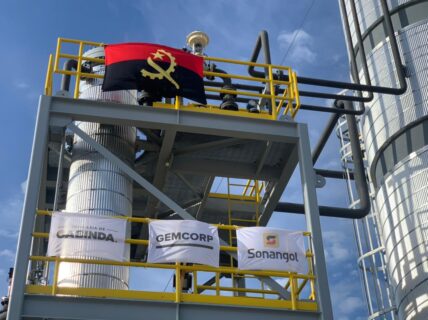
The Cabinda Oil Refinery is a landmark project that addresses Angola’s critical dependence on imported refined fuels, a situation where the country exports nearly all its crude oil while importing almost all of its finished products. Located in the Malembo plain of Cabinda province, the refinery is a strategic public-private venture, with UK-based Gemcorp holding a 90% stake and state-owned Sonangol holding 10%. Following its inauguration in September 2025, the facility is set to begin operations in phases.
Phase 1, with an estimated investment of over $500 million, will have an initial processing capacity of 30,000 barrels per day (bpd), focusing on essential domestic products like diesel and jet fuel. A planned Phase 2 will double the capacity to 60,000 bpd, aligning with the government’s aim to boost energy security, save billions in foreign exchange, and stimulate significant job creation in the enclave province. This is one of Africa’s major oil refinery projects currently under development.
The project acquired some financing from the Afreximbank. The Afreximbank is emerging as a leading financier of major projects in the continent at large. Other projects that are funded by the Afreximbank in Angola include the Soyo Fertilizer Plant.
Reported on September 3, 2025
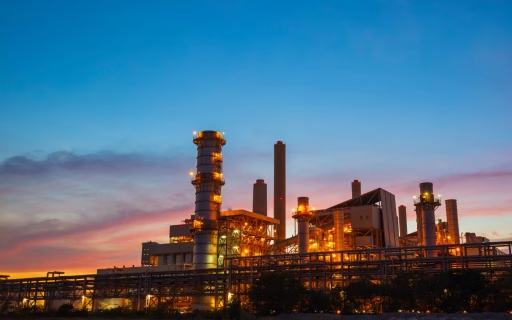
Angola marks the inauguration of its Cabinda oil refinery today. The Cabinda Oil Refinery will put the country on track to nearly double its capacity and cut expensive imports. This information was reported by Angolan news agency Angop.
After several delays, the Cabinda Oil Refinery finished construction works of the first phase of the industrial unit. Furthermore, the production and sale of fuels is set to commence in around three months.
Cabinda Oil Refinery Project Factsheet
Location: Malembo Plain, Cabinda Province
Developers: A joint venture between Gemcorp Holdings which holes a 90% stake and Sonangol which holds 10% stake.
Project phases and capacity
Phase 1:
- Capacity: 30,000 barrels per day (bpd)
- Investment: Approximately $500
- Products: Diesel, jet fuel, naphtha, and heavy fuel oil. Additionally, the diesel and jet fuel will serve the domestic market, while naphtha and heavy fuel oil are planned for export.
- Timeline: commissioned and expected to begin operations in September 2025.
Phase 2:
- Capacity: An additional 30,000 bpd, bringing the total capacity to 60,000 bpd.
- Timeline: Engineering works for this phase are expected to start after phase one becomes operational, with a planned timeline of 18 to 24 months for completion.
- Products: Will include gasoline, diesel, and gas, and the addition of a hydrocracking unit to increase the production of diesel and jet fuel.
Capacity
The initial capacity of 30,000 barrels per day (bpd) of diesel and jet fuel represents approximately 10 percent of Angola’s current requirement.
Also, as for the second phase, it will see the import of diesel to ensure alignment with full production capacity, eventually reaching 60,000 bpd. Additionally, this will nearly double the current capacity of 65,000 bpd from the Luanda refinery.
Furthermore, Cabinda refinery is a public-private partnership between UK-based Gemcorp and Sonango, Angola’s state-owned oil company. The two companies share governance under the supervision of Angola’s Ministry of Mineral Resources, Petroleum and Gas.
Construction Start Date
Construction of the Cabinda Oil Refinery began in 2019 with tree-clearing, earth-moving and demining. Also, the project was a critical step in a country still riddled with landmines from decades of conflict.
Challenges the Project Faced
Gemcorp completed that work the following year but the Covid-19 pandemic, along with the confounding complexities typical of such projects, led to frequent delays.
Job Creation
Construction of this project created over 3,300 jobs. Most of these jobs most went to Angolans. Furthermore, worker training aims to prepare 5,000 Angolans for refinery-related jobs in mechanics, electrical work, welding and IT.
Financiers
Phase one of the Cabinda Oil Refinery was backed by multiple African financial institutions. Africa Finance Corporation (AFC) managed to mobilize $335 million and a another $138 million raised through equity sponsors.
The oil refinery project was originally estimated at US$473 million. However, due to Covid-related delays and inflation pushed the cost to more than $500 million as of last October, when inauguration was set for April 2025.
Phase Two Funding
Additionally, funding for the second phase, expected to come online 18 months to two years after phase one, had not been finalised at that time. Also, Gemcorp founder and CEO Atanas Bostandjiev revealed to Reuters that he expected a final decision on that after the plant opened.
Furthermore, the executive stressed the need for local refining, as Angola “imports almost 100 percent of its refined products from Europe.” Those imports amount to over US$2 billion annually. Therefore, this underscores the need for a more efficient, financially sustainable alternative. These alternatives include development of new refineries such as the Lobito refinery.
Project Team
Principal Owners & Sponsors
- Gemcorp Holdings Limited (GHL): A London-based investment management firm that holds a 90% majority stake in the project. Gemcorp is the lead developer and has been instrumental in the project’s financing and execution.
- Sonangol E.P.: Angola’s state-owned oil company, which holds the remaining 10% stake. Beyond its role as a shareholder, Sonangol is the sole supplier of the Cabinda Grade crude oil (feedstock) and is responsible for marketing the refined products.
Financial Institutions
- Africa Finance Corporation (AFC): A lead arranger of the debt facility and a primary strategic partner.
- African Export-Import Bank (Afreximbank): A lead arranger that provided significant debt capital and advisory services.
- Fund for Export Development in Africa (FEDA): The impact investment subsidiary of Afreximbank, which provided equity investment to support the refinery’s modular platform.
- BADEA (Arab Bank for Economic Development in Africa): A key lender within the international financing consortium.
- Industrial Development Corporation (IDC) of South Africa: Provided debt financing as part of the regional support for the project.
- Banco de Fomento Angola (BFA): A local Angolan bank that participated in the financing syndicate, emphasizing local financial involvement.
Engineering & Operational Partners
- VFuels: A specialized American engineering firm that provided the modular refinery units. Their technology allowed for the “plug-and-play” construction style that characterized Phase 1.
- Odebrecht (Now OEC): Historically involved in early site preparations and infrastructure work in the Malembo area.
- INEFOP (National Institute for Employment and Vocational Training): A local partner working with Gemcorp and Sonangol on the Kuma Project, a training initiative to upskill 5,000 local workers for refinery operations.
Leave a Reply