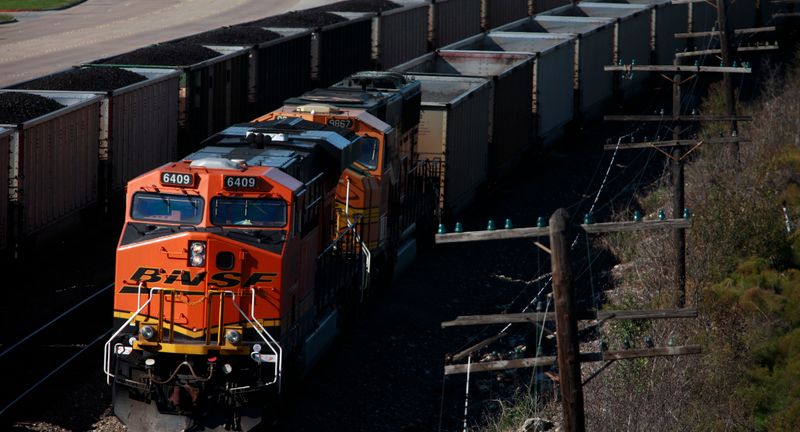
The Barstow International Gateway rail complex in California continues progressing toward full construction after securing key land-use approvals and advancing through multi-stage regulatory reviews. The integrated freight project, located west of Barstow, remains central to BNSF Railway’s long-term strategy to shift cargo handling inland and reduce pressure on congested coastal ports.
Meanwhile, the development has moved through environmental review milestones and planning commission processes that shape large-scale logistics infrastructure in San Bernardino County. Additionally, local authorities have supported phased approvals tied to zoning, annexation, and infrastructure planning requirements. Consequently, the project remains positioned as one of the most significant inland rail investments in the United States freight corridor.
Barstow International Gateway rail complex moves through 2026 regulatory phase
Barstow International Gateway rail complex is currently in an advanced pre-construction phase as of 2026. Furthermore, planning authorities have continued reviewing development agreements, environmental documentation, and infrastructure alignment within Barstow’s general plan update cycle. The project footprint, covering roughly 4,500 acres, has already seen substantial land acquisition progress, with BNSF controlling most parcels within the development zone.
Additionally, the Barstow City Council and Planning Commission have held hearings focused on zoning amendments and infrastructure integration for the freight hub. These proceedings also address utility expansion, rail alignment interfaces, and road network adjustments required for heavy freight operations. Moreover, environmental compliance under CEQA remains a key procedural requirement before full construction mobilization. Consequently, construction readiness has improved, but final build authorization continues to depend on remaining permitting conditions.
Barstow International Gateway rail complex strengthens inland freight strategy
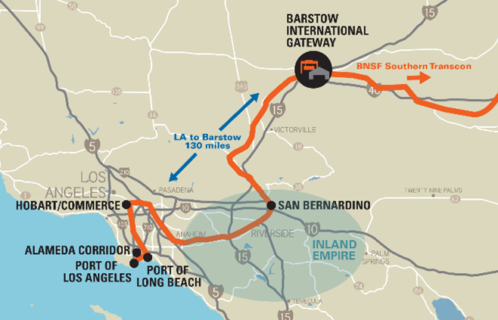
Barstow International Gateway rail complex continues to anchor BNSF’s inland logistics strategy for Southern California. Moreover, the facility is designed to transfer containers directly from ports in Los Angeles and Long Beach to inland processing and distribution systems. The project integrates rail yard operations, intermodal transfer systems, and warehousing infrastructure to streamline cargo movement across national rail corridors.
Furthermore, the site will reduce truck dependency on coastal highways by shifting freight volumes to rail. This approach is expected to ease congestion along major corridors while improving supply chain efficiency across western states. Additionally, planners anticipate that the project will support long-term growth in intermodal freight demand driven by international trade flows. Consequently, the facility remains a strategic component of U.S. freight modernization efforts.
2026 status update: construction readiness increases but full works pending
As of 2026, the Barstow International Gateway rail complex is not yet under full construction but is approaching final pre-construction readiness. Additionally, engineering refinement continues across rail yard design, intermodal handling systems, and supporting warehouse infrastructure. BNSF has also continued property consolidation and preliminary site preparation activities within the project boundary.
Moreover, final construction timelines are expected to align with late-2026 to early-stage mobilization windows, depending on remaining approvals. However, utility relocation, environmental mitigation commitments, and final engineering sign-offs still influence the start date. Therefore, while physical construction has not fully commenced, the project is transitioning from planning dominance to implementation readiness. Consequently, contractors and suppliers are increasingly positioning for upcoming procurement opportunities.
The Barstow International Gateway rail complex forms part of a broader Southern California freight expansion network, including the recently covered California rail intermodal project worth $4 billion, which similarly aims to enhance inland freight distribution and reduce coastal congestion through expanded intermodal capacity.
Expectations for the Barstow International Gateway rail complex
The facility will enable direct container transfer from ships to trains for transportation. The containers will be staged and formed onto trains going east via BNSF’s network across the country.
Once they arrive at the Barstow International Gateway, they will be processed using technology powered by clean energy. In the same manner, westbound freight will be handled at the facility. As a result, this will speed up the delivery of trains to the ports and other California terminals.
Also read: US$ 143M “Rail to Rail” Project breaks ground in Los Angeles, California
The local government gave the go-ahead to a private investment company in August to build a port facility. The facility in the Mojave Desert will serve as a “relief valve” for traffic in Los Angeles and Long Beach. In an effort to decrease truck traffic, the Port of Long Beach and the Utah Inland Port Authority, on the other hand, collaborated with Union Pacific.
Significance of the facility
The Barstow International Gateway will increase regional and nationwide rail and distribution efficiency. Additionally, it will lessen truck traffic and road congestion in the Los Angeles Basin and the Inland Empire.
Moreover, the complex will enable more effective freight transfers directly between ships and rail. This will be crucial in enhancing the efficiency of the current intermodal hubs, such as those in the Midwest and Texas, as well as increasing container removal rates from ports and network-wide rail fluidity.
According to Katie Farmer, President, and CEO of BNSF, the facility will also have a significant beneficial economic impact, including the development of new, local railroad employment.
Project Fact Sheet
Project Name: Barstow International Gateway rail complex project
Location: West of Barstow, San Bernardino County, California, USA
Developer: BNSF Railway
Estimated Investment Value: Approximately $1.5 billion (initial phase estimate)
Site Area: About 4,500–5,000 acres depending on final annexation boundaries
Project Type: Integrated rail intermodal facility, classification yard, and logistics/transload hub
Core Function: Transfer of international containers from coastal ports to inland rail processing and redistribution
Key Components: Rail yard expansion, intermodal terminals, transload warehouses, maintenance and staging yards, supporting utility infrastructure
Connectivity: Links Ports of Los Angeles and Long Beach via Alameda Corridor to BNSF transcontinental rail network
Environmental Framework: Subject to CEQA review and mitigation planning requirements
Status (2026): Advanced pre-construction phase with ongoing permitting, land consolidation, and engineering refinement
Strategic Role: Inland freight consolidation hub supporting U.S. west coast port decongestion and national distribution efficiency
Project Team
Project Owner / Developer: BNSF Railway
Parent Company: Berkshire Hathaway
Lead Planning Jurisdiction: City of Barstow, California
County Authority: San Bernardino County Government
State Regulatory Agencies:
- California Department of Transportation (Caltrans)
- California Environmental Protection Agency (CalEPA)
Environmental Review Authority: California Environmental Quality Act (CEQA) reviewing bodies and consultants
Port Partners: Port of Los Angeles, Port of Long Beach
Rail Network Integration: BNSF Southern Transcon operational division
Engineering & Master Planning Consultants: Multi-disciplinary rail, civil, and logistics infrastructure firms contracted by BNSF (varies by package and phase)
Utility & Infrastructure Coordination: Regional power, water, and transport service providers supporting site enablement
Local Stakeholders: Barstow City Council, Barstow Planning Commission, Inland Empire logistics stakeholders
Community & Workforce Partners: Local labor organizations, workforce development agencies, and regional economic development authorities

Leave a Reply