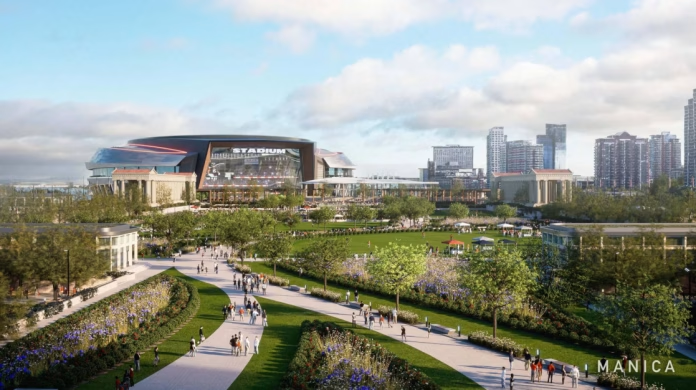
On September 8, 2025, the Chicago Bears publicly outlined plans for a privately financed domed stadium and mixed-use development in Arlington Heights. The proposed $5 billion project is designed to transform the former Arlington Park site and could reshape the region with significant long-term economic impact.
Chicago Bears’ proposed $5 billion domed stadium and mixed-use development remains unresolved, with team leadership actively weighing multiple location options. While the franchise has continued discussions tied to its previously announced Arlington Heights vision, it has also engaged in exploratory conversations with officials in Northwest Indiana, where lawmakers have advanced legislation that could support a new stadium authority structure. The organization has publicly stated that no final site decision has been made.
In Illinois, negotiations continue around tax policy and legislative mechanisms that would help facilitate development at the former Arlington Park property in Arlington Heights. State leaders, including Governor J.B. Pritzker, have signaled ongoing dialogue aimed at keeping the team in Illinois. At the same time, local officials in Arlington Heights have sought clarity on the club’s timeline as infrastructure planning and long-term land use considerations remain in flux.
Meanwhile, contingency planning is underway in Chicago should the Bears ultimately depart Soldier Field. The Chicago Park District has advanced early concepts to reposition the stadium as a large-scale concert and event venue if necessary. With legislative discussions unfolding on both sides of the Illinois–Indiana border, the coming months are expected to be pivotal in determining the franchise’s long-term home.
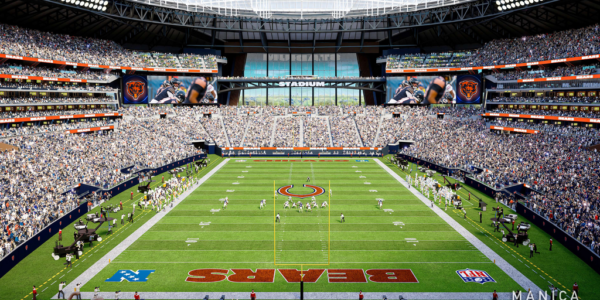
The project would transform the 326-acre former Arlington International Racecourse property, purchased by the team in 2023 for $197 million, into a year-round destination anchored by a new stadium. The venue is designed to seat between 65,000 and 70,000 fans and would be surrounded by a mixed-use district with restaurants, retail, housing, hotel accommodations, and public parkland.
Moving Forward
Indiana’s rapid legislative coordination illustrates how stadium negotiations often hinge less on headline dollar amounts and more on structural readiness. By advancing Senate Bill 27 on February 19, 2026 and outlining a stadium authority with bonding capacity, state leaders provided a tangible governance framework that reduces ambiguity around financing and land control — two of the most complex elements in large-scale sports developments. That clarity contrasts with Illinois’ ongoing deliberations over tax structure and infrastructure support, where details remain under refinement.
Equally important is the alignment of political messaging. In Indiana, state and local officials have presented a unified, pro-development narrative emphasizing speed, partnership, and regional growth. The Bears’ public acknowledgment of a $2 billion team contribution reinforces the seriousness of the Hammond proposal. In high-stakes negotiations, synchronized public support can accelerate confidence among investors, lenders, and private development partners.
Still, substantial hurdles remain on both sides of the state line. The Indiana proposal requires full legislative approval, completion of site-specific due diligence, environmental assessments around the Wolf Lake area, and finalized financing terms. Meanwhile, Illinois continues to pursue property tax certainty and infrastructure frameworks tied to Arlington Heights. With no binding agreement executed, the Bears retain leverage — but the window for clarity is narrowing as political calendars and market dynamics exert increasing pressure.
Projected economic impact
Team officials estimate that the construction would create more than 56,000 construction jobs and register $10 billion in economic impact to the state, in addition to creating about 9,000 permanent jobs once open.
In a letter to fans, Bears President and CEO Kevin Warren described the plan as a “once-in-a-generation opportunity” and clarified that the team will not seek state financing for stadium construction. “Arlington Heights is the single location that raises the bar to deliver a transformative stadium and entertainment district,” he stated.
The stadium itself is estimated at $2 billion, while the overall site development brings the total to perhaps $5 billion. Planned upgrades include direct train service from Metra, expanded parking, and highway improvements to alleviate congestion and enhance tailgating.
Before Arlington Heights was in its sights, the Bears had eyed a new lakefront stadium on Chicago’s downtown waterfront. That proposal ultimately fell through because it didn’t have a solid financing model as well as adequate available ground, making Arlington Heights the sole site where the team’s requirements could be met. The company also emphasized that this project is an expansion one, not an exodus one, noting that over half of the Bears season-ticket holders are within 25 miles of the site.
The Bears are working with state and local governments to develop bargains on property tax assurance and infrastructure donations. While no state money will be used for construction, a proposed “mega-project” bill pending in Springfield could provide donations for site infrastructure and public improvements.
Projected Construction Timeline
If approvals are obtained, construction might begin as early as late 2025, with the stadium opening in 2028. Officials of the team assert that the building would be able to host the biggest sporting and entertainment events in the world, from the Super Bowl and NCAA Final Four to world soccer games and monster concerts.
The Arlington Heights Village has already signed a memorandum of understanding with the Bears, and traffic, infrastructure, and tax impact studies are already underway. If completed, the project would be one of the largest construction projects in the history of Illinois and become one of a short list of privately financed NFL stadiums.
Similar to the recently approved $2.4 billion Cleveland Browns stadium in Brook Park, officials frame the Bears’ project as both a quirky expansion engine for Illinois and the next installment in a franchise history that long has made its way through different venues, with hopes to bid on a Super Bowl as early as 2031.
For the Bears, the move represents a departure from Soldier Field, the NFL’s oldest continuously operating stadium, and a chance to create what Warren called “a truly elevated gameday experience” for one of the league’s most passionate fan bases. This project follows a growing number of stadium construction projects across the U.S.
A comparable large-scale stadium effort gaining measurable momentum is the Tampa Bay Rays’ proposed ballpark development in Tampa, where the franchise and public partners have advanced site control arrangements and secured key governmental approvals tied to land use and property transfer. The project envisions a new stadium anchored within a broader mixed-use district designed to generate year-round economic activity, backed by a financing structure combining significant private investment with public participation. While meaningful progress has been made on site alignment and political support, final funding agreements, binding development approvals, and construction timelines still need to be completed before the project can fully break ground — underscoring how complex, multi-jurisdictional stadium deals often evolve in stages.
Project partners
Mixed-Use Development Planner: Hart Howerton, the firm created the renderings and master-planning concepts for the surrounding development, including the district’s commercial, housing, and park elements.
Design & architectural partner team: MANICA, handling stadium design.
Chicago Bears Arlington Heights Stadium and Mixed-Use Development Factsheet
Project Overview
Location: Arlington Heights, Illinois (former Arlington International Racecourse)
Total Investment: $5 billion privately financed development
Stadium Cost: $2 billion
Site Size: 326 acres (purchased 2023 for $197 million)
Stadium Capacity: 65,000 – 70,000 seats
Design: Domed stadium with year-round capabilities
Development Components
Primary Venue: New domed NFL stadium
Mixed-Use District: Restaurants, retail, housing, hotel accommodations
Public Amenities: Parkland and green spaces
Infrastructure: Direct Metra train service, expanded parking, road improvements
Entertainment Capabilities: Super Bowl, NCAA Final Four, international soccer, major concerts
Economic Impact Projections
Construction Jobs: 56,000+ positions
Permanent Jobs: 9,000 ongoing positions
Statewide Economic Impact: $10 billion
Project Scale: One of largest construction efforts in Illinois history
Timeline
Construction Start: Late 2025 (pending approvals)
Stadium Opening: 2028
Super Bowl Bid Target: 2031
Funding Structure
Stadium Construction: 100% privately financed (no state funding)
Infrastructure Support: Potential state assistance through proposed “mega-project” bill
Local Agreements: Property tax certainty and infrastructure contributions under negotiation
Current Status
Land Acquisition: Complete (2023)
Planning Phase: Detailed proposals submitted
Environmental Studies: Traffic, infrastructure, and tax impact studies underway
Regulatory Process: Seeking state and local approvals
Community Engagement: Working with Arlington Heights officials
Leave a Reply