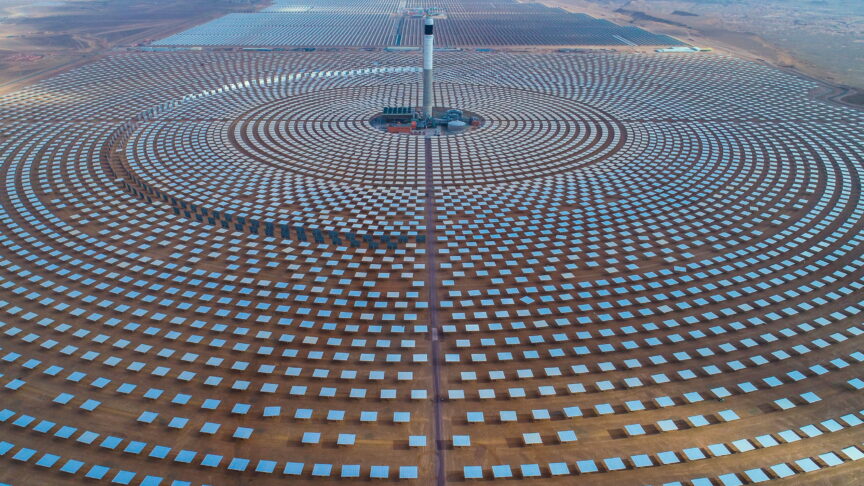
Morocco’s Noor Ouarzazate solar complex remains one of the most emblematic utility-scale solar deployments globally. This massive project was developed in four phases, employing a mix of concentrated solar power (CSP) and photovoltaic (PV) technologies. While the original Noor plants are already operational, recent policy and infrastructure updates show Morocco expanding grid integration and storage capabilities tied to the complex. This continues to reinforce the project’s role as a cornerstone of Morocco’s strategy to source more than 50% of its electricity from renewables in the coming decade as part of its energy transition strategy.
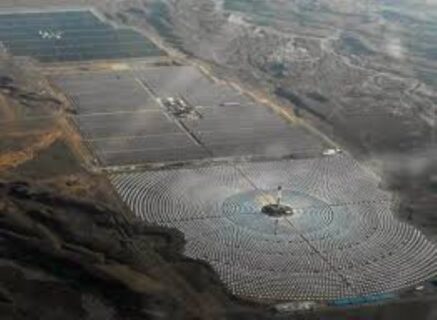
Phased Development and Technology Employed at Noor Ouarzazate Solar Complex
The complex was built under a Build, Own, Operate, and Transfer (BOOT) strategy by the ACWA Power Ouarzazate consortium, which includes ACWA Power, the Moroccan Agency for Solar Energy (Masen), Aries, and TSK. Operations and maintenance are managed by a consortium led by NOMAC (an ACWA Power subsidiary) and Masen.
| Phase | Plant Name | Capacity (MW) | Technology | Commissioned | Storage Capacity |
| 1 | Noor I | 160 (CSP) | Parabolic Trough (SENERtrough) | February 2016 | 3 hours (Molten Salt) |
| 2 | Noor II | 200 (CSP) | Parabolic Trough (SENERtrough-2) | 2018 | 7 hours (Molten Salt) |
| 2 | Noor III | 150 (CSP) | Solar Tower (Central Receiver) | 2018 | 7.5 hours (Molten Salt) |
| 3 | Noor IV | 70 (PV) | Photovoltaic (PV) | 2017 (Launched) | N/A |
For the first three plants, Sener was the technology licensor.
- CSP Technology: Noor I (160 MW) and Noor II (200 MW, 612 hectares) utilize parabolic trough collectors—mobile, 12-meter-tall mirrors ()—to focus sunlight onto a liquid, heating it to generate steam for a turbine.
- Solar Tower Technology: Noor III (150 MW, 598 hectares) employs a cutting-edge solar tower with a field of 7,400 heliostats (mirrors) that concentrate light onto a receiver at the top, achieving higher temperatures and maximizing thermodynamic efficiency.
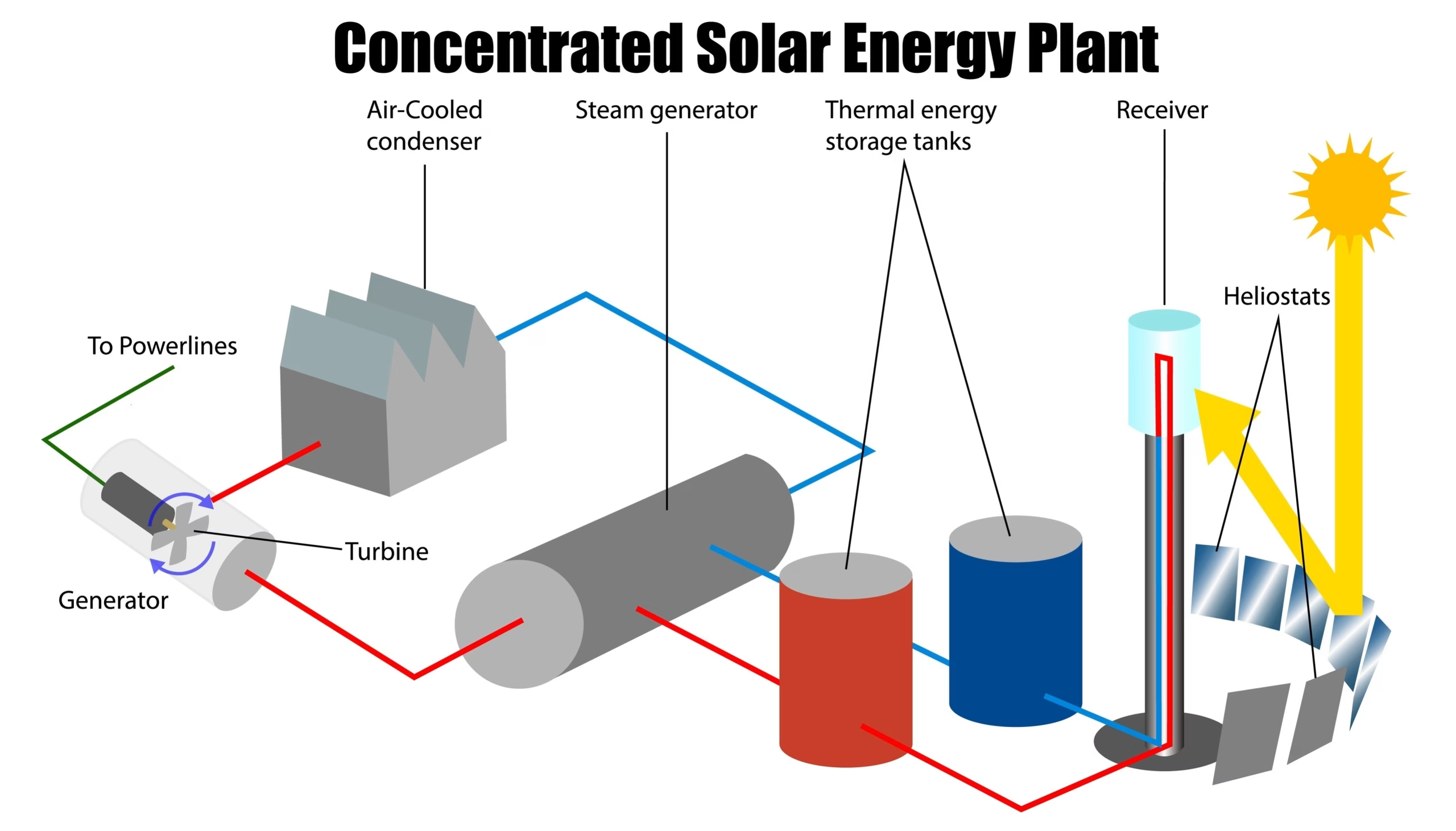
This configuration, which uses salt receivers and molten salt storage to reach higher temperatures, allows for power generation management in the absence of solar radiation. The plant was designed and built by Sener.
- PV Technology: Noor IV uses the more common photovoltaic (PV) technology.
A key feature of the CSP units is the use of molten salt thermal storage, which allows the plants to continue generating power for several hours after sunset. This is crucial for meeting peak demand, allowing electricity to be supplied to an estimated 1 million residences day and night. Water for the plants is supplied from the Mansour Eddabhi dam, 12 kilometers away.
Read also: Partnership for Construction of Smart Paper Rooftop Solar Plant in Egypt
Strategic Significance and Impact of Noor Ouarzazate Solar Complex
The Noor Solar Complex is the cornerstone of Morocco’s ambitious renewable energy strategy, which aimed to generate 42% of its energy from renewables by 2020 and has a long-term goal of 52% by 2030. Morocco’s heavy reliance on imported fossil fuels (over 90% of its needs) made this shift a matter of energy security and economic stability. The country hosted the United Nations Climate Conference (COP22) in November 2016, showcasing its commitment.
- Energy Security & Export: The project marked Morocco’s first renewable energy venture, with the capacity aimed at 580 MW by 2018. Morocco is strategically positioned to take a technology and market lead, potentially generating an energy surplus for export to Europe.
- Environmental Impact: The entire complex is expected to reduce global $\text{CO}_2$ emissions by an estimated 760,000 tonnes per year. Noor I alone offsets 240,000 tonnes of $\text{CO}_2$ annually, while Noor II and Noor III together were to reduce 533,000 tonnes annually.
- Socioeconomic Benefits: Construction of Noor I created around 1,000 jobs, with 60 permanent positions for operation and maintenance. The project contributes to the development of a local skill base for future regional solar initiatives.
Funding and Partnerships
The project received significant international funding, with a total investment for Phase II reaching $2 billion (80% loan, 20% equity).
| Phase | Estimated Cost | Lead Funding Source |
| Phase I | €500 million | African Development Bank (AfDB) Group |
| Phase II | $2 billion | Masen (Debt Facility) |
The debt facility for Phase II was provided by Masen, including financing from a consortium of institutions:
- AfDB
- Agence Française de Développement
- Clean Technology Fund (CTF)
- European Commission
- European Investment Bank
- Kreditanstalt für Wiederaufbau (KfW)
- World Bank
The success of Noor has also led to further solar initiatives, such as the later launch of the 400MWp Noor PV II project tender by the Moroccan Agency for Sustainable Energy (MASEN) in 2021, reinforcing Morocco’s commitment to achieving its 2GW solar goal by 2020 and 52% renewable share by 2030.
Noor Ouarzazate Solar Complex Project Team
Owner
-
MASEN
Lead Developers
-
ACWA Power
-
Sener
Primary Contractors
-
Acciona — EPC
-
TSK — EPC partner
-
Sepco III — construction
Key Stakeholders
-
World Bank Group
-
African Development Bank
-
European Investment Bank
-
Moroccan national grid operator ONEE
Related Reading:
- Morocco launches the construction of 70 MW Noor Ouarzazate IV PV plant
- Morocco’s Noor Ouarzazate III solar thermal power plant switched on
- Construction of center dedicated to smart electricity grids in Morocco
Leave a Reply