
Rail Baltica project advances as a flagship European rail corridor linking Estonia, Latvia, Lithuania, and Poland through a 1,230km high-speed standard-gauge network. The project aims to integrate the Baltic States into the wider European rail system while replacing legacy Russian-gauge infrastructure.
Moreover, it strengthens freight and passenger connectivity across Northern and Central Europe. According to recent 2026 updates, construction activity has accelerated across all three Baltic States, with over 43% of the mainline now construction-ready or under active development. Consequently, the project has moved firmly from planning into large-scale execution.
The Rail Baltica corridor forms part of the EU’s Trans-European Transport Network (TEN-T) strategy. Additionally, it supports dual-use objectives, including military mobility for NATO operations in the region. However, the project faces ongoing financing pressure and rising cost estimates now reaching approximately €23.8 billion. Despite these challenges, governments in Estonia, Latvia, and Lithuania continue to prioritise phased delivery. Therefore, construction continues across key sections including terminals, bridges, and embankments.
Rail Baltica project accelerates cross-border rail integration
Rail Baltica construction project accelerates infrastructure works across Estonia, Latvia, and Lithuania as mainline construction expands. Moreover, Estonia leads with major segments already under active construction, including sections near Tallinn and Pärnu. Lithuania has also advanced early track-laying works, particularly on the Šveicarija–Žeimiai corridor. Additionally, Latvia continues complex civil engineering works around Riga Central Station and the airport link.
Furthermore, project developers confirm that more than 267 kilometers of the mainline are now construction-ready. This represents a significant milestone in overall corridor readiness. However, land acquisition, procurement delays, and technical coordination remain key challenges. Consequently, authorities are adopting phased construction strategies to maintain delivery momentum.
Rail Baltica project strengthens European connectivity and security
Rail Baltica project strengthens Europe’s strategic mobility corridor by linking Warsaw to the Baltic capitals. Moreover, it enhances integration with Poland’s wider rail expansion program under the Integrated Railway Network (ZSK). This alignment creates a continuous high-speed corridor from Central Europe into the Baltic region.
Additionally, officials highlight the project’s importance for both civilian transport and defence logistics. Consequently, it is increasingly viewed as critical infrastructure for regional resilience. However, financial constraints have led to discussions about revised timelines, with some forecasts extending completion toward 2040. Despite this, the European Commission maintains strong support for the 2030 milestone framework.
Current Status Update (2026)
- Rail Baltica has entered full-scale construction phase across all three Baltic states
- Approximately 43% of the mainline is construction-ready or under active works
- Estonia: Major civil works underway including terminals and mainline segments
- Lithuania: Early track-laying and embankment works progressing on key sections
- Latvia: Complex urban integration works ongoing in Riga and airport corridor
- Financing status: Estimated total cost around €23.8 billion, with continued EU and state funding support
- Key milestone: 267km+ of mainline ready for construction rollout
Defence and Security Authorities (NATO-aligned stakeholders): Oversight of dual-use strategic mobility requirements
LTG Infra announced that the joint venture partners had secured two tenders worth approximately €165.54 million. The construction work is in Jonava District. LTG Infra is in charge of project implementation in Lithuania. The Šveicarija-Žeimiai section contract is valued at €87.88m. Additionally, the Žeimiai-Šėta section contract is worth €77.6m.
The Šveicarija–Žeimiai section will be completed in one and a half years, and the Zeimiai–Šėta section will be completed in two years. Fegda and Tilsta will build a 17.7km substructure and engineering structures on the 10km section. It will stretch from Šveicarija to Žeimiai, as well as the section from Žeimiai to Šėta.
Read Also: Plans approved for Keadby 3 carbon capture power station in UK
Construction works on the Rail Baltica project
All railway works will be completed without the installation of the superstructure. These works include the preparation of land and parcels of land and the installation of a railway drainage system. Others include the construction of a protective fence, as well as the implementation of a portion of the service roads.
During the course of the contracts, railway bridges, wildlife crossings, sound barrier walls, and other engineering structures will be built. The reconstruction and repairs of the telecommunications and electricity networks and the reconstruction of the state district and national roads will be carried out during the construction of the substructure.
“The most developed section of Rail Baltica is already under construction and be much expanded,” said Dovydas Palaima, general manager of LTG Infra Rail Baltica Management. “In 2024, we intend to begin major construction work on the railway to Panevėžys. This is as well as the majority of the preparations for the railway’s construction on the other sections.”
Rail Baltica Project Overview
Also known as Rail Baltic in Estonia, Rail Baltica is an ongoing greenfield railway infrastructure project in the Baltic Countries. It is meant to link Finland, Estonia, Latvia, and Lithuania with Poland.
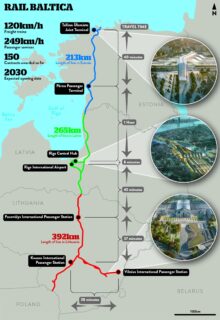
The project envisages a continuous rail link from Tallinn in Estonia to Warsaw in Poland. It consists of links via Riga in Latvia, and Kaunas and Vilnius in Lithuania. The total length in the Baltic States is 870 kilometers. 213 kilometers are within Estonia, while 265 and 392 kilometers are within Latvia and Lithuania respectively.
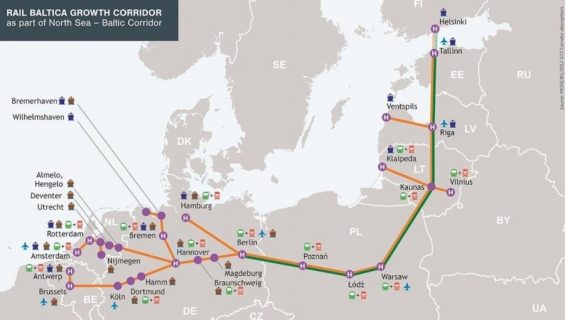
It will consist of three multimodal freight terminals. These will be constructed in Estonia’s Muuga Harbour, Salaspils in Latvia, and Kaunas in Lithuania. It will also consist of seven international passenger stations. These will be located in Tallinn, Pärnu, Riga, Riga Airport, Panevežys, Kaunas, and Vilnius. The project has potential regional stations and connections to airports and seaports.
From Poland, Rail Baltica will connect will the European standard gauge rail network. It is one of the priority projects of the European Union. In addition, it is a part of the North Sea-Baltic Corridor of the Trans-European Transport Networks (TEN-T).
Its purpose is to provide passenger and freight service between the participating countries. Additionally, it intends to improve rail connections between Central and Northern Europe, specifically the area in the Southeast of the Baltic sea. Furthermore, Rail Baltica will be a catalyst for building the economic corridor in Northeastern Europe.
Summary
Name: Rail Baltica
Type: High-speed rail
Length: 870 kilometers
Max. speed: 249 km/h (passengers), 120 km/h (freight)
Construction: 2019-2029
Reported earlier
Dec 2020
Rail Baltica Central Hub construction begins
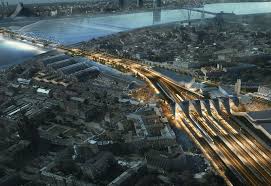
Construction of Rail Baltica Central hub in Riga, Latvia has officially begun on schedule. This marks a significant milestone as it will be the largest infrastructure project in the region in 100 years. The project includes a new central station building, a major railway bridge on the Daugava river, and various rail infrastructures.
The project, financed by the European Union (EU) and the Republic of Latvia, will integrate the Baltic States; Helsinki, Tallinn, Riga, Vilnius, and Warsaw into the European rail network. The construction site was formally opened by senior representatives of Rail Baltica, the project implementer, and the supervisory team of civil engineers. They welcomed the builders and congratulated them on the commencement of construction work.
Also Read: Rail Baltic project exceeds budget estimations.
Central Hub in Riga, one of the most important construction phases of Rail Baltica
The Central Hub in Riga represents one of the most important construction phases of the Rail Baltica Project. The latter includes the reconstruction of the Riga Railway Station complex and the construction of a railway bridge across the River Daugava.
In addition, Rail Baltica Project includes the construction of the European standard gauge tracks and the removal of embankments. The construction of an overpass and the construction of the adjacent infrastructure are also a part of the project. BESIX is responsible for the design and build of it, as part of a joint venture with SIA RERE BŪVE.
Earlier, the JV BERERIX engineers successfully saw the complex design of the future railway station pass the wind tunnel and wind comfort tests. Moreover, the design received the final approval for the master designs. The team is now eager to make the Rail Baltica project visible and tangible for citizens and guests of Riga. This will achieve while strictly following all restrictive measures to curb the spread of COVID-19.
The construction site is set up to enable continuous work and social distancing for about 100 workers employed on the site who are working day and night shifts. In order to meet all requirements, prevent the carrying and spreading of COVID-19 on the building site, and ensure a timely construction process of the Central Hub in Riga according to Xavier Debruche, one of the project leaders.
Aug 2022
Rail Baltica: Tender announced for Kaunas Urban Node to Vilnius Urban Node stretch
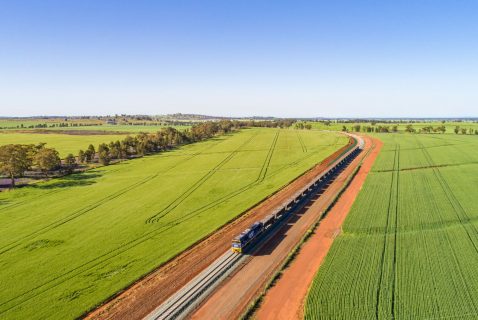
A new tender for design and design supervision services for the Kaunas Urban Node to Vilnius Urban Node portion of Rail Baltica has been revealed. This is according to RB Rail, a Rail Baltica joint venture. LTG Infra, the company in charge of putting Lithuania’s Rail Baltica project into action, will help with the project’s execution.
Applications for the qualification stage are expected to be received by October 14 of this year. The contract on the other hand is anticipated to be signed in the second half of 2023.
Read Also: Refurbishment almost complete on Southampton’s Redbridge Causeway
Scope of the Kaunas Urban Node to Vilnius Urban Node contract
The contract covers the provision of design and design supervision services to construct railway track substructures, superstructures, and related civil systems. All this will be carried out on the stretch that features 65 km of double-track 1,435 mm-gauge railroads.
Particularly, the contract covers the rehabilitation of about 16 km of the existing 1,520 mm-gauge railroads. Additionally, it covers the construction of 15 culverts, additional infrastructure, and utilities. Moreover, the contractor will build ten road viaducts, one road tunnel, 13 railway viaducts, eight wildlife crossings, and three passing loops.
Speaking on this initiative, Marius Narmontas said they will promote transparent competition in the Rail Baltica procurements, therefore, improving the best practice. Narmontas is the head of RB Rail Lithuania. He added that the re-launch will help to integrate improved qualification standards into the procurement rules permitting larger market participation.
RB Rail and Esri recently signed an enterprise agreement. This was in order to integrate geographic information system (GIS) software across all project units.
Nov 2022
Construction procurement announced for Rail Baltica Ülemiste terminal in Estonia

Rail Baltica Estonia has announced the construction procurement for the first stage of the Ülemiste terminal building in Tallinn, Estonia. The tender is expected to cost around €66.5 million.
After the existing railway is demolished, an underground level and other railway facilities will be built. The existing Ülemiste railway infrastructure will be rebuilt in order to make room for the Rail Baltic 1,435mm gauge railway. Three bids had been submitted for the reconstruction of the railway infrastructure associated with the joint terminal by the deadline for the construction tender.
The Ülemiste terminal project will begin with the demolition of approximately 16.3 kilometers of existing tracks, and then the construction of over 8 kilometers of new 1,520mm gauge railways. It will also include the rebuilding of utility networks that cross the railway and the Kantsi viaduct.
Construction permits have been issued for the completion of the Ülemiste terminal project. The majority of the railway work is expected to be completed in 2024. Thus, the contractual work would wrap up in 2026.
Read Also: Contract awarded for U2 and U4 subway lines digital train control system in Germany
Design for Ülemiste terminal project
The Ülemiste railway infrastructure was designed by OU Reaalprojekt and OU Allspark. Additionally, the terminal was written and designed by Zaha Hadid Architects and Esplan OU.
“We are procuring the construction of the Ülemiste joint terminal in stages,” said Rail Baltic Estonia operations head Marko Kivila. “Now that the procurement for the reconstruction of the railway infrastructure has been completed, we can go on with the next stage, which is the construction procurement for the concrete structures under the railway.” In essence, we are acquiring the terminal building’s underground portion.”
The deadline for submitting bids for the construction of railway facilities at the Ülemiste passenger terminal has been set for January 5, 2023. If the procurement is completed on time, construction will begin early next year.
Project Fact Sheet
Project Name: Rail Baltica High-Speed Rail Corridor
Location: Estonia, Latvia, Lithuania, Poland
Total Length: ~1,230 km
Investment Value: ~€23.8 billion (updated 2026 estimates)
Gauge: Standard European (1,435 mm)
Speed Design: Up to 249 km/h (passenger services)
Core Function: Passenger, freight, and military mobility corridor
Integration: EU TEN-T Core Network Corridor
Key Sections: Tallinn–Riga–Kaunas–Warsaw axis
Construction Status: 43% mainline construction-ready or underway
Completion Target: 2030 (EU framework), with extended forecasts to 2040 in some scenarios
Project Team
European Union (Connecting Europe Facility / TEN-T Programme): Primary co-founder and strategic integration authority
Governments of Estonia, Latvia, and Lithuania: National ownership, policy direction, and land acquisition coordination
Republic of Poland (Ministry of Infrastructure): Cross-border integration and southern corridor linkage
RB Rail AS: Central coordination body for design, procurement, and technical alignment
Rail Baltic Estonia: National implementing agency for Estonia section delivery
Eiropas Dzelzceļa līnijas: Latvian infrastructure implementation authority
LTG Infra: Lithuanian rail infrastructure manager responsible for delivery execution
European Investment Bank (EIB): Long-term financing and advisory support
EPC Contractors and International Engineering Consortia: Civil works, rail systems, bridges, and electrification delivery


Leave a Reply