
Black Hills Corp. plans to invest $1.8 billion in new natural-gas generation and related infrastructure to serve a planned Google data center in Cheyenne, Wyoming, under long-term agreements extending through 2048.
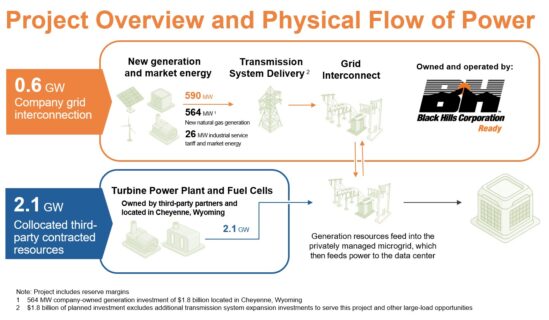
The utility announced October 6 that it had signed definitive agreements to provide energy services for the project. The agreements cover up to 590 megawatts of grid-connected service and the management of approximately 2.1 gigawatts of third-party contracted resources through a privately managed microgrid.
The planned data center is expected to require a total resource mix of approximately 2.7 gigawatts, including reserve margins. Energy service is scheduled to begin in late 2027, with demand expected to increase to the project’s peak load by 2030.
New generation and private microgrid
Black Hills plans to construct and own 564 megawatts of natural-gas generation at its existing Cheyenne Prairie Generating Station. The remaining 26 megawatts of the company’s planned 590-megawatt grid-connected service would come from market purchases and retail utility service under the applicable industrial tariff.
The company will also coordinate the output of roughly 2.1 gigawatts of contracted Wyoming resources and market energy through a private microgrid. Black Hills said the arrangement will allow it to coordinate grid operations, reliability services and energy dispatch for the planned data center.
The company expects to begin earning a return on its generation investment when construction starts in 2027. Revenue from microgrid management fees is expected to begin in late 2027 and increase as the data center’s electricity demand ramps up.
Google has provided Black Hills with $399 million in refundable advances for long-lead equipment. Black Hills expects to repay those advances by June 30, 2027, while financing the remaining generation investment through project cash flow, debt and other financing options.
Customer protections
The project comes as utilities and regulators face questions over whether large data centers could increase electricity costs for households and smaller businesses.
Black Hills said its agreements are structured so that Google will bear the costs associated with serving the planned data center. The company said existing retail customers will be protected through cost pass-through provisions, stranded-asset protections, early-termination safeguards and credit requirements.
The Generation Facilities Agreement is designed to provide recovery of the generation investment over the contract period, according to Black Hills. The company also said the agreements protect against inflation, interest-rate volatility and other cost pressures.
Those protections are based on Black Hills’ description of the contracts. Their practical effect will depend on the final regulatory framework, project execution and the data center’s continued development.
Financial impact
Black Hills expects the project to generate approximately $150 million in net income in 2030. Beyond 2030, the company expects to continue earning microgrid management fees and a return on its capital investment through the contract term.
The company projects approximately $2.4 billion in unlevered free cash flow through 2048, after deducting the planned $1.8 billion generation investment. Black Hills said the cash flow would strengthen its balance sheet and provide additional flexibility for future investment and capital allocation.
The financial projections are tied to a planned project rather than an operating data center. They remain dependent on construction, regulatory approvals, financing, the ramp-up of electricity demand and the continued performance of the contractual arrangements.
Regulatory and transmission work
Black Hills has already advanced several regulatory steps linked to the energy buildout. Wyoming regulators approved the Robinson substation’s Certificate of Public Convenience and Necessity in May 2026. Black Hills filed an industrial-siting permit for the Cheyenne Prairie Generating Station expansion in July, and regulators approved the expansion’s air-quality permit in August.
The company is also pursuing additional transmission infrastructure. Black Hills filed a Large Customer Transmission Cost Adjustment Mechanism in June and submitted a Certificate of Public Convenience. And Necessity application for the South Cheyenne Transmission Expansion in September. The company expects to file another Wyoming transmission-expansion application during the fourth quarter of 2026.
Earlier reports linked the Cheyenne development to a large data-center campus with a planned capacity of 1.8 gigawatts. Later local planning records identified Google as the developer behind a proposed 2.7-gigawatt campus in the area.
The project is not yet a completed data center. Black Hills describes it as a planned Google facility, with energy service expected to start in late 2027 and demand reaching its expected peak in 2030.
What it means for Wyoming
The development would make Cheyenne a major center for data-center and energy infrastructure. It would bring new natural-gas generation, transmission investment, construction work and long-term utility revenue to the region.
It would also increase scrutiny of the project’s land use, emissions, water needs, gas supply, transmission requirements and effect on Wyoming’s power system. A 2.7-gigawatt resource requirement is large enough to shape regional energy planning, particularly as other technology companies expand data-center operations in the state.
The main public question is whether the agreements will prevent the project from shifting costs to existing customers. Black Hills says the contracts protect current customers, but regulators will determine how those protections work in practice. The project’s final impact will also depend on how Black Hills finances, builds and operates the new infrastructure.
While Black Hills plans to build large-scale natural-gas generation and manage a private microgrid for Google’s planned Wyoming data center, Fit Energy is pursuing a different model in Pennsylvania. Its Newport Township project would combine a technology and data-center development with on-site natural-gas fuel cells on former mining land, highlighting how developers are pairing new computing facilities with dedicated power systems.
Factsheet
- Project: Energy service for a planned Google data center.
- Location: Cheyenne, Wyoming.
- Utility: Black Hills Corp.
- Agreement signing: 30th, Sept. 2026
- Announcement: October 6, 2026.
- Contract term: Through 2048.
- Expected total resource mix: Approximately 2.7 gigawatts, including reserve margins.
- Grid-connected service: Up to 590 megawatts.
- New company-owned generation: 564 megawatts.
- Generation type: Natural gas.
- Third-party resources managed: Approximately 2.1 gigawatts.
- Capital investment: $1.8 billion.
- Planned construction start: 2027.
- Expected energy service: Late 2027.
- Expected peak demand: 2030.
- Projected 2030 net income: Approximately $150 million.
- Projected unlevered free cash flow: Approximately $2.4 billion through 2048.
- Google equipment advance: $399 million.
- Generation site: Cheyenne Prairie Generating Station.
- Customer protection: Black Hills says Google will bear the costs of serving the data center.



Leave a Reply