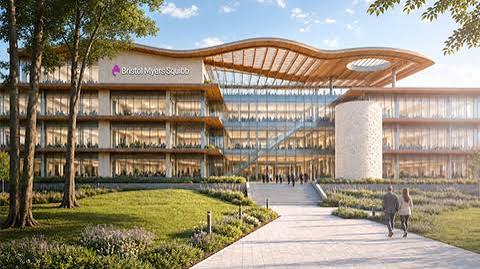
Bristol Myers Squibb has selected Houston, Texas, for a new $2.3 billion pharmaceutical manufacturing campus, converting an earlier proposal into a confirmed project at Generation Park.
The approximately 600,000-square-foot campus will create nearly 500 permanent skilled jobs, while BMS expects about 2,000 construction and other indirect jobs between 2027 and 2030 as the facility is built and brought online.
The project forms part of BMS’ broader $40 billion commitment to invest in the United States over five years across research and development, technology and domestic manufacturing.
From a potential $1B project to a $2.3B investment
The Houston project had been under consideration for several months before BMS formally selected the site.
In May, a Texas incentive filing revealed that BMS was considering a roughly $1 billion, 600,000-square-foot manufacturing facility at Generation Park. The proposal was expected to create approximately 489 jobs, while Houston remained one of several locations under evaluation.
BMS has now selected Houston and increased the announced investment to approximately $2.3 billion.
The company has not provided a detailed explanation for the increase, so it would be speculative to attribute the difference to a particular expansion, equipment package or change in project scope.
What is clear is that the 600,000-square-foot footprint remains central to the project, while BMS now describes the campus as one designed to expand in scale and manufacturing capability beyond its initial configuration.
A campus designed for multiple drug types
The facility’s most distinctive feature is its planned multi-modal manufacturing capability.
Rather than dedicating the campus to one manufacturing platform, BMS says it will be capable of producing different types of medicines, including small molecules, biologics and antibody-drug conjugates.
The campus will support drug-product and finished-goods manufacturing from late-stage development through commercial launch. Its modular configuration is intended to allow manufacturing capacity to be added or reconfigured as the company’s pipeline changes.
That makes the project different from a facility built around a single product or manufacturing process. BMS is designing the physical campus around changes in its future pipeline rather than locking the site into its initial production configuration.
The company also plans to incorporate digital capabilities and automation but has not disclosed the specific technologies or production systems it will install.
Generation Park is attracting multibillion-dollar pharmaceutical investment
BMS’ investment will add another major pharmaceutical manufacturing project to Generation Park, the 4,300-acre development in northeast Houston.
The site is already home to another major pharmaceutical investment. Eli Lilly announced in 2025 that it would invest more than $6.5 billion to build a manufacturing facility at Generation Park focused on domestic production of small-molecule medicines.
With BMS’ latest announcement, the two projects represent at least $8.8 billion in announced pharmaceutical manufacturing investment at Generation Park.
That does not by itself establish Generation Park as a pharmaceutical manufacturing hub, but it demonstrates that the development is attracting multiple multibillion-dollar investments from major drugmakers.
Texas incentives helped secure the project
BMS said its site-selection process evaluated multiple markets in the Central and Eastern U.S. The company identified workforce availability, incentives, utilities, transportation infrastructure and the broader business environment among the factors considered.
Texas Governor Greg Abbott’s office confirmed that the BMS project will receive a $4.89 million Texas Enterprise Fund grant and qualifies for additional state benefits through the Jobs, Energy, Technology and Innovation program.
The Texas Enterprise Fund grant represents roughly 0.2% of BMS’ announced $2.3 billion investment, providing context for the scale of the public incentive relative to the overall project.
Construction will extend into 2030
BMS expects the campus to create approximately 2,000 construction and other indirect jobs between 2027 and 2030 as construction progresses and the facility comes online.
The company has not announced a specific groundbreaking date, construction completion date or commercial production start date in its August 10 announcement.
Earlier reporting based on the Texas incentive application had associated the proposed project with construction beginning in 2027 and operations beginning around 2030. Those dates were part of the earlier proposal and should not be treated as a newly confirmed construction schedule.
Part of a wider U.S. manufacturing build-out
BMS’ Houston project comes as major pharmaceutical companies continue announcing large U.S. manufacturing investments.
Companies including Eli Lilly, Johnson & Johnson, Roche and Pfizer have also announced major investments in U.S. manufacturing as the pharmaceutical industry expands domestic production capacity.
BMS’ project adds another $2.3 billion to that broader investment cycle, but its significance is more specific: the Houston campus will manufacture multiple pharmaceutical modalities in a flexible, expandable facility.
For Houston, the project also deepens the concentration of pharmaceutical manufacturing investment at Generation Park. With Lilly’s $6.5 billion facility already announced and BMS now committing another $2.3 billion, the development has attracted at least $8.8 billion in announced pharmaceutical manufacturing investment from the two companies alone.
BMS’ Houston campus is therefore more than another large industrial development. It represents the company’s decision to put a significant investment into a facility designed to adapt to its evolving drug pipeline, while placing that manufacturing capacity alongside another multibillion-dollar pharmaceutical project already planned at Generation Park.
Project Factsheet
Project: Bristol Myers Squibb Houston Manufacturing Campus
Developer: Bristol Myers Squibb
Location: Generation Park, Houston, Texas
Investment: Approximately $2.3 billion
Building size: Approximately 600,000 square feet
Project type: Pharmaceutical manufacturing campus
Manufacturing capabilities: Small molecules, biologics and antibody-drug conjugates
Design: Modular and multi-modal, with capacity to be added or reconfigured
Permanent jobs: Nearly 500 skilled jobs
Construction and indirect jobs: Approximately 2,000
Construction period: BMS expects construction and related activity to generate those jobs between 2027 and 2030
Site: Generation Park, a 4,300-acre development
State incentive: $4.89 million Texas Enterprise Fund grant
Broader BMS commitment: Part of BMS’ $40 billion U.S. investment commitment over five years
Earlier proposal: BMS had previously been considering a roughly $1 billion, 600,000-square-foot facility at the site before selecting Houston
Status: Site selected and investment announced; detailed construction schedule not yet disclosed


Leave a Reply