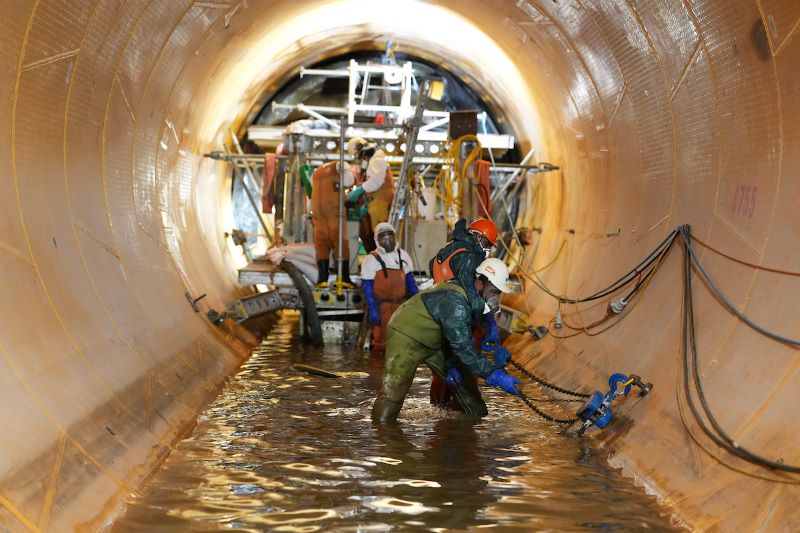
The final piece of Auckland’s Central Interceptor tunnel is in place. Watercare has removed the massive bulkhead that separated the two halves of the tunnel during construction, clearing the last major construction milestone on New Zealand’s largest wastewater project before the 16.2km tunnel becomes fully operational, which is expected by late July 2026.
The Central Interceptor runs from Point Erin in Herne Bay to the Māngere Wastewater Treatment Plant and is New Zealand’s longest and largest bored wastewater tunnel. It is owned by Watercare and was built by the Ghella Abergeldie Joint Venture — pairing Italy’s Ghella with Australia’s Abergeldie — which was appointed main contractor in early 2019, with design support from Arup and Jacobs. Boring began at the start of the decade using the tunnel boring machine Hiwa-i-te-Rangi, and the project’s budget was revised over time to around NZ$1.5 billion amid scope additions and post-2021 inflation.
Watercare chief programme delivery officer Mark Crowle said the project reflects the organisation’s investment in long-term infrastructure to support a growing Auckland while protecting the health of waterways, the environment and connected communities. He described it as a once-in-a-generation project and said seeing it so close to full operation was an exciting moment for both Watercare and Auckland.
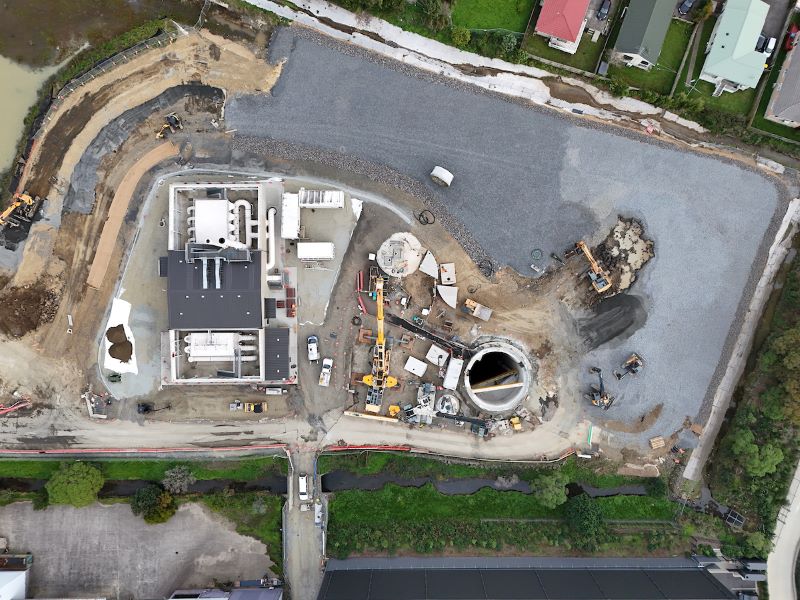
How the bulkhead was removed
The bulkhead removal was carried out at the project’s May Road site in Mount Roskill. The glass-reinforced plastic (GRP) and steel bulkhead had been installed in 2024 to seal off the southern half of the tunnel before it went live in early 2025, protecting crews working in the northern section.
The operation took weeks of meticulous planning to ensure it could be done safely. Specialist firm New Zealand Divers and Salvage was engaged to provide the expertise and protective equipment crews needed to work in a live sewer environment. Watercare lead engineer Emmanuel Vaki said the success of the complex work relied on continuous monitoring, clear communication between the teams, and strict adherence to the safety plan.
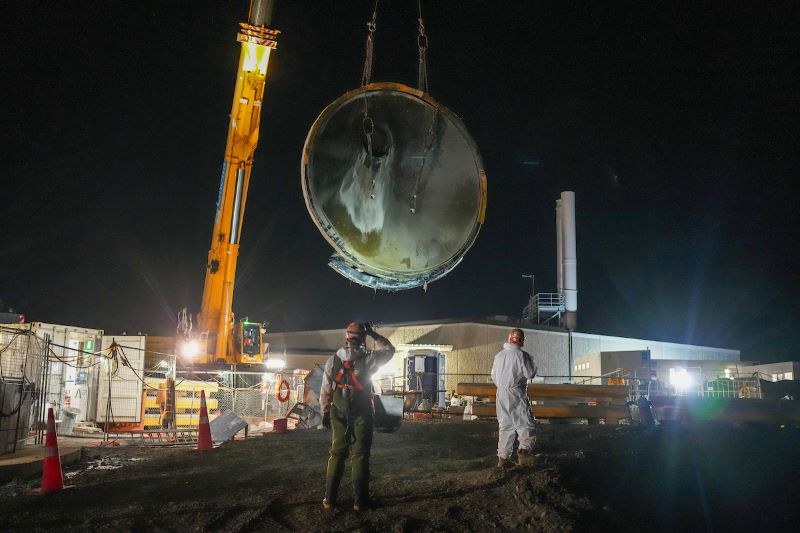
Although the bulkhead had been installed as a single piece, its components were removed separately and lifted out of a 70-metre-deep shaft, with the GRP “dome” the final element to come out. A gantry mounted on a small vehicle was driven into the tunnel to support the dome while the metal body of the bulkhead was removed; the dome was then towed out on the gantry vehicle and lifted from the shaft by crane. Crews repaired the tunnel liner where the bulkhead had been bolted and sealed in place, completing the works.
What the Central Interceptor delivers
The Central Interceptor is designed to improve the health of waterways and beaches across Auckland’s central and western suburbs by reducing wet-weather overflows, while upgrading an ageing wastewater network and providing capacity for the city’s growth over coming decades. The 16.2km main tunnel is now complete, along with two link sewers that will capture flows from Blockhouse Bay, Avondale, Mt Roskill and Mt Albert.
The southern half of the tunnel has been operating since the start of 2025. As of March 2026, Watercare estimates it has already prevented around 450,000 cubic metres of combined wastewater and stormwater from spilling into the environment. With the bulkhead now gone and the tunnel liner restored, the full system is due to come online by late July 2026.
Background: a tunnel built for the next century
First budgeted in 2018 and starting construction in 2019, the Central Interceptor was procured as a single major contract awarded to the Ghella Abergeldie Joint Venture, with works spread across 16 sites and shafts along the alignment. Ghella are an Italian company specailised in tunnel construction. They are currently working on the Caterina Tunnel Excavation in Italy.
The 4.5-metre-diameter tunnel is engineered to hold roughly 226,000 cubic metres of flow and to manage the rate at which wastewater reaches the Māngere treatment plant. The project’s scope grew over its life — including an extension toward Grey Lynn and connections serving new development in Mt Roskill — and Watercare has positioned the asset as infrastructure intended to serve Auckland for around 100 years.
Project Factsheet: Central Interceptor
- Project name: Central Interceptor
- Location: Auckland, New Zealand — Point Erin (Herne Bay) to the Māngere Wastewater Treatment Plant
- Type: Wastewater conveyance and storage tunnel — New Zealand’s largest wastewater project
- Owner / client: Watercare Services
- Main contractor: Ghella Abergeldie Joint Venture (Ghella, Italy; Abergeldie, Australia)
- Design support: Arup (tunnel lining and shaft structures) and Jacobs (scheme design)
- Main tunnel length: 16.2 km, plus two link sewers
- Tunnel diameter: 4.5 m
- Storage capacity: Approximately 226,000 m³
- Tunnel boring machine: Hiwa-i-te-Rangi
- Estimated cost: Around NZ$1.5 billion (revised budget of NZ$1.523 billion)
- Construction start: 2019
- Southern half operational: Early 2025
- Final milestone: Bulkhead removed at the May Road site, Mount Roskill
- Full operation expected: Late July 2026
- Link sewer catchments: Blockhouse Bay, Avondale, Mt Roskill, Mt Albert
- Overflow prevented to date: ~450,000 m³ since early 2025 (as of March 2026)
- Purpose: Reduce wet-weather overflows, improve waterway and beach health, and provide wastewater capacity for ~100 years



Leave a Reply