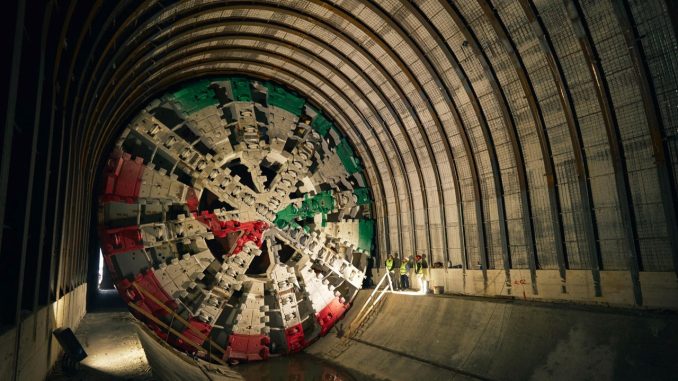
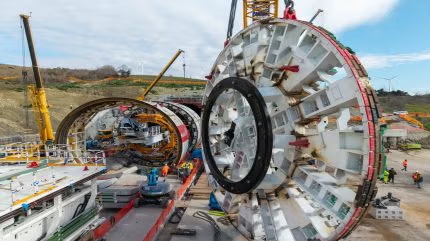
A significant underground milestone has been reached on one of southern Italy’s most strategically important infrastructure programmes. Excavation of the Caterina Tunnel has been completed on Lot 1A of the Salerno Reggio Calabria High-Speed/High-Capacity Railway, a strategic project connecting southern Italy with northern Italy and Europe, with works carried out by a consortium led by Webuild under contract from RFI, part of the FS Italiane Group. The tunnel, measuring just over one kilometre in length, was excavated through challenging geology by TBM “Mireille,” an innovative tunnel-boring machine weighing 1,200 tonnes and equipped with a cutterhead over 10 metres in diameter, powered by 11 engines generating 3,850 kW of power. Notably, Mireille became the first TBM to be refurbished at a Webuild facility in Umbria, established to give new life to large excavation machines, having previously operated on the Grand Paris Express. Following completion of the Caterina bore, Mireille is now scheduled to be relocated approximately 400 metres to begin excavation of the Sicignano Tunnel, where it will drive a further section of more than 2.5 kilometres. The breakthrough, announced on 10 April 2026, is the first completed tunnel on Lot 1A and confirms the project is entering its most operationally intensive phase, with four TBMs simultaneously active across multiple fronts.
Italy’s Southern Rail Gap and Why This Corridor Carries More Than Passengers
The Salerno Reggio Calabria project sits at the heart of a long-standing structural inequality in Italian infrastructure, one that has shaped economic outcomes across the Mezzogiorno for decades. While Italy’s high-speed network has long connected Milan, Bologna, Florence, and Rome with world-class rail links, the connection southward into Calabria and toward Sicily has remained one of the most underdeveloped rail corridors in Western Europe. Journeys that take under two hours between major northern cities can still take four to six hours across comparable distances in the south, suppressing business mobility, tourism, and the competitiveness of southern Italian exports. The Salerno Reggio Calabria upgrade is therefore not simply a construction achievement, it is a long-overdue correction to a connectivity imbalance that has contributed to persistent emigration of young people out of Calabria and Campania. The Salerno Reggio Calabria line will form a strategic axis of the Scandinavian-Mediterranean Corridor within the Trans-European Transport Network, and Webuild is delivering approximately 60 kilometres of modern railway along the full high-speed corridor. Situating this project against comparable European HSR programmes, Spain’s AVE expansion into Andalusia, France’s LGV Sud-Europe-Atlantique, shows that Italy is attempting something of similar ambition, but in far more geologically demanding terrain. The density of tunnelling required on Lot 1A alone, 20 tunnels and 19 viaducts across just 35 kilometres, is a direct consequence of the Apennine mountain terrain through which the line must pass, making this as much an engineering tour de force as a transport investment.
This focus on overcoming extreme topography to unify regional economies is perfectly mirrored at Italy’s northern border by the Brenner Base Tunnel (BBT), which achieved a historic milestone in September 2025 as workers broke through the final layer of rock to connect Austria and Italy underground. Once completed in 2032, this 64km engineering marvel—set to become the world’s longest railway tunnel—will slash travel times between Fortezza and Innsbruck from 80 minutes to just 25. By shifting freight from the congested Brenner Pass road routes to a flat, high-capacity rail line capable of handling 400 trains daily, the project acts as the northern anchor for the same Scandinavian-Mediterranean Corridor. With over 150km of its complex 230km tunnel network already excavated, the BBT represents a massive €10.5 billion investment in European energy efficiency and logistical integration, bridging the Alps with the same high-speed precision being deployed across the southern Italian peninsula.
Ghella who are a consortium partner are currently working on New Zealand’s largest wastewater project. The Central Interceptor runs from Point Erin in Herne Bay to the Māngere Wastewater Treatment Plant and is New Zealand’s longest and largest bored wastewater tunnel.
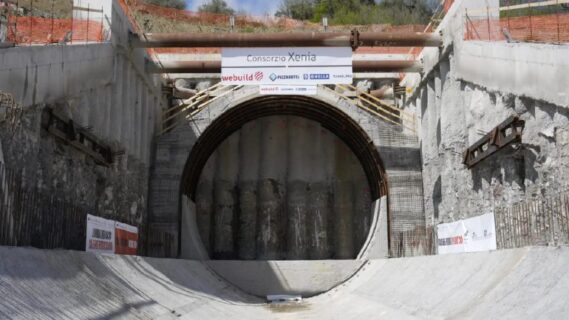
Project Fact Sheet
- Project name: Salerno Reggio Calabria High-Speed/High-Capacity Railway, Lot 1A (Battipaglia to Romagnano)
- Location: Salerno Province, Campania, southern Italy
- Client: RFI (Rete Ferroviaria Italiana), part of the FS Italiane Group
- Lot 1A contract value: €1.6 billion (approximately USD 1.86 billion)
- Total Webuild portfolio in southern Italy: Over €16 billion across 21 projects
- Lot 1A section length: 35 kilometres (Battipaglia to Romagnano)
- Infrastructure scope on Lot 1A: 20 tunnels (8 by TBM) and 19 viaducts
- Current milestone: Excavation of Caterina Tunnel completed, April 2026 — first completed tunnel on Lot 1A
- Caterina Tunnel length: Over 1 kilometre
- Sicignano Tunnel (next): Over 2.5 kilometres; Mireille to relocate approximately 400 metres to begin
- Cerreta Tunnel: 450 metres; excavated using conventional (drill-and-blast) methods
- Total TBMs on Lot 1A: 4 (Mireille, Partenope, Leucosia, Ligea)
- Largest TBM cutterhead diameter (Partenope, Leucosia, Ligea): Over 13 metres — largest Webuild TBMs in operation in Europe
- Mireille specs: 1,200 tonnes, 10m+ cutterhead, 11 engines, 3,850 kW power output
- Workforce on Lot 1A: Over 1,400 people (direct and subcontracted)
- Supply chain: Over 500 companies engaged since construction began
- Corridor classification: Scandinavian-Mediterranean Corridor, Trans-European Transport Network (TEN-T)
- Total Webuild workforce in southern Italy: 10,200 people (direct and third-party)
- Total suppliers in southern Italy (since start): 7,500
Project Team
Client
- RFI (Rete Ferroviaria Italiana) — Project client and contracting authority; part of the FS Italiane Group
Lead Contractor / Consortium
- Xenia Consortium — Joint venture consortium responsible for delivery of Lot 1A
- Webuild — Consortium leader; also responsible for TBM refurbishment programme and overall project management
- Pizzarotti — Consortium partner
- Ghella — Consortium partner; specialist tunnelling contractor
- Tunnel Pro — Consortium partner
TBM Equipment
- Webuild Umbria Facility — First dedicated TBM refurbishment facility of its kind in Italy; responsible for the regeneration of TBM Mireille for redeployment from the Grand Paris Express project



Leave a Reply