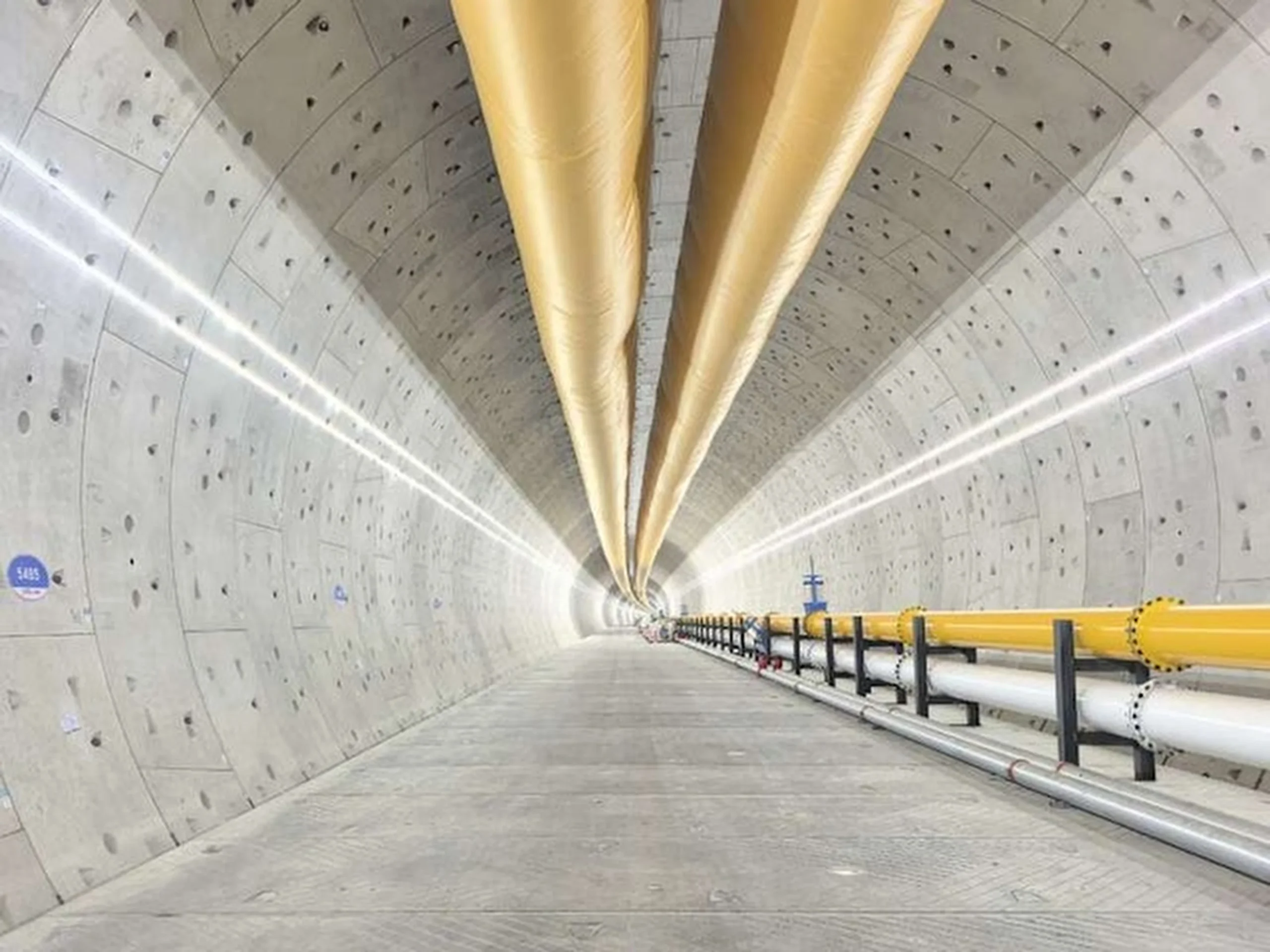
The Pearl River Estuary Tunnel — the undersea shield tunnel at the heart of the Shenzhen-Jiangmen High-Speed Railway in Guangdong Province — has reached a record excavation depth of 113 metres beneath the seabed, with the domestically developed large-diameter tunnel boring machine “Shenjiang-1” continuing to advance round the clock after more than four years of continuous operation and over 4 kilometres of completed excavation. The milestone represents a new world record for the deepest undersea high-speed rail shield tunnel. The tunnel’s maximum design depth of 116 metres — and a maximum water pressure of 1.06 megapascals at that depth — has yet to be reached, and the TBM continues to advance through a corridor of exceptional geological complexity. The Shenzhen-Jiangmen High-Speed Railway, a 116-kilometre line running through five cities in the Guangdong-Hong Kong-Macao Greater Bay Area at a design speed of 250 km/h, is expected to complete by 2028, with the Pearl River Estuary Tunnel representing its most technically demanding single element.
Shenjiang-1: The TBM Boring Through 13 Strata at World-Record Depth
“Shenjiang-1” is a large-diameter slurry shield TBM manufactured by the 14th Bureau of China Railway, carrying full domestic intellectual property and featuring a cutter head decorated with a dancing lion motif reflecting the cultural heritage of Guangdong Province. The machine has a total body length of approximately 130 metres, weighs 3,800 tonnes, and operates with an excavation diameter of approximately 13.32 to 13.42 metres — making it one of the largest-diameter TBMs in active operation on any undersea railway project in the world. Its overall design pressure rating of up to 12 bar allows it to operate against the extreme hydrostatic pressures encountered at maximum tunnel depth, where the weight of the water column above the cutterhead creates forces that must be continuously countered by the pressurised slurry systems at the face.
Project Fact Sheet: Shenzhen-Jiangmen High-Speed Railway / Pearl River Estuary Tunnel
Shenzhen-Jiangmen High-Speed Railway
Line Name: Shenzhen-Jiangmen High-Speed Railway (深江铁路 / Shenjiang Railway)
Location: Guangdong Province, China (Greater Bay Area)
Total Length: 116.12 km
Design Speed: 250 km/h (200 km/h on Xili–Nansha section)
Stations (7): Shenzhen Xili; Shenzhen Airport East; Dongguan Binhaiwan; Nansha (Guangzhou); Zhongshan North; Henglan; Jiangmen
Cities Served: Shenzhen, Dongguan, Guangzhou, Zhongshan, Jiangmen
Construction Start: October 9, 2022 (full line)
Expected Completion: ~2028
Budget (Shenzhen-Jiangmen section): ~RMB 51.3 billion (~US$7.3 billion)
Network Context: China’s “Eight Vertical and Eight Horizontal” coastal HSR corridor
Pearl River Estuary Tunnel
Total Length: 13.69 km (underwater section: ~11.05 km)
Type: Single-bore, double-track undersea slurry shield tunnel
Design Speed: 250 km/h
Maximum Depth (Design): 116 m below seabed
Depth Reached (April 6, 2026): 113 m — new world record for undersea HSR shield tunnel
Maximum Water Pressure: 1.06 MPa (~12 bar)
Geological Complexity: 13 strata; 5 composite geology types; 6 fault zones
TBM Progress at Milestone: >4 km excavated; >4 years continuous operation
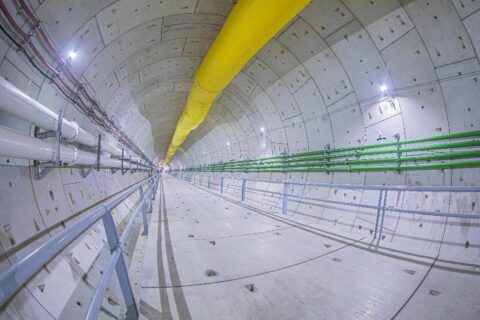
Segment Lining: Precast concrete; 9 segments/ring; ~2 m wide each; ring diameter >13 m
Tunnel Boring Machine: “Shenjiang-1”
Manufacturer: 14th Bureau of China Railway (China Railway No. 14 Engineering Group)
Excavation Diameter: ~13.32–13.42 m
Total Length: ~130 m
Weight: ~3,800 tonnes
Design Pressure: Up to 12 bar
Technology: Domestic (full Chinese IP); cutter head features Guangdong dancing lion motif
Operator: China Railway Guangzhou Bureau Group Co., Ltd.
The geological environment through which the TBM is excavating is among the most complex encountered by any Chinese rail tunnel. The route passes through 13 distinct geological strata, five composite geology types, and six fault zones — a combination of conditions that places extreme and constantly varying demands on cutter wear, face support pressure management, and segment installation tolerances. The TBM operates using two main pipeline systems: one delivers pressurised fluid slurry to the cutterhead face to reduce friction and maintain face stability, while the other transports thick, debris-laden slurry back to the surface through a continuous pipeline for processing and material separation at a dedicated treatment plant. Recovered slurry is cleaned and recycled for reuse, reducing water consumption and the environmental footprint of the operation. Behind the cutterhead, workers install precast concrete segments — each approximately two metres wide, with nine segments required to complete a full ring of the 13-metre-diameter tunnel lining — in a continuous cycle of excavation and assembly that proceeds simultaneously to maximise construction efficiency.
The Pearl River Estuary Tunnel: Engineering Superlatives and Strategic Significance
The Pearl River Estuary Tunnel is the defining engineering challenge of the Shenzhen-Jiangmen railway programme. At 13.69 kilometres in total length — of which approximately 11.05 kilometres is genuinely underwater — it is a single-bore, double-track tunnel designed for high-speed rail operation. Its maximum buried depth of 116 metres and maximum water pressure of 1.06 MPa at that depth make it the deepest undersea high-speed railway shield tunnel in the world and the highest-water-pressure cross-harbour tunnel in China. The tunnel is located between Dongguan and Guangzhou, crossing multiple waterways at the mouth of the Pearl River — the complex estuarine delta system that separates Shenzhen and the eastern Pearl River Delta from the western cities of Zhongshan, Jiangmen, and the Nansha district in Guangzhou.
The engineering rationale for the tunnel’s extreme depth is geological and navigational. The Pearl River Estuary carries some of the busiest shipping traffic in the world, serving the ports of Guangzhou, Shenzhen, Dongguan, and Hong Kong through deep-water channels that cannot be bridged without severe interference with vessel movements. At the same time, the alluvial sediments and weathered rock at shallower depths beneath the estuary floor are highly water-bearing and unstable under excavation, requiring the shield tunnel to descend well below those problematic upper strata to reach more competent ground. The result is a tunnel alignment that reaches depths unprecedented in undersea high-speed rail construction globally — a category that places it above the existing Chinese cross-harbour rail tunnels such as the Shiziyang Tunnel (completed 2011) and well beyond the deepest sections of the Channel Tunnel between England and France, which reach approximately 75 metres below the seabed, or the Seikan Tunnel in Japan at approximately 100 metres below the seabed (a conventional rather than high-speed rail alignment). The Shenzhen-Jiangmen section of the broader Shenzhen-Zhanjiang coastal railway programme is budgeted at approximately RMB 51.3 billion (approximately US$7.3 billion), reflecting the extraordinary civil engineering demands of the Pearl River Estuary crossing.
The Shenzhen-Jiangmen Railway and the Greater Bay Area’s East-West Connectivity Gap
The Shenzhen-Jiangmen High-Speed Railway is a 116-kilometre line forming a critical missing link in the eastern coastal section of China’s “Eight Vertical and Eight Horizontal” national high-speed rail network — the master plan that designates eight north-south and eight east-west intercity rail corridors. The line runs through seven stations — Shenzhen Xili, Shenzhen Airport East, Dongguan Binhaiwan, Nansha (Guangzhou), Zhongshan North, Henglan, and Jiangmen — connecting five cities: Shenzhen, Dongguan, Guangzhou, Zhongshan, and Jiangmen. At design speed, a journey between Shenzhen’s Xili and Jiangmen will take under one hour. The Qianhai Free Trade Zone in Shenzhen and the Nansha Free Trade Zone in Guangzhou will be within 30 minutes of each other, and travel between Shenzhen Airport and Zhongshan North will take just 25 minutes.
The east-west connectivity gap being bridged by this railway reflects a longstanding structural asymmetry in the Greater Bay Area’s transport geography. Despite the region’s extraordinary economic density and the complementary manufacturing and service specialisations of cities on both sides of the Pearl River, physical movement between the eastern and western Pearl River Delta has historically required either lengthy circumnavigation through Guangzhou or the Humen Bridge, or ferry crossings. The Shenzhen-Zhongshan Link — the 49.7-kilometre bridge-tunnel road crossing — opened in June 2024, and the Shenzhen-Jiangmen High-Speed Railway, when it opens in approximately 2028, will add rail capacity to that corridor. These travel time reductions are not merely logistical conveniences; they are the enabling infrastructure for a genuinely integrated Greater Bay Area economic region in which labour, capital, and goods can move freely between its constituent cities at an efficiency scale previously impossible.
China’s TBM Capability and the Global Context for Undersea Rail Tunnelling
The “Shenjiang-1” TBM’s progress through the Pearl River Estuary represents more than a single construction milestone. It reflects the maturation of a domestic Chinese tunnelling technology and equipment manufacturing capability built systematically over three decades — from near-total dependence on imported TBM technology from Herrenknecht (Germany), Robbins (USA), and NFM Technologies (France) in the 1990s and early 2000s, to a position in which China’s own manufacturers — led by China Railway Engineering Equipment Group (CREG), China Railway Construction Heavy Industry (CRCHI), and the tunnelling subsidiaries of the major state railway engineering groups — are producing large-diameter, high-pressure machines that operate at specifications meeting or exceeding anything available internationally.
The Pearl River Estuary Tunnel’s current world record — 113 metres beneath the seabed for a high-speed rail shield tunnel, with the maximum of 116 metres still to be reached — places it above all previous undersea railway tunnels in both depth and water pressure for a high-speed rail application. The Channel Tunnel reaches approximately 75 metres below the seabed; the Seikan Tunnel in Japan reaches approximately 100 metres but is a conventional railway. The Pearl River Estuary Tunnel’s combination of maximum depth, 1.06 MPa water pressure, 13-metre-plus diameter, and 250 km/h design standard makes it a genuinely novel engineering achievement — one whose successful completion will validate design, manufacturing, and construction capabilities with direct applicability to any future undersea high-speed rail connections that may be contemplated in Chinese infrastructure planning.
This push for unprecedented rail capabilities extends to ground-based transit as well, with the news that North China has begun construction of a test line for a 1,000 km/h maglev train. Located in Datong, Shanxi Province, this “high-speed flying train” project recently reached a critical milestone as its full-scale test line completed integrated demonstration tests, verifying the stability of its superconducting navigation and low-vacuum environment systems. Developed by CASIC, the system aims to eventually reach speeds surpassing commercial airliners, positioning it as a core component of future inter-city transport between China’s megacity clusters.

Leave a Reply